What Is Strategic Defense Reserve (SDR)? The Solana Meme Coin Blending Defense Narratives with DeFi
In the fast-moving world of crypto, narratives often travel faster than fundamentals. From AI tokens to real-world asset plays, thematic positioning has become a defining feature of many new launches. Strategic Defense Reserve (SDR) enters this landscape with a distinctive angle, drawing on global defense spending, geopolitical tension, and the concept of sovereign reserves to frame its identity within the Solana ecosystem.
At first glance, the project presents itself as part of a broader shift toward defense-linked digital assets and on-chain reserve systems. A closer examination, however, shows a structure more consistent with a speculative meme coin, where value depends largely on market sentiment rather than verifiable backing or institutional adoption. This blend of macro narrative and crypto speculation raises important questions about positioning, risk, and long-term viability. In this article, we will learn what Strategic Defense Reserve (SDR) is, how it works, its tokenomics, and what its future outlook may look like.
What Is Strategic Defense Reserve (SDR)?

Strategic Defense Reserve (SDR) is a meme coin built on the Solana blockchain that positions itself around the concept of “defense-backed” digital assets. Launched in early April 2026, the project attempts to align itself with macroeconomic themes such as rising global defense spending and increasing geopolitical tensions. According to its official website, SDR aims to represent a new class of strategic reserves that combine defense sector narratives with decentralized finance infrastructure.
In practice, SDR functions as a standard SPL token with no direct linkage to defense institutions, government reserves, or real-world military assets. The “defense-backed” framing reflects a thematic narrative rather than a verifiable financial structure. The project highlights trends such as digital asset adoption and infrastructure modernization, positioning SDR as a token that captures these dynamics in a speculative format.
The token operates within the Solana ecosystem, which is known for its low transaction costs and high throughput. This makes it suitable for fast trading on decentralized exchanges, where most SDR activity takes place. Like many meme coins, its primary use case is trading and liquidity participation rather than utility-driven demand. There are no clearly defined functions such as staking rewards, governance mechanisms with proven impact, or revenue-generating protocols tied to the token.
Who Created Strategic Defense Reserve (SDR)?
The creators of Strategic Defense Reserve (SDR) have not been publicly identified. The project operates without disclosing any founders, developers, or affiliated organization. This level of anonymity is common among meme coins, where projects are often introduced quickly to capture market narratives rather than to showcase a transparent leadership structure.
Beyond the official website and token contract, there is limited verifiable information about the team’s background, experience, or long-term involvement. The project references ideas such as community governance and multi-signature treasury management, but these claims are not supported by publicly available documentation or third-party verification. There are no confirmed audits, institutional backers, or partnerships, which means SDR currently relies on its narrative and community engagement rather than on identifiable leadership or established credibility.
How Strategic Defense Reserve (SDR) Works
Strategic Defense Reserve (SDR) operates as a standard SPL token on the Solana blockchain, with its core functionality centered on trading and liquidity rather than utility-driven use cases. Users can buy and sell SDR through decentralized exchanges, typically via liquidity pools paired with SOL or USDC. The project leverages Solana’s infrastructure, which allows for fast transaction speeds and relatively low fees. While the official website references advanced features such as treasury management and strategic reserves, these remain largely conceptual and are not supported by detailed technical disclosures or verified implementations.
Key operational components include:
-
Token Trading: SDR is primarily traded on Solana-based decentralized exchanges, where price is determined by supply and demand within liquidity pools.
-
Liquidity Pools: A significant portion of the token supply is allocated to liquidity pools, enabling swaps between SDR and other assets such as SOL or stablecoins.
-
On-Chain Infrastructure: All transactions occur on the Solana network, providing transparency through publicly accessible blockchain data.
-
Treasury Narrative: The project claims to maintain a form of on-chain treasury with multi-signature controls and time-locks, although these features are not independently verified.
-
No Defined Utility: There are no confirmed mechanisms such as staking, governance with measurable impact, or revenue generation tied directly to the token.
SDR functions like a typical meme coin, where participation is driven by market activity and narrative interest rather than by a structured economic model or underlying asset exposure.
Strategic Defense Reserve (SDR) Tokenomics
Strategic Defense Reserve (SDR) follows a simple token model typical of many Solana-based meme coins. The total supply is fixed at 1,000,000,000 tokens, with no indication of additional minting or inflation mechanisms. Available data suggests that nearly the entire supply is already in circulation, which means there are no scheduled token unlocks or emissions that could dilute holders over time. This full-circulation structure can contribute to price volatility, as supply is immediately exposed to market activity rather than gradually released.
Despite the fixed supply, transparency around token distribution remains limited. The project does not provide a detailed breakdown of allocations across the team, treasury, liquidity pools, or community. On-chain observations indicate that a large portion of the supply is concentrated in liquidity pools, while the rest is spread across wallets of varying sizes. Without clear disclosure, it is difficult to assess concentration risk or the potential influence of large holders, which remains an important consideration for participants evaluating the token.
Strategic Defense Reserve (SDR) Price Prediction for 2026, 2027–2030
Strategic Defense Reserve (SDR) Price
Source: dexscreener
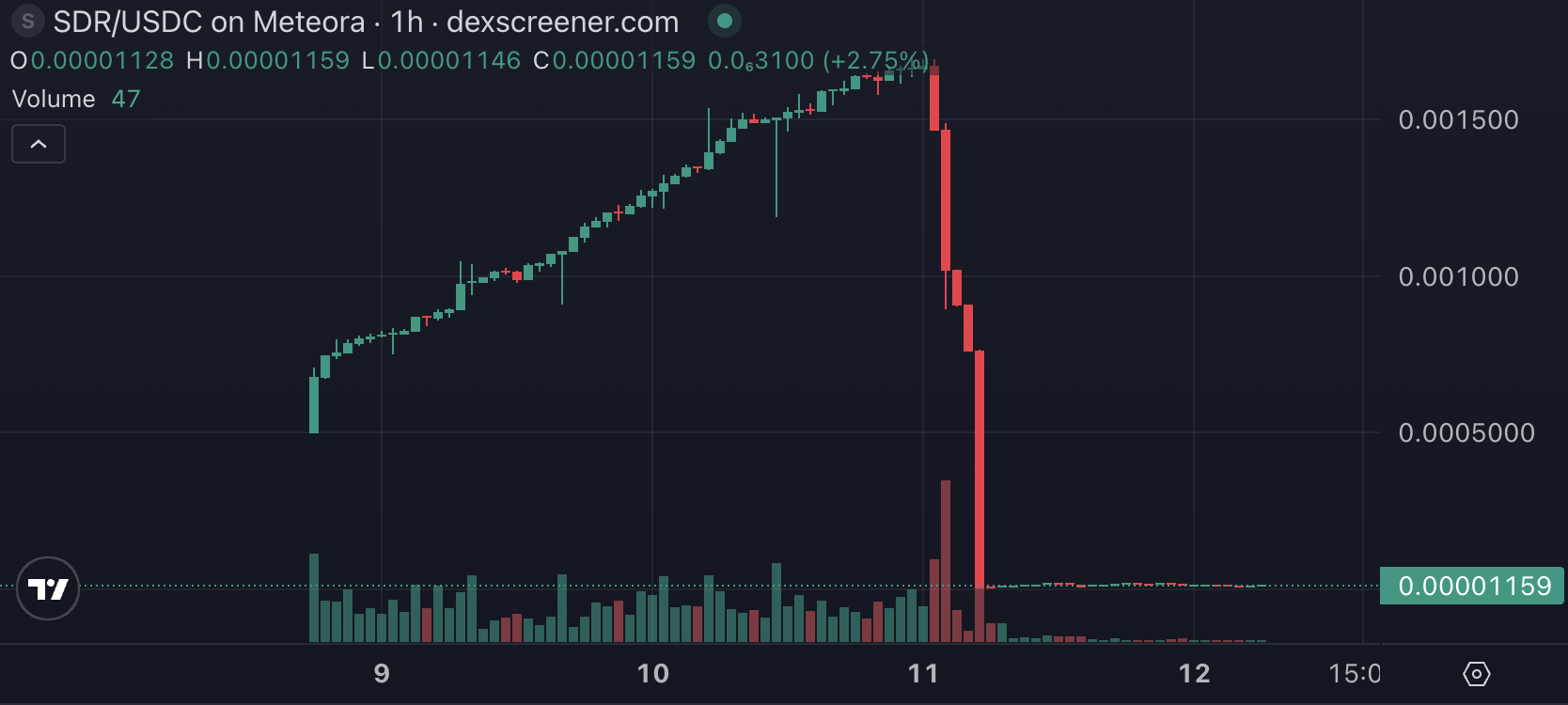
As of this writing, Strategic Defense Reserve (SDR) is trading at $0.00001159, reflecting its position as a micro-cap meme coin within the Solana ecosystem. At this price level, the token operates in a low-liquidity environment where relatively small buy or sell orders can lead to noticeable price swings. This makes SDR highly sensitive to short-term trading activity, social sentiment, and broader market trends, particularly within the meme coin sector.
-
2026 Outlook: SDR could trade in a highly volatile range between $0.000005 and $0.00005, depending on short-term trading activity and meme coin sentiment. Low liquidity means even small capital inflows could trigger sharp spikes, while profit-taking may lead to rapid pullbacks.
-
2027 Outlook: SDR may stabilize or decline toward a range of $0.000002 to $0.00002 if market interest weakens. Without new developments or utility, sustaining higher price levels could become difficult as trading volume decreases.
-
2028–2030 Outlook: Over the longer term, SDR could trend lower toward $0.0000005 to $0.00001 unless it evolves beyond its current narrative. Continued relevance would depend on community activity and broader meme coin cycles, with occasional short-term rallies still possible.
Conclusion
Strategic Defense Reserve (SDR) is a clear example of how powerful narratives can shape activity in the crypto market. By drawing on themes like global defense spending and sovereign reserves, the project presents an idea that feels larger than a typical meme coin. Yet beneath that framing, SDR operates much like other low-cap tokens on Solana, where price action is driven more by speculation, liquidity, and community interest than by underlying fundamentals.
For potential investors, this creates a mix of curiosity and caution. SDR may capture attention during strong market cycles or narrative shifts, but its long-term outlook depends on whether it can move beyond storytelling into something more tangible. Until then, it remains a high-risk, sentiment-driven asset where timing and market behavior matter far more than traditional valuation metrics.
Disclaimer: The opinions expressed in this article are for informational purposes only. This article does not constitute an endorsement of any of the products and services discussed or investment, financial, or trading advice. Qualified professionals should be consulted prior to making financial decisions.