
The Impact of New Technologies on Improving Educational Programs and Boosting Institutional Effectiveness
- Global EdTech and STEM markets are transforming via AI, cybersecurity, and VR/AR integration, driving curricular innovation and institutional scalability. - Farmingdale State College exemplifies this shift, boosting enrollment 40% through AI/cybersecurity programs and securing $75M for a new tech-focused campus center. - AI-in-education market alone is projected to grow from $5.88B in 2024 to $32.27B by 2030, with EdTech overall expected to reach $738.6B by 2029 at 14.13% CAGR. - Government funding and i
EdTech and STEM Education: A New Era of Innovation
The global landscape of education technology and STEM learning is experiencing a significant transformation, propelled by advancements in artificial intelligence (AI), cybersecurity, and immersive tools such as virtual and augmented reality (VR/AR). As educational institutions embrace these cutting-edge solutions, they are not only modernizing their teaching methods but also improving operational efficiency and scalability. This technological evolution is creating attractive prospects for investors interested in EdTech companies and STEM-oriented platforms.
Expanding Markets and Investment Momentum
The EdTech industry has shown robust growth and adaptability, with its worldwide value reaching $334.29 billion in 2023. Projections indicate this figure could soar to $738.60 billion by 2029, reflecting a compound annual growth rate (CAGR) of 14.13%. This surge is largely attributed to the widespread adoption of blended learning environments, AI-powered personalized education, and cloud-based platforms that streamline costs and facilitate swift implementation, as reported by Grand View Research.
The K–12 STEM education sector is also on an upward trajectory, growing at a CAGR of 13.5% and expected to hit $49.88 billion by 2025, with forecasts suggesting a leap to $168.63 billion by 2032. Investments in AI and immersive technologies are accelerating this momentum. The AI-in-education market, currently valued at $5.88 billion in 2024, is anticipated to expand to $32.27 billion by 2030. Meanwhile, the VR segment in education alone is projected to reach $31.28 billion by 2025. These statistics highlight a field where innovation is essential, driven by the need for future-ready skills and engaging, interactive learning experiences.
Institutional Innovation: The Example of Farmingdale State College
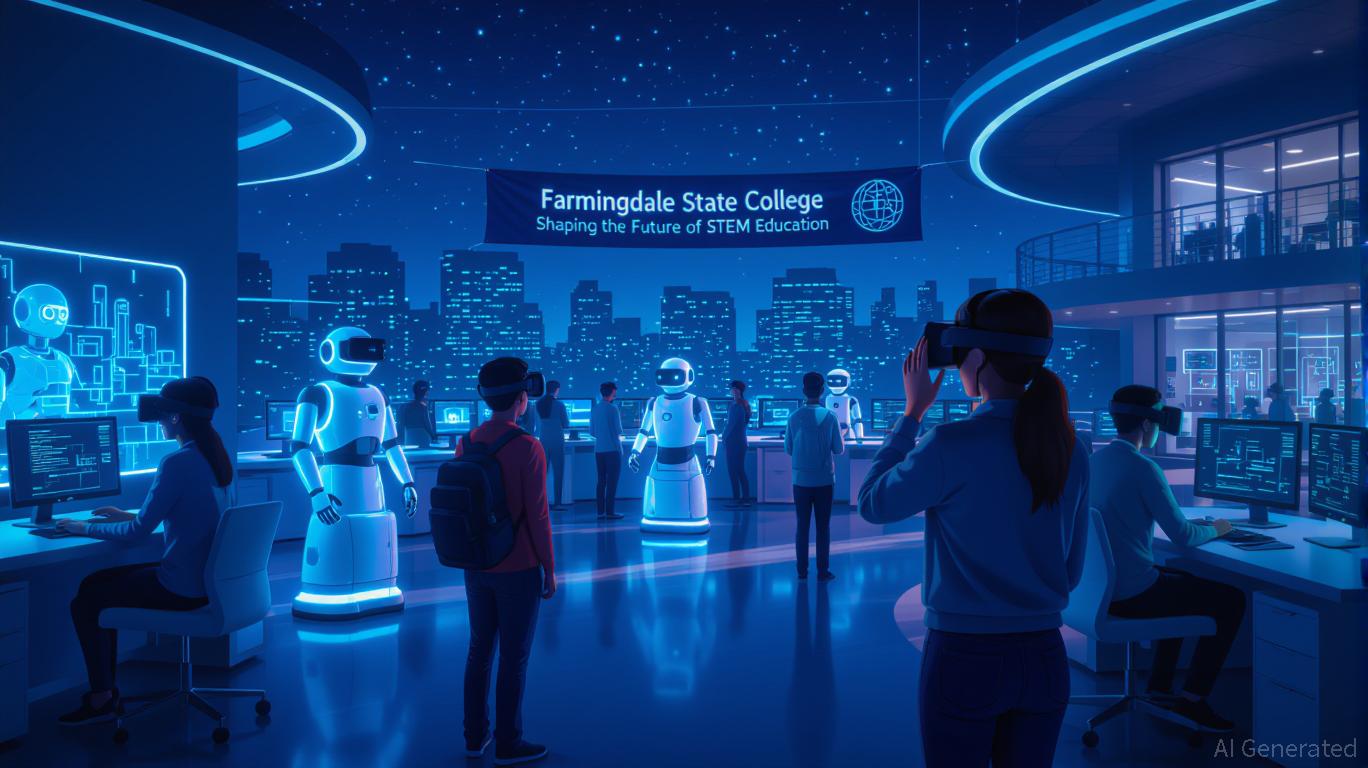
Farmingdale State College (FSC) stands as a prime illustration of how academic institutions are utilizing emerging technologies to enrich their programs and boost student enrollment. Over the past five years, FSC’s Division of Computing has experienced a 40% rise in student numbers, thanks to its emphasis on AI, cybersecurity, and engineering disciplines. To accommodate this growth, the college has initiated the construction of a $75 million Computer Sciences Center, supported by $30 million from the Empire State Development's Long Island Investment Fund and $45 million from the SUNY Construction Fund. This new facility aims to double enrollment capacity and promote interdisciplinary collaboration in AI and cybersecurity, according to FSC’s official statements.
Faculty-led projects further underscore FSC’s dedication to educational innovation. Professors Nur Dean and Xiaojin Ye have secured a National Science Foundation grant exceeding $164,000 to create an AI-powered Socratic Metacognitive Inquiry-based Learning Environment (SMILE), which leverages Large Language Models (LLMs) to foster critical thinking in introductory programming courses. These initiatives align with the college’s broader mission to prepare students for careers in AI-driven STEM fields and address the growing demand for cybersecurity professionals.
Investment Strategies and Market Impact
The adoption of advanced technologies in education is more than an academic pursuit—it represents a strategic investment in workforce development and institutional effectiveness. Cloud-based EdTech solutions are gaining popularity for their scalability and cost benefits, with their deployment expected to see the fastest growth rate in the sector. AI and AR/VR technologies are revolutionizing STEM education by offering immersive, practical learning experiences that surpass traditional teaching methods, as noted by HTF Market Intelligence.
Public and private funding initiatives further reinforce these trends. State-led programs, such as Utah’s appointment of AI specialists and North Carolina’s AI pilot projects, demonstrate the policy support driving EdTech adoption. At the same time, investments like FSC’s $75 million Computer Sciences Center and NSF-backed faculty projects illustrate how funding from various sources is converging to expand innovative educational programs.
Future Outlook and Sector Potential
The outlook for AI and immersive technology in education is exceptionally promising. The AI software sector is expected to reach $467 billion by 2030, growing at a 25% CAGR, while the generative AI market is projected to rise from $37.1 billion in 2024 to $220 billion by 2030, according to ABI Research. These developments position EdTech and STEM platforms at the forefront of the broader AI and immersive technology revolution.
For investors, the message is clear: institutions that prioritize AI, cybersecurity, and engineering are not only attracting more students and talented faculty but are also securing sustainable funding and institutional backing. As the global EdTech market approaches $404 billion by 2025, companies that deliver personalized learning, immersive training, and scalable infrastructure are poised to outperform their competitors in both growth and profitability.
Conclusion
The integration of advanced technologies into education has shifted from a speculative trend to a strategic necessity. Institutions like Farmingdale State College are leading the way, showcasing how AI, cybersecurity, and engineering can drive enrollment, foster faculty innovation, and enhance institutional performance. For investors, the EdTech and STEM sectors represent a dynamic opportunity to participate in a rapidly expanding market that is redefining the future of education and workforce preparation.
Disclaimer: The content of this article solely reflects the author's opinion and does not represent the platform in any capacity. This article is not intended to serve as a reference for making investment decisions.
You may also like
Investor Interest Grows as GeekStake Highlights Its 2025 Staking Features
Vitalik Buterin Backs ZKsync: Accelerating the Evolution of Ethereum’s Layer 2 Solutions
- Vitalik Buterin endorsed ZKsync, highlighting its ZK rollup role in Ethereum's scalability and security. - ZKsync's Atlas upgrade achieved 30,000 TPS with Ethereum compatibility, driving ZK token's 120% surge to $0.74. - Institutional adoption grew with $3.3B TVL, 27M monthly transactions, and partnerships with Deutsche Bank/Sony. - ZKsync leads ZK rollups with $3.3B TVL vs. $1.2B (StarkNet), leveraging EVM compatibility and low fees. - Investors face opportunities in ZKsync's network effects and deflati
ZK Atlas Enhancement and Its Impact on Blockchain Scalability
- ZKsync's October 6, 2025 Atlas Upgrade introduces modular architecture with 15,000–43,000 TPS and $0.0001 ZK proof costs, enhancing blockchain scalability and EVM compatibility. - Deutsche Bank and UBS adopt the upgrade for cross-chain settlements, leveraging its cryptographic finality and real-time RWA tokenization capabilities. - Bitget projects 60.7% CAGR for ZK-based Layer-2 solutions, reaching $90B by 2031, driven by institutional demand for interoperable, compliant blockchain infrastructure. - Modu

The Growing Enthusiasm for Zero-Knowledge (ZK) Technologies and What It Means for Cryptocurrency Investors
- Zero-Knowledge (ZK) technologies are reshaping blockchain infrastructure, enabling 28B TVL and 27M monthly transactions via platforms like zkSync Era and StarkNet. - Institutional adoption by Deutsche Bank , Sony , and UBS , plus $725M+ VC funding, validates ZK's scalability and compliance advantages over traditional systems. - EU regulatory frameworks now align with ZK's privacy-by-design model, using GDPR-compliant ZKPs for digital identity and enterprise NFTs. - Investors face strategic opportunities





