

AppFolio, Inc.
Last updated as of 2026-06-01 03:14 EST. Stock price information is sourced from TradingView and reflects real-time market prices.
APPF stock price change
Trending stocks
About Bitget
APPF key data

AppFolio, Inc. overview
APPF stock price forecast
According to technical indicators for APPF stock, the price is likely to fluctuate within the range of 163.91–183.66 USD over the next week. Market analysts predict that the price of APPF stock will likely fluctuate within the range of 163.66–198.88 USD over the next months.
Based on 1-year price forecasts from 76 analysts, the highest estimate is 332.07 USD, while the lowest estimate is 154.43 USD.
APPF competitors


New trends in the stock industry and Bitget's stock trading strategy
Stock tokenization is emerging as a major trend at the intersection of traditional finance and the cryptocurrency market. By bringing assets such as stocks onto the blockchain and enabling 24/7 global trading, it enhances accessibility, efficiency, and transparency for investors.
Bitget views stock trading support as a key strategic direction for platform development. The platform currently supports trading in stock tokens and stock perps, and has already established itself as a major player in this space.
The core advantages of Bitget stock perps lie in their innovation and user-focused design:
1. World's first: The industry's first tokenized stock index perps, anchored to multiple price sources for greater transparency and security.
2. High leverage: Supports up to 25x leverage, maximizing capital efficiency and potential returns.
3. Diversified underlying assets: Covers hundreds of popular stocks, supporting a wide range of trading strategies.
4. Low transaction fees: Fees are capped at 0.06%, reducing costs for high-frequency traders.
5. Index calculation mechanism: Based on the USDT prices of tokenized assets from different issuers (e.g., xStocks, Ondo). Weights are recalculated regularly or whenever major market events occur to ensure the index remains aligned with market conditions.
As of early December 2025, Bitget has recorded over $18 billion in trading volume in the stock perps market, making it one of the most popular platforms for stock tokens and stock perps. By the end of 2026, Bitget's cumulative trading volume in the stock perps market is expected to exceed $100 billion.
Continue reading to learn more about the assets supported for trading on Bitget, as well as detailed information on Bitget stock tokens and stock perps.
Trending stock tokens


Articles related to stock tokens and stock perps
Understanding What Are RWA Real World Assets in Crypto
What are RWA real world assets? In the context of crypto and blockchain, RWAs (Real World Assets) refer to tangible or traditional financial assets—like real estate, commodities, bonds, or even luxury goods—that are represented and traded on-chain through tokenization. This process allows these assets to be bought, sold, or used as collateral within decentralized finance (DeFi) ecosystems, unlocking new liquidity and investment opportunities. For users, understanding RWAs means discovering how blockchain is bridging the gap between digital and physical value, making finance more accessible and transparent.
Industry Trends: The Rise of RWA Tokenization
As of September 2024, the tokenization of real world assets is gaining significant momentum in the crypto industry. According to Chainalysis, the total value of tokenized RWAs on public blockchains surpassed $6 billion, with daily trading volumes steadily increasing. Major institutions and DeFi protocols are actively exploring RWA integration, aiming to bring traditional assets like government bonds, real estate, and even art onto the blockchain. This trend is driven by the promise of increased liquidity, 24/7 global markets, and reduced reliance on intermediaries.
Recent developments highlight this shift. For example, the PayDax Protocol enables users to borrow stablecoins using both crypto and tokenized RWAs as collateral, while platforms like Bitget are expanding support for RWA-backed products. These innovations are making it easier for both retail and institutional investors to access and utilize real world assets within the crypto ecosystem.
How RWA Real World Assets Work: Tokenization and Use Cases
Tokenization is the core mechanism behind RWAs. It involves creating a digital token on a blockchain that represents ownership or a claim on a physical asset. For instance, a token could represent a share in a property, a gold bar stored in a vault, or a government bond. These tokens can then be traded, used as collateral, or integrated into DeFi protocols for lending, borrowing, or yield generation.
Key use cases include:
- Collateral for DeFi Loans: Platforms like PayDax allow users to pledge tokenized RWAs to access stablecoin liquidity without selling their assets.
- Fractional Ownership: Tokenization enables investors to own fractions of high-value assets, such as real estate or fine art, lowering entry barriers.
- Yield Generation: RWA tokens can be staked or lent out, allowing holders to earn yields similar to traditional finance but with the efficiency of blockchain.
Security and transparency are ensured through smart contracts and third-party verification. For example, PayDax partners with established custodians and auction houses to authenticate and safeguard physical assets, while Chainlink oracles provide real-time pricing data.
Market Data and Recent Developments
According to DeFiLlama, the total value locked (TVL) in RWA-focused DeFi protocols has grown by over 200% in the past year. As of September 2024, platforms like Centrifuge and Maple Finance report daily transaction volumes exceeding $50 million, reflecting growing user interest and institutional adoption.
On the regulatory front, several jurisdictions are clarifying guidelines for tokenized securities and asset-backed tokens, further legitimizing the RWA sector. Bitget, as a leading exchange, is actively monitoring these developments and expanding its RWA product suite to meet evolving market demand.
Common Misconceptions and Risk Considerations
Despite the promise of RWAs, there are common misconceptions:
- Myth: All RWAs are risk-free. Fact: Like any asset, tokenized RWAs carry risks such as market volatility, regulatory changes, and counterparty risk.
- Myth: Tokenization guarantees liquidity. Fact: While blockchain improves access, actual liquidity depends on market demand and platform adoption.
Users should conduct due diligence, understand the underlying asset, and use secure platforms like Bitget for trading or investing in RWA tokens. Always be aware of smart contract risks and ensure assets are properly verified and insured where possible.
Bitget’s Role in the RWA Ecosystem
Bitget is at the forefront of RWA integration, offering users access to a growing range of tokenized assets and DeFi services. By prioritizing security, compliance, and user education, Bitget empowers both new and experienced investors to explore the benefits of RWAs with confidence. For those seeking a secure and innovative platform to engage with real world assets, Bitget provides a robust gateway to this emerging sector.
Further Exploration and Practical Tips
Ready to learn more about what are RWA real world assets and how they can diversify your crypto portfolio? Explore Bitget’s educational resources, stay updated with the latest RWA listings, and consider using Bitget Wallet for secure asset management. As the line between traditional and digital finance continues to blur, RWAs are set to play a pivotal role in the next wave of blockchain innovation.
OpenEden is a blockchain-based platform focused on real-world asset tokenization, bringing tangible assets like U.S. Treasury Bills onto the blockchain in a regulated, secure, and accessible manner. Founded by Jeremy Ng in 2022 and backed by YZi Labs with $5 million in funding, OpenEden (EDEN) will soon be available on Bitget!
What is OpenEden (EDEN)?
OpenEden is a real-world asset tokenization platform that converts traditional financial products like government bills and bonds into digital tokens on the blockchain. The platform's flagship products include TBILL (tokenized U.S. Treasury Bills) and USDO (yield-bearing stablecoin), enabling users to access institutional-grade financial assets through blockchain technology.

The platform addresses barriers to access, liquidity limitations, inefficient settlement processes, and regulatory frictions that traditional assets face when moving across global markets. OpenEden allows fractional ownership and seamless transfer on the blockchain while providing a regulated, transparent platform that gives users confidence in asset management.
Core Innovation: OpenEden uses blockchain to tokenize real-world assets, meaning these assets are converted into digital tokens that represent ownership or rights. This allows users to invest in, trade, and manage traditional financial products directly on-chain with transparency and efficiency.
Who Created OpenEden (EDEN)?
OpenEden was founded in 2022 by Jeremy Ng, an experienced executive with backgrounds in both traditional finance and the crypto sector.

Jeremy Ng (Founder CEO):
● Former Managing Director and Head of APAC at Gemini
● Former CEO of Leonteq Asia
● Former Goldman Sachs FICC Derivatives Head
● Previous roles at Deutsche Bank and Morgan Stanley
● Holds a CFA designation
Key Team Members:
● Duke Du (CTO): Leads technical development with experience in fintech and blockchain organizations
● Wayne Tan (General Counsel): Responsible for legal and regulatory compliance, formerly at OKX and Bybit
● Frederick Chng (Head of Product): Oversees product strategy and development
The team brings decades of experience from Goldman Sachs, Morgan Stanley, Deutsche Bank, Gemini, OKX, Bybit, SEA, Accenture, and BlockFi, combining institutional finance expertise with blockchain development capabilities.
What VCs Back OpenEden (EDEN)?
OpenEden has raised $5 million across multiple funding rounds from crypto and finance investors, with additional institutional partnerships.
Funding Rounds:
● May 2023: $5 million raised
● September 2024: Strategic round (amount undisclosed)
Major Venture Capital Backers:
● YZi Labs (formerly Binance Labs): Leading early-stage investor and strategic partner
● UXD Protocol: Investor and ecosystem partner
Institutional Partnerships:
● Bank of New York Mellon (BNY): Appointed as flagship investment manager and primary custodian for OpenEden's tokenized U.S. Treasury Bills fund, providing institutional-grade custody and management services
The combination of venture capital support from YZi Labs and institutional partnership with BNY Mellon demonstrates strong confidence in OpenEden's regulated approach to real-world asset tokenization.
How OpenEden (EDEN) Works
OpenEden enables users to access and invest in real-world financial products through blockchain-based tokens while maintaining strong regulatory and security standards.
Asset Tokenization Process
OpenEden takes traditional assets like U.S. Treasuries and holds them securely with trusted banks or custodians. For every real asset held, OpenEden issues a digital token on blockchain networks. Each token is backed 1:1 by the real-world asset and regularly audited for proof that real assets are held in reserve.
Smart Contract Infrastructure
The platform uses smart contracts on blockchains to automatically manage token creation, redemption, and movement, making processes fast, transparent, and low-cost. These programs run on blockchains with transparent rules and automated execution.
Multi-Chain Support
OpenEden operates on Ethereum with expansion to Arbitrum, Base, Solana, BNB Chain, and XRP Ledger. This provides flexibility and lower transaction fees across different networks, enabling users to choose their preferred blockchain environment.
Proof-of-Reserves and Security
Independent partners and the protocol regularly prove that every token is fully backed by real assets using audits and blockchain data. Real assets are safeguarded by regulated institutions like BNY Mellon through institutional-grade custody rather than company storage.
Cross-Chain Interoperability
Integration with Chainlink's CCIP protocol enables cross-chain proof-of-reserve data, onchain pricing for stablecoins, and seamless token movement across supported blockchains.
You can access the platform at openeden.com.
OpenEden Token (EDEN) and Economics
The EDEN token serves as the native digital asset of the OpenEden ecosystem, enabling governance, staking, and ecosystem participation.
Token Details
● Token Name: OpenEden
● Token Symbol: EDEN
● Total Supply: 1,000,000,000 tokens (1 billion)
● Blockchain Deployment: ERC-20 (Ethereum), with deployments on Arbitrum, Solana, Base, BNB Chain, and XRPL
● Ethereum Contract Address: 0x7c2a792acafcfc9dece3396e2119ccd036bab182
Token Distribution
● Ecosystem: 30.22% - TGE unlock 100%
● Team Advisors: 20% - TGE unlock 5%, 6-month cliff, 24-month linear vesting
● Investors: 15.28% - TGE unlock 5%, 6-month cliff, 24-month linear vesting
● Treasury: 15% - TGE unlock 50%, 6-month cliff for remaining 50%
● Partners: 10% - TGE unlock 81.25%, 25% monthly unlock with early claim penalty
● Airdrop Campaign: 9.5% - TGE unlock 25%, 25% monthly unlock with early claim penalty
Vesting Structure: Team, advisor, and investor tokens include multi-year vesting schedules to ensure long-term protocol alignment and prevent sudden sell pressure.
Token Utilities
● Governance: Vote on protocol upgrades, fee structures, and ecosystem decisions
● Staking: Stake EDEN tokens to help secure the network and earn platform rewards
● Ecosystem Rewards: Earn incentives for liquidity provision, early adoption, and community participation
● Fee Discounts: Access reduced platform fees and premium features
● DeFi Composability: Use as collateral in liquidity pools and yield-generating strategies on partner protocols
Why OpenEden?
Traditional real-world assets face significant barriers in accessibility and liquidity. OpenEden addresses these challenges with several advantages:
Experienced Leadership: Founded by Jeremy Ng with experience at Gemini, Goldman Sachs, Morgan Stanley, and Deutsche Bank, combining institutional finance expertise with crypto industry knowledge.
Institutional Partnership: BNY Mellon serves as investment manager and primary custodian, providing institutional-grade security and management for tokenized assets.
Funding Validation: $5 million raised from YZi Labs and UXD Protocol demonstrates venture capital confidence in regulated real-world asset tokenization.
Multi-Chain Infrastructure: Native support for Ethereum, Arbitrum, Base, Solana, BNB Chain, and XRP Ledger enables broad accessibility and cross-chain interoperability.
Key Partnerships: Collaborations with Chainlink for cross-chain interoperability, Curve and Balancer for DeFi integration, Ceffu and Anchorage for custody solutions, and Bake for retail access.
Regulated Approach: Compliance-first platform with transparent custody, proof-of-reserves, and regulatory adherence provides user confidence and institutional trust.
DeFi Integration: Tokens designed for easy integration into major DeFi protocols like Curve, Balancer, Euler, Pendle, and ZeroLend for lending, borrowing, and yield opportunities.
Real Yield Products: TBILL and USDO tokens provide actual returns from U.S. Treasury Bills rather than inflationary token emissions, creating sustainable value.
The platform successfully bridges traditional finance with blockchain technology, making institutional-grade financial products accessible to global users while maintaining transparency and security.

OpenEden (EDEN) Goes Live on Bitget
We are thrilled to announce that OpenEden (EDEN) will be listed in the Innovation and RWA Zone. Check out the details below:
Trading Available: 30 September 2025, 11:00 (UTC)
Trade EDEN/USDT on Bitget!
Disclaimer: The opinions expressed in this article are for informational purposes only. This article does not constitute an endorsement of any of the products and services discussed or investment, financial, or trading advice. Qualified professionals should be consulted prior to making financial decisions.
Introduction
As a leading cryptocurrency trading platform, Bitget has recently launched 25 USDT-M U.S stock perpetual futures, supporting up to 25x leverage. This innovative product allows users to seize U.S. stock investment opportunities with USDT settlement, without directly holding the underlying stock assets. Compared to traditional U.S. stock futures, Bitget U.S. stock futures offer clear advantages in leverage, transaction fees, and trading hours. This article explains the definition, features, supported assets, trading guide, risk management, and considerations for Bitget U.S. stock futures to help users understand and trade safely.
What are stock futures?
Stock futures are innovative perpetual futures index for stock assets introduced by Bitget. Its underlying assets are tokenized stock indices already circulating in the market. Each index includes at least one tokenized stock, which may come from different issuers. Bitget sets and publishes the weights based on market trading shares and liquidity. For example, the index price of NVDA/USDT perpetual futures may be a composite index of NVDA RWA tokenized stocks issued by xStock, ONDO, and others.
Bitget adds or removes tokens or trading markets based on factors such as market activity and trading volume, updating the index sources. This makes futures prices more transparent and stable. Instead of tracking the underlying stock assets directly, they serve as a measure of the tokenized stock prices.
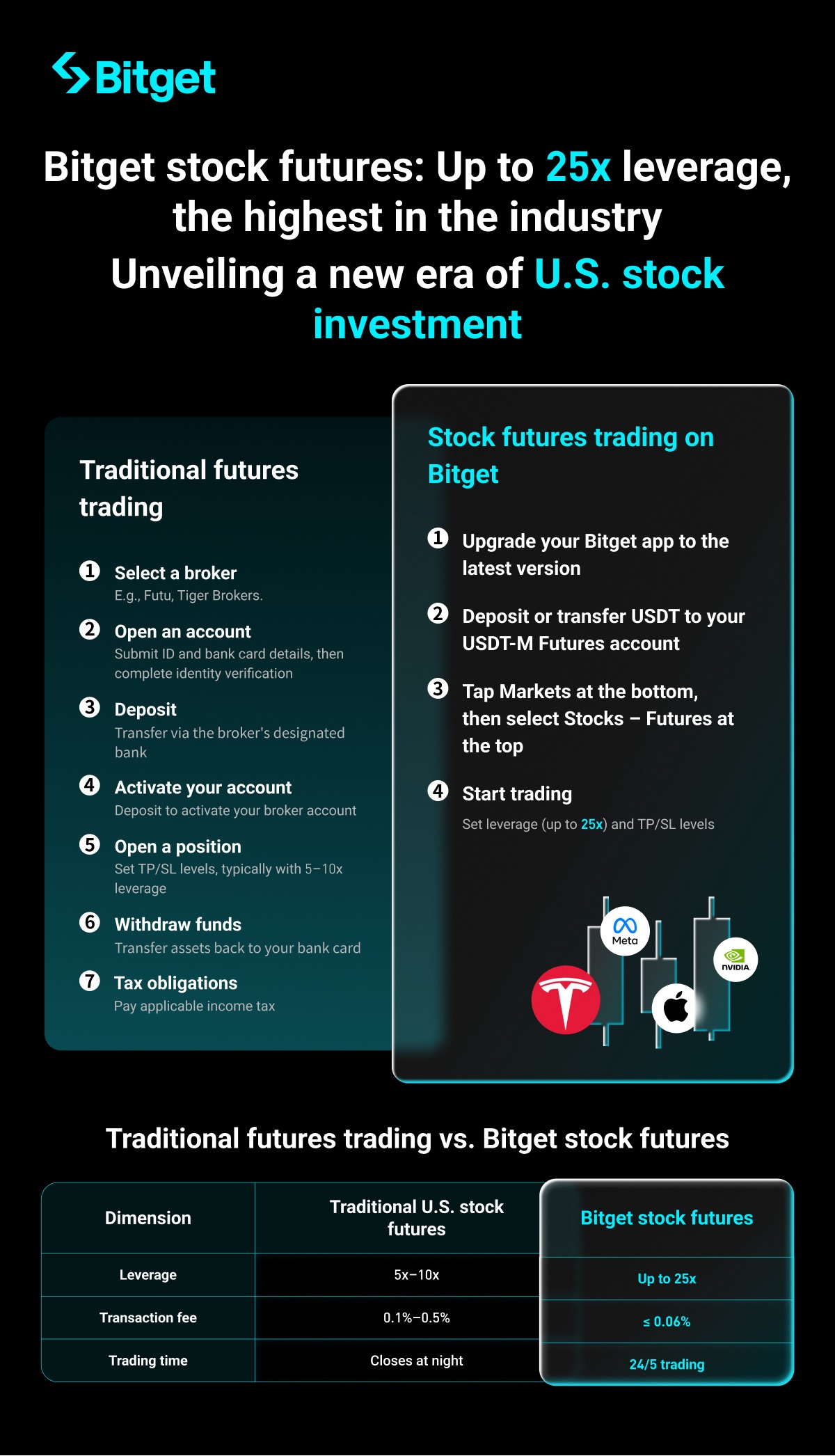
Traditional futures and Bitget U.S. stock futures
Bitget U.S. stock futures outperform traditional U.S. stock futures in several aspects. Here are the key comparisons:
Differences between Bitget U.S. stock futures and standard USDT-M perpetual futures
Bitget U.S. stock futures are designed to be different from standard USDT perpetual futures. Here are the key comparisons:
| Feature |
Stock futures |
Regular USDT perpetual futures |
| Trading period |
24/5 (UTC-4: from 12:00 AM Monday to 12:00 AM Saturday). Possible suspensions will be announced in advance.
|
24/7 |
| Settlement currency |
USDT |
USDT |
| Quote currency |
USDT |
USDT |
| Underlying asset |
Composite index of tokenized assets issued across multiple platforms (multi-token index) |
A single designated token |
| Position mode |
Isolated margin mode only |
Isolated margin, cross margin, and unified trading account |
| Max leverage |
25x |
125x |
| Index price |
Composite index of token prices from markets such as xStock and ONDO |
Spot market price of the designated token |
| Mark price |
Standard method |
Standard method |
| Open interest (OI) limits |
Both individual and platform-wide OI limits apply |
Individual OI limits only |
| Funding rate |
4h |
Every 1h, 2h, 4h, or 8h |
Advantages of Bitget U.S stock futures
The core advantages of Bitget US stock futures lie in their innovation and user-friendly design:
1. World's first: The industry's first tokenized stock index futures, anchored to multiple price sources for greater transparency and security.
2. High leverage: Supports up to 25x leverage to maximize potential profits and improve capital efficiency.
3. Diversified underlying assets: Covers over 20 popular US stocks to support different trading strategies.
4. Low transaction fees: Transaction fee rate no higher than 0.06%, reducing cost for high-frequency traders.
5. Index calculation: Based on USDT prices of tokenized assets from different issuers (e.g., xStock, ONDO), weights are recalculated regularly or whenever major events occur, ensuring the index keeps up with market changes.
Index rebalancing
● Regular rebalancing: The index components and their weights are recalculated daily at 8:01:00 AM (UTC).
● Special adjustment: If components face significant changes (such as delisting, lack of liquidity, or extreme volatility), they will be removed, weights will be recalculated, and a substitute component will be used.
● Hard fork/airdrop/adjustments: No adjustment is needed for forks that do not generate new tokens. If new tokens are generated, they will be included with the original weight. If they do not meet criteria, they will be removed during the next rebalancing. For token splits or merges, the original component will be replaced with the new token, and the weight will be adjusted accordingly.
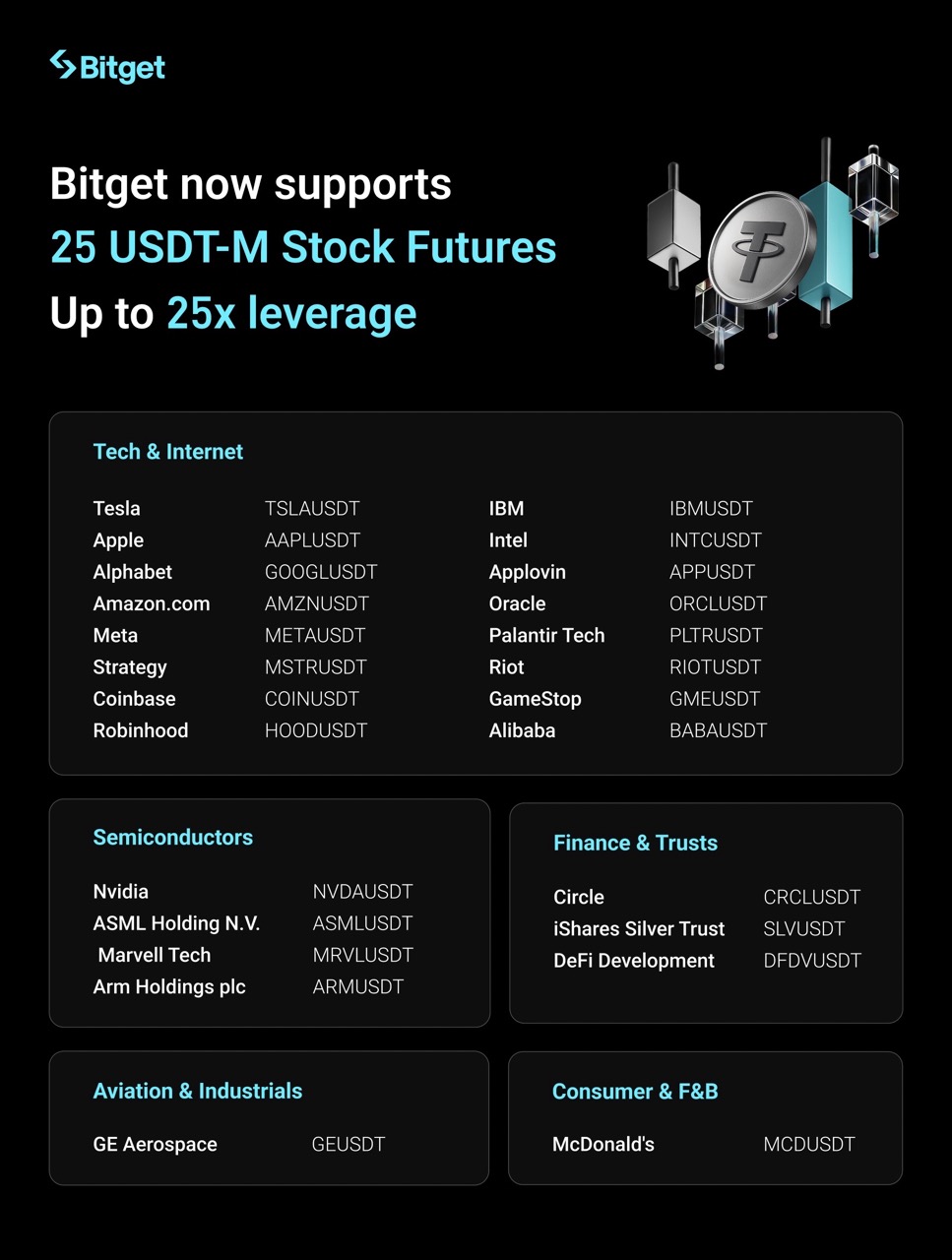
Details of supported U.S. stock futures on Bitget
Bitget currently supports 25 trending U.S stock USDT-M perpetual futures, grouped by company:
How can I trade U.S stock futures on Bitget?
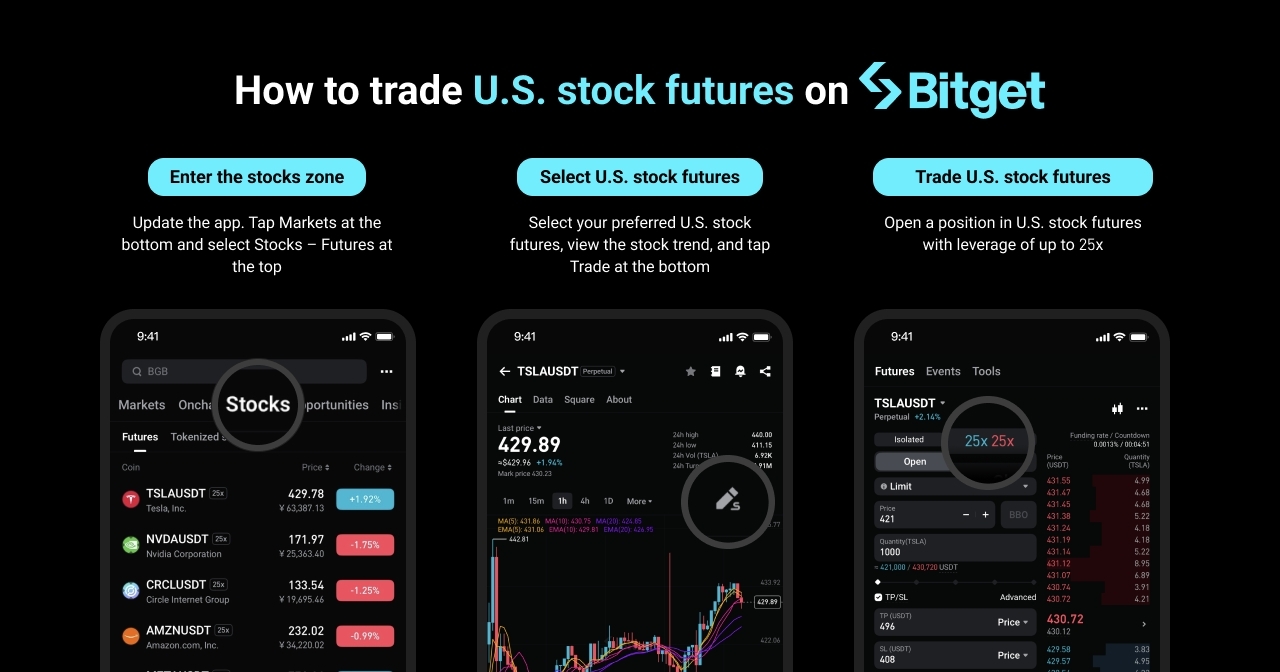
1. Upgrade the app: Ensure you are using the latest version of the Bitget App or visit the official website.
2. Deposit/transfer: Deposit or transfer USDT to your USDT-M futures account.
3. Enter the trading page: Tap on Markets at the bottom, select Stocks - Futures at the top. Search by ticker or browse under the stock categories.
4. Start trading: Set leverage (up to 25x), TP/SL, and more. Web, app, and API trading are supported, but not unified trading account mode. You must switch to single-asset mode.
5. During trading suspension: You may cancel existing orders but you will not be able to place new orders. Funding fees will not be settled; the mark price will not be updated, and positions will not be liquidated.
Trading hours and holidays
● Regular trading hours: Trading is available 24 hours a day, five days a week, from Monday 4:00 AM to Saturday 4:00 AM (UTC+8).
● Suspension: Trading will be suspended on public holidays when financial markets are closed. The main closing dates for 2025 are as follows:
| Date |
Week |
Festival name |
Trading schedule |
| January 1, 2025 |
Wednesday |
New Year's Day |
Closed all day |
| January 20, 2025 |
Monday |
Martin Luther King Jr. Day |
Closed all day |
| February 17, 2025 |
Monday |
President's Day |
Closed all day |
| April 18, 2025 |
Friday |
Good Friday |
Closed all day |
| May 26, 2025 |
Monday |
Memorial Day |
Closed all day |
| June 19, 2025 |
Thursday |
Juneteenth |
Closed all day |
| July 4, 2025 |
Friday |
Independence Day |
Closed all day |
| September 1, 2025 |
Monday |
Labor Day |
Closed all day |
| November 27, 2025 |
Thursday |
Thanksgiving Day |
Closed all day |
| December 25, 2025 |
Thursday |
Christmas |
Closed all day |
● Early closures: The market will close early at 1:00 AM (UTC+8) on July 3, 2025 (day before Independence Day), November 28, 2025 (day after Thanksgiving), and December 24, 2025 (day before Christmas).
● Note: Opening price may differ significantly from the previous day's closing price. Please assess the risks if you hold positions overnight.
Risk management and reminders
Liquidation mechanism
● Similar to regular isolated margin futures, risk is determined by the liquidation price or position margin ratio.
● During suspension, positions will not be liquidated. However, if there is a price gap after trading resumes, it may result in liquidation. It is recommended to add extra margin before the market opens.
Insurance fund
● ADL is enabled by default for each futures trading pair, with 50,000 USDT injected as the initial risk fund.
● ADL trigger: Triggered when the insurance fund equity falls to 0.
General risk warning
● The U.S. stock perpetual futures may experience high volatility. Trading with high leverage can significantly increase your risk exposure. Manage your positions carefully.
● This product is not a security and does not represent ownership of the underlying stock. No dividends, interest, or voting rights apply.
● Not covered by government insurance or guarantees. Bitget is not the issuer or distributor.
● Digital assets are highly volatile. It is recommended to invest only what you can afford to lose. Past performance does not guarantee future results. Bitget is not liable for any losses.
● You should always seek independent financial advice and consult Bitget's Terms of Use and Contract Service Agreement.
● Bitget may adjust parameters such as leverage and margin ratio based on market conditions. Refer to the latest official announcements.
Bitget will continue improving products to deliver professional and secure trading services. For further assistance, visit the Bitget Help Center or contact customer service. Thank you for your support!
Risk warning:
Stock tokens (the "Product") are based on a basket of tokenized stock indices already circulating in the market. However, the Product is not a security and does not represent actual ownership of the underlying stocks, corresponding stock tokens, or indices. The Product does not entitle you to any dividends, interest, voting rights, shareholder rights, or rights offerings (including but not limited to share splits, spin-offs, or subscription rights) related to the underlying stocks, corresponding stock tokens, or indices. This product is not backed, insured, approved, or guaranteed by any government or institution. Bitget is neither the issuer nor the distributor of the underlying stocks, corresponding stock tokens, or indices.
Digital asset prices are highly volatile and may undergo significant fluctuations. Investors should only invest funds they can afford to lose. The value of your investment may change, and there is no guarantee of achieving financial goals or recovering your principal. Investors are advised to seek independent financial advice and carefully assess their own financial experience and circumstances. Past performance does not guarantee future results. Bitget assumes no liability for any potential losses. Nothing in this article should be construed as financial advice. For more information, refer to our Terms of Use and Futures Service Agreement.
Risk warning
With just a Bitget account, you can trade stocks and cryptocurrencies at the same time.
Join now!FAQ
What is the stock price of AppFolio, Inc.?
What is the stock ticker of AppFolio, Inc.?
What is the stock forecast of APPF?
What is the market cap of AppFolio, Inc.?
What is P/E ratio (TTM)?
The P/E ratio (TTM) stands for price-to-earnings ratio (trailing twelve months). It is a historical valuation metric calculated using a company's earnings per share (EPS) over the most recent twelve consecutive months, reflecting the company's past profitability.
The P/E ratio measures the relationship between a stock's price and a company's profitability, and is often used as a basis for judging whether a stock is "cheap" or "expensive."
P/E ratio = market price (P) ÷ earnings per share (EPS), or P/E ratio = total market capitalization ÷ net profit attributable to shareholders
The interpretation of the P/E ratio (TTM) should always be considered alongside other factors and is mainly used for valuation comparisons rather than as a standalone indicator.
- A lower P/E ratio (TTM) means investors are paying less for each unit of earnings. This may indicate that the stock is undervalued, or that the market has limited expectations for the company's future growth, such as in mature or slow-growing industries.
- A higher P/E ratio (TTM) means investors are paying more for each unit of earnings. This often reflects expectations of strong future earnings growth, which is common among growth or technology stocks, though it may also suggest the stock is overvalued.
- Comparison with peers: Compare the company's P/E (TTM) with the average or median P/E of other companies in the same industry. A significantly higher P/E may require further analysis to determine whether the company's high valuation is justified by stronger growth prospects or competitive advantages.
- Comparison with historical levels: Compare the company's current P/E (TTM) with its own historical average (such as over the past 5 or 10 years) to assess whether the current valuation is at a historical high or low.
- Comparison with the broader market: Compare the company's P/E (TTM) with major market indices (such as the S&P 500) to see how the market is valuing the company overall.
P/E ratios can vary widely across industries, and there is no single "ideal" P/E level. A reasonable P/E range depends on the industry, the company's growth potential, and the broader macroeconomic environment. Investment decisions should not rely solely on the P/E ratio (TTM) but should be based on a comprehensive analysis that includes company quality, growth prospects, and financial health.
Can I trade stocks on Bitget?
You can trade stocks on Bitget, but mainly through stock tokens and stock perps, rather than by directly buying or selling traditional stocks.
This approach reflects Bitget's vision as a Universal Exchange (UEX), designed to connect traditional financial markets with cryptocurrency markets.
Bitget currently offers the following stock-related trading formats:
1. Stock tokens (spot)
Nature: Stock tokens are digital tokens pegged to the price of specific traditional stocks (such as TSLAUSDT and NVDAUSDT) and are traded on Bitget's spot market.
Features: When you trade stock tokens, you are buying and holding tokens rather than owning the underlying traditional stocks.
- The price of these tokens generally follows the price movements of the stocks they are pegged to, such as Tesla or Nvidia.
- The advantage is that you can participate in the price movements of traditional financial assets, such as U.S. stocks, using cryptocurrencies (for example, USDT), without the need for a traditional brokerage account.
2. Stock perps
Nature: Bitget also offers USDT-margined perpetual futures, commonly referred to as stock perps, based on major U.S. blue-chip stocks such as Tesla and Meta.
Characteristics: Stock perps are derivative products that allow you to take a bullish or bearish view on the future price of an underlying stock through margin trading. These products typically support leverage, such as up to 25x.
It does not involve owning the underlying stock. Instead, profits and losses are settled based on price movements of the futures.
Important note: When trading stock perps on Bitget, you are participating in derivative markets within the cryptocurrency ecosystem. This is fundamentally different from purchasing publicly traded shares through a traditional brokerage, as you do not own equity in the underlying company.
Futures trading and the use of leverage involve high risk. Please ensure you fully understand the risks before trading.
If you wish to directly hold equity in traditional stocks and enjoy shareholder rights (such as receiving dividends), you must trade through a regulated traditional securities brokerage or brokerage platform.
What are the advantages of Bitget's stock perps?
Bitget's stock perps—typically perpetual futures based on stock token prices—are an innovative offering that allows cryptocurrency platforms to provide exposure to traditional financial markets.
Compared to traditional stock or futures trading, they offer several unique advantages, primarily due to the platform's trading infrastructure.
Bitget's stock perps, typically USDT-denominated derivatives, offer the following key advantages:
1. Trading convenience and global accessibility
- 24/7 trading: Traditional stock markets, such as U.S. equity markets, operate during fixed trading hours. In contrast, cryptocurrency derivatives markets are typically open 24/7. This means investors can trade anytime, capitalizing on breaking news or market fluctuations.
- Lower entry barriers and faster onboarding: Compared with traditional brokerages, which often require extensive identity verification and lengthy account setup processes, Bitget generally offers faster account onboarding. Users can trade using cryptocurrencies such as USDT, without the need for complex fiat deposit and withdrawal procedures.
- Global accessibility: Users can access derivatives trading linked to globally recognized stocks via the Bitget platform, subject to applicable regulations.
2. Capital efficiency and high leverage
- High leverage options: Stock perps typically offer higher leverage than traditional stock trading (for example, up to 25x). This allows traders to control larger positions with smaller margin requirements, improving capital efficiency.
Note: While high leverage can amplify gains, it also amplifies losses proportionally. - Two-way trading: Traders can easily take both long and short positions. This means traders can potentially profit from market volatility whether stock prices rise or fall, provided the market direction is correctly anticipated.
3. Trading and settlement using cryptocurrency
- USDT margin: Stock perps on Bitget typically use USDT (or other stablecoins) as the margin and settlement currency. For users who already hold cryptocurrency, there is no need to convert assets into fiat currency, allowing them to trade directly with stablecoins.
- Efficient fund transfers: Crypto-based transfers and settlements are typically faster than traditional fiat systems, enabling more efficient global fund allocation.
4. Integration
One-stop platform: Bitget allows users to trade spot cryptocurrencies, crypto derivatives, and stock perps on a single platform, making it easier to manage different asset types in one place.
While Bitget's stock perps offer several advantages, it is important to understand the associated risks.
- High leverage risk: Leveraged trading can result in rapid loss of your entire margin.
- No equity ownership: When trading stock perps, you do not own the underlying shares. As a result, you are not entitled to dividends or voting rights.
- Market liquidity risk: Stock token perps may have lower liquidity than their counterparts in traditional stock markets, especially outside regular trading hours.
In summary, Bitget's stock perps offer advantages such as greater trading flexibility, lower entry barriers, and higher capital efficiency.
What are the trading fees for Bitget stock perps?
Trading fees for Bitget stock perps (USDT-margined perpetual futures) mainly include transaction fees and funding rates.
Transaction fees:
Bitget offers limited-time fee promotions for stock perps (especially stock token perps) from time to time to attract traders.
Standard reference rates: Under Bitget's standard futures fee structure, the taker fee is typically around 0.06%, while the maker fee is around 0.02%.
Current promotions for stock perps (important): To promote its stock perps products, Bitget is offering discounted transaction fees during Q4 2025, with taker fees as low as 0.006% and maker fees as low as 0.002%. There is also a limited-time promotion offering zero-fee trading for spot stock tokens.
Funding rate:
The funding rate is a key mechanism in perpetual futures (including stock perps) that helps keep the futures price closely aligned with the spot price of the underlying asset. It is not a fee charged by the platform, but a periodic payment exchanged between long and short traders.
Funding rates fluctuate dynamically and are mainly driven by market sentiment and imbalances between long and short positions. Stock perps generally experience lower volatility than cryptocurrencies, so funding rates are often relatively low during stable market conditions. However, during earnings seasons or major positive or negative news events, heavy concentration of long or short positions—such as in high-growth technology stocks like Tesla or Nvidia—can create significant imbalances, causing funding rates to spike in the short term.
Funding payments are typically settled every 8 hours. If you close your position before the funding settlement time, no funding payment will be charged or received.
Funding rates are not fixed. If you hold a position for an extended period, high positive funding rates (for long positions) or high negative funding rates (for short positions) will affect your overall holding costs or potential returns. For this reason, it is important to monitor the funding rate in real time on the trading interface.
Why is Bitget the ideal platform for trading stock perps?
Bitget has positioned itself as a leading Universal Exchange (UEX) by bridging the gap between traditional finance (TradFi) and the crypto ecosystem. In late 2025 and into 2026, it became one of the first major centralized exchanges to offer tokenized stock perps, allowing users to trade equity derivatives using crypto-native tools.
Here is why Bitget is considered an ideal platform for trading stock perps:
1. Unified collateral (USDT-margined)
One of the biggest advantages is the ability to trade U.S. equities—like Tesla (TSLA), NVIDIA (NVDA), and Apple (AAPL)—using USDT as collateral.
- No fiat conversion: You don't need to exit the crypto ecosystem or convert to USD to trade global stocks.
- Cross-asset efficiency: You can manage your crypto and stock positions from a single USDT-M Futures account, allowing for easier capital allocation.
2. High capital efficiency
Bitget offers aggressive leverage options that are typically unavailable on traditional brokerage platforms:
- Up to 25x leverage: While traditional stock brokers often limit retail traders to 2x or 4x leverage, Bitget allows for significantly higher capital efficiency.
- Fractional trading: You can take positions in expensive stocks (like Meta or Amazon) without needing the full capital for a single share, thanks to the flexible position sizing of perpetual futures.
Extended trading hours (24/5)
Traditional stock markets are restricted by opening bells and weekend closures. Bitget's stock perps products are designed for the modern global trader:
- Continuous access: Trading typically runs 24/5 (Monday to Friday, UTC+8), mirroring the flexibility of crypto markets.
- Macro responsiveness: If a major tech company reports earnings after New York closes, Bitget users can often react to price movements immediately through stock token markets
4. Competitive fee structure
Bitget has disrupted the traditional brokerage model with a low-cost approach:
- Low fees: Transaction fees for stock perps are often at or below 0.06%, which is highly competitive compared to both traditional brokers and other crypto–TradFi hybrid platforms.
- No hidden commissions: Unlike many "zero-fee" brokers that profit from wide spreads (payment for order flow), Bitget uses a transparent funding and margin model.
5. Advanced trading and copy trading
Bitget brings its social trading DNA to the stock market:
- Copy trading for stocks: You can follow elite traders who specialize in equity markets, automatically replicating their stock perps trades.
- AI-powered tools: The platform includes AI agents that assist with trade execution, risk management, and technical analysis.
How does the Bitget exchange better protect user assets?
Bitget has established a multi-dimensional and transparent defense system to protect user assets, specifically designed to address the trust challenges inherent in centralized exchanges (CEXs).
Here are the five key pillars of Bitget's asset protection:
Bitget maintains a dedicated Protection Fund, which serves as the last line of defense against hacks or security breaches.
- Massive scale: As of early 2026, the fund's average valuation is maintained at approximately $600 million (previously peaking at over $750 million).
- Asset diversification: The fund consists of highly liquid assets such as BTC and USDT, ensuring solvency even during extreme market volatility.
- Self-funded: This fund does not rely on third-party insurance. Bitget self-funds it and commits to maintaining a balance above $300 million for at least three years without withdrawals.
To demonstrate that the platform does not misappropriate user funds, Bitget utilizes Merkle Tree architecture to publish regular reserve reports.
- High coverage ratio: Data from January 2026 shows that the average reserve ratio for core assets (BTC, ETH, USDT, USDC) reached 163%, far exceeding the 1:1 benchmark.
- Independent verification: Users can use open-source tools provided by the platform to verify that their assets are included in the reserve snapshots via anonymous IDs.
3. Cold/hot wallet isolation and multi-sig
At the underlying technical level, Bitget employs bank-grade security architecture:
- 95% offline storage: The vast majority of user assets are kept in cold wallets, completely isolated from the internet to prevent remote hacking.
- Multi-signature (multi-sig): Critical fund transfers require signatures from multiple geographically dispersed and independent key holders, eliminating the risk of a single point of failure.
4. Rigorous withdrawal security policies
To mitigate the risk of individual account theft, Bitget has implemented multiple protective mechanisms:
- Withdrawal whitelist lock: After adding a new withdrawal address, the account enters a 24-hour withdrawal freeze period.
- Cross-device scan confirmation: A feature launched in 2026 requires that any withdrawal initiated on the web be confirmed by scanning a QR code via the mobile app, effectively preventing PC-based trojans from tampering with addresses.
5. Compliance and international certification
Bitget actively embraces regulation and has obtained several international information security certifications:
- ISO 27001 and ISO 27701: Bitget has obtained dual certification for Information Security Management and Privacy Information Management, demonstrating that its internal processes meet top-tier global compliance standards.