
RBNZ Expected To Cut Interest Rates To 2.25% In November

The Reserve Bank of New Zealand (RBNZ) is expected to cut the Official Cash Rate (OCR) to 2.25% from 2.5%, following the conclusion of the November monetary policy meeting on Wednesday. The decision will be announced at 01:00 GMT, accompanied by the Monetary Policy Statement (MPS) and followed by RBNZ Governor Christian Hawkesby’s press conference
The Reserve Bank of New Zealand (RBNZ) is expected to cut the Official Cash Rate (OCR) to 2.25% from 2.5%, following the conclusion of the November monetary policy meeting on Wednesday.
The decision will be announced at 01:00 GMT, accompanied by the Monetary Policy Statement (MPS) and followed by RBNZ Governor Christian Hawkesby’s press conference at 02:00 GMT. The New Zealand Dollar (NZD) will likely experience a big reaction to the central bank’s policy announcements.
What to expect from the RBNZ interest rate decision?
Following a standard 25-basis-point (bps) rate cut in August and a surprise 50-bps move in October, the RBNZ is expected to deliver a hat-trick, with a 25-bps reduction fully baked in for the November monetary policy meeting.
The central bank decided to opt for a big rate cut in its last policy decision in the face of a slowing economy and confidence that inflation was under control.
In its October Monetary Policy Review (MPR), the RBNZ noted that the “committee remains open to further reductions in the OCR as required for inflation to settle sustainably near the 2 percent target midpoint in the medium term.”
Therefore, another rate cut on Wednesday would come as no surprise.
Hence, all eyes will be on the discussions among the policymakers on further monetary policy easing heading into 2026.
The revisions to the OCR projection in the first half of next year will also be closely scrutinized to gauge the bank’s path forward on rates.
NZ Inflation Continues to Accelerate
Since the October 8 meeting, New Zealand’s annual Consumer Price Index (CPI) inflation accelerated in the third quarter (Q3), coming in at 3.0%, in line with the forecasts and at the top end of the central bank’s 1% to 3% target range.
However, the RBNZ made it clear in October that inflation was ticking higher, but noted that spare capacity in the economy should bring it back to 2% by mid-2026, suggesting that policymakers don’t expect inflation to be persistent.
On top of that, the annual non-tradeable inflation decreased to 3.5% in Q3, compared with 3.7% in the second quarter.
Additionally, the RBNZ’s monetary conditions survey showed on November 11 that two-year inflation expectations, seen as the time frame when the central bank policy action will filter through to prices, steadied at 2.28% in Q4 2025.
Meanwhile, New Zealand’s Unemployment Rate rose to 5.3% in Q3 from 5.2% in the second quarter, according to the official data released by Statistics New Zealand on November 4. The figure aligned with the market consensus.
Amidst expectations that underlying inflation is largely slowing, another rate cut by the RBNZ is justified.
Economists at Westpac NZ said: “We expect a 25bp cut in the OCR to 2.25%.
We see a downward revision in the projected OCR track of around 30-35bp, with a low point in the projection of around 2.20% in the first half of 2026. The implication is a mild and data-dependent easing bias for next year.”
How will the RBNZ interest rate decision impact the New Zealand Dollar?
The NZD/USD pair is miring in seven-month lows as the RBNZ event risk looms. Heightened expectations of a November rate cut have weighed heavily on the NZD since the end of October.
If the central bank downgrades its inflation and/or OCR forecasts while retaining the easing bias, the Kiwi Dollar could extend the current downside.
On the contrary, the NZD could witness a big relief rally should the RBNZ signal the end of the rate-cutting cycle amid an improving economic outlook and receding US tariff fears.
Dhwani Mehta, Asian Session Lead Analyst at FXStreet, offers a brief technical outlook for NZD/USD and explains:
“From a near-term technical perspective, bearish potential remains intact for the Kiwi pair as the 14-day Relative Strength Index (RSI) remains vulnerable well beneath the midline.”
“If sellers flex their muscles on a dovish RBNZ cut, the NZD/USD pair could drop further toward the falling trendline support at 0.5550. Further south, the 0.5500 round level and the April low of 0.5486 could be tested. On the flip side, the pair needs to scale the 21-day Simple Moving Average (SMA) at 0.5663 on a sustained basis for any meaningful recovery. The next relevant topside targets align at the 50-day SMA at 0.5735 and the 0.5800 threshold,” Dhwani adds.
Disclaimer: The content of this article solely reflects the author's opinion and does not represent the platform in any capacity. This article is not intended to serve as a reference for making investment decisions.
You may also like
ALGO Climbs 5.83% as Recent Gains Counteract Overall Downtrend
- ALGO surged 5.83% in 24 hours on Dec 2, 2025, but remains down 58.74% annually amid broader crypto market declines. - Short-term buying interest drove the rally, though analysts warn of continued volatility due to macroeconomic uncertainties. - The 24-hour rebound contrasts with a 4.37% seven-day loss, highlighting uneven recovery in the crypto sector. - Traders remain cautious as isolated buying pressure emerges, but long-term bearish trends persist despite temporary optimism.

Chainlink ETF Set to Debut as LINK Slips Amid Market Weakness
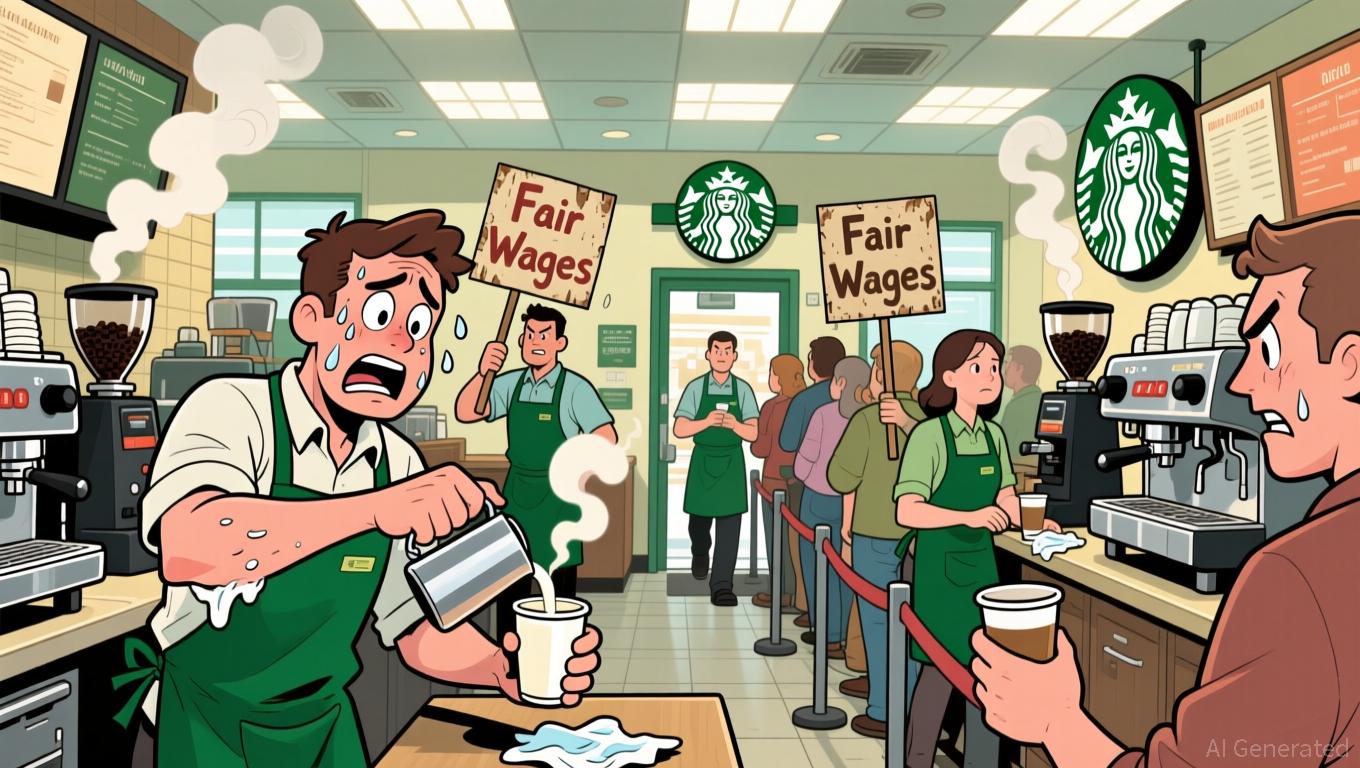
Striking baristas win $38.9 million in compensation, yet contract disputes continue
- Starbucks settles NYC Fair Workweek Law violations for $38.9M, including $35.5M restitution to 15,000+ workers. - Striking baristas demand collective bargaining amid ongoing labor disputes and unionization efforts at 550 stores. - Mayor-elect Mamdani and Sen. Sanders join protests, framing demands as moral issues against corporate resistance. - Settlement addresses 500,000 scheduling violations since 2021, with workers receiving $50/week compensation. - Starbucks defends labor law complexity but faces cr
Alphabet's AI-driven ecosystem accelerates flywheel momentum, driving shares up by 68% in 2025
- Alphabet's stock surged 68% in 2025, outperforming peers like Microsoft and Nvidia , driven by strong AI monetization and cloud growth. - Analysts raised price targets to $375-$335, citing Google Cloud's $15.2B Q3 revenue (34% YoY) and $155B cloud backlog growth. - The company's AI ecosystem spans Search, YouTube, and Workspace, generating premium subscriptions and ad yield through Gemini's 650M MAUs. - Projected cloud revenue could exceed estimates by $40B, but risks include regulatory scrutiny and comp

Trending news
MoreCrypto prices
More





