
BeatSwap's IP RWA: From Monetizing Ranking Economy to Becoming the No.1 RWA on BNB Chain DappBay

BeatSwap's patent not only makes IP copyrights the first type of real-world asset (RWA) that can be stably traded in an AMM, but also provides a technological model for more categories of real assets in the future.
With the development of blockchain technology and the influx of users, RWA tokenization has become one of the hottest narratives in Web3 today. However, the mainstream market is more focused on traditional financial assets such as bonds, real estate, and gold. Although these assets have brought some incremental growth to the crypto industry, their models still rely on traditional frameworks, and ordinary users remain cautious and find it difficult to participate deeply.
Meanwhile, the music and intellectual property sectors are experiencing explosive growth. According to Goldman Sachs, by 2035, the global music industry will double in size to reach $200 billions. The global IP licensing market is expected to reach about $48.2 billions by 2033, with a compound annual growth rate of 8.5%. However, in this vast market, copyright management remains opaque, settlements are slow, and most of the value is captured by intermediaries. IP copyright RWA holds enormous potential.
Against this backdrop, BeatSwap has emerged. BeatSwap has chosen a path different from traditional financial asset on-chain models, aiming to build truly Web3-native infrastructure for the global IP economy, transforming content copyrights into tradable, financeable, and settleable IP copyright RWA, and implementing on-chain risk management through patented algorithms.
A Full-Stack RWA Infrastructure for the Global IP Economy
BeatSwap claims to be the "world's first Web3 full-stack IP copyright platform," with its ecosystem composed of four core modules, covering the entire lifecycle of IP from creation, rights registration, fan participation, to trading.
The first is Oracle, the core of the BeatSwap ecosystem. This module permanently records the metadata of IP works on-chain, including basic information about the work, lyricists, composers, rights holders, as well as daily streaming volumes and royalty settlement history. This trusted data not only helps rights holders monitor the use of their works in real time, but also connects with external streaming platform data to enable automatic royalty settlements.
According to official disclosures, BeatSwap is pioneering a Web3-native DePIN model tailored for the global IP economy. Participants only need to create content and, without any hardware, can contribute to the ecosystem by integrating its Oracle SDK into existing digital platforms. This means BeatSwap will also become a full-stack DePIN network for verifying IP data.
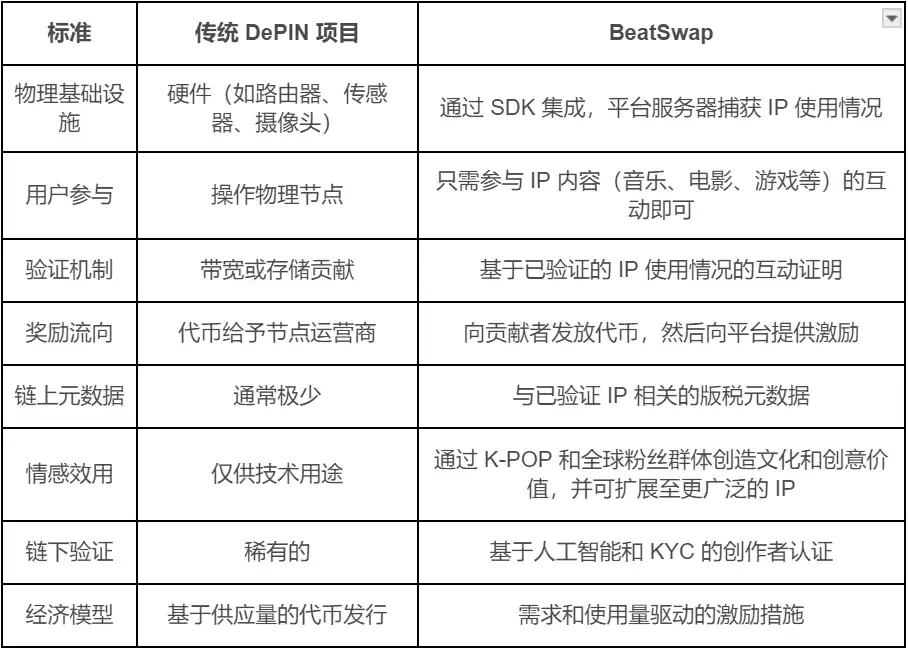
The second core module is the social platform Space, a Web3 social space designed by BeatSwap for creators and fans, covering all types of creators including music, film, and gaming. Creators must complete KYC and confirm content rights before publishing works, ensuring all content can be linked to verified data on Oracle. Fan interactions in Space, such as likes, comments, and follows, are all recorded on-chain and together constitute the creator's Exposure Score. The Exposure Score is calculated as 50% fan interaction metrics and 50% creator BTX staking, reflecting both fan enthusiasm and the creator's community engagement.
In fact, the "chart economy" has long existed in Web2, where fans boost the commercial value of celebrities or products by increasing their rankings through various online and offline activities. However, most fans contribute out of passion and cannot share in the increased commercial value. BeatSwap links fan behavior to rewards, making participation a contribution and contributions eligible for economic returns.
Additionally, RWA Launcher and BeatSwap are both core modules of BeatSwap. The former is used to convert IP into RWA assets, while the latter allows IP RWA to be traded like any other on-chain asset.
Ranked First in RWA Category on BNB Chain DappBay
Innovation in technology and philosophy must ultimately be implemented in concrete products. In the process of industrializing music copyright RWA, BeatSwap's licensing mining product "Licensing to Earn (L2E)" stands out. With its unique economic mechanism and real-world use cases, BeatSwap L2E has topped the RWA category ranking on BNB Chain DappBay, becoming the most outstanding project among its peers.
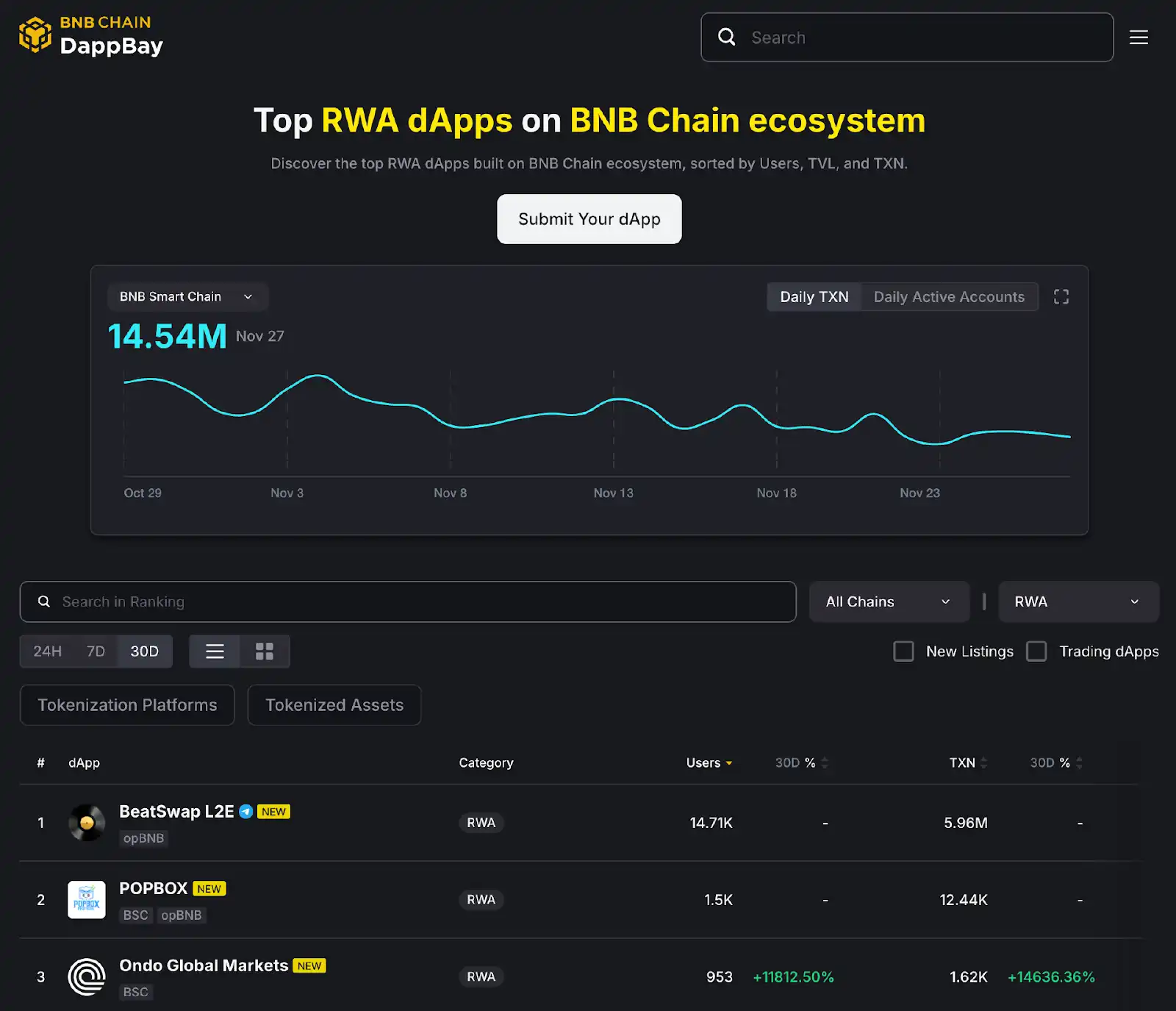
Image source: BNB Chain
L2E is BeatSwap's licensing mining module, centered on the introduction of the IP Licensing Index (IPL), an untransferable, non-redeemable index token minted on the opBNB mainnet to measure users' real contributions to the IP ecosystem, with issuance fully linked to user behavior.
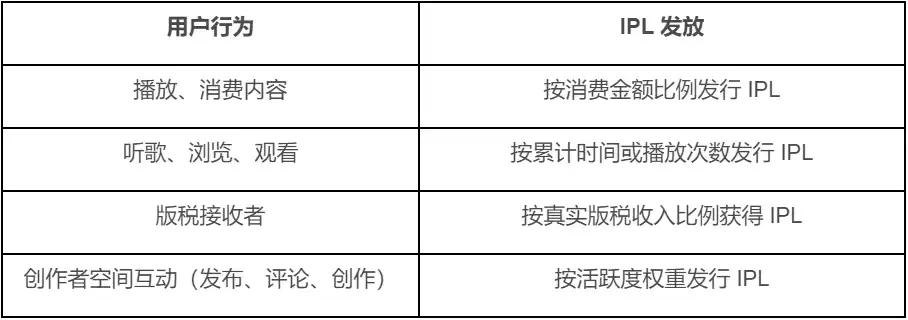
These behaviors are written to the chain in real time, and a snapshot of all IPL holders is taken monthly, with the BTX reward pool distributed according to the proportion of IPL held, achieving "participation equals rewards." In other words, IPL represents contribution, and contribution determines the proportion of BTX rewards. In addition, leveraging the high scalability and low cost of the opBNB network, BeatSwap can support massive copyright transactions with smooth execution. Its verifiable proof-of-participation system ensures every reward is transparent, fair, and auditable, making "listen-to-earn mining" feasible both technically and economically.
From a macro perspective, BeatSwap's economic model is centered around three components: RWA tokens, the platform's native token BTX, and IPL, forming a mutually reinforcing value loop.
BeatSwap standardizes each IP work into 2,000 RWA IP tokens, representing the neighboring rights of the work. Half are sold to the public via RWA Launcher for financing and market exposure; 18% are injected into the protocol by BeatSwap to provide initial liquidity. Among creators, composers, lyricists, and singers hold 6%, 6%, and 8% of the RWA tokens respectively, and can choose to hold long-term to share in the work's growth or freely trade on the market. The remaining 12% is used by BeatSwap for exclusive copyright management and does not enter the public market.
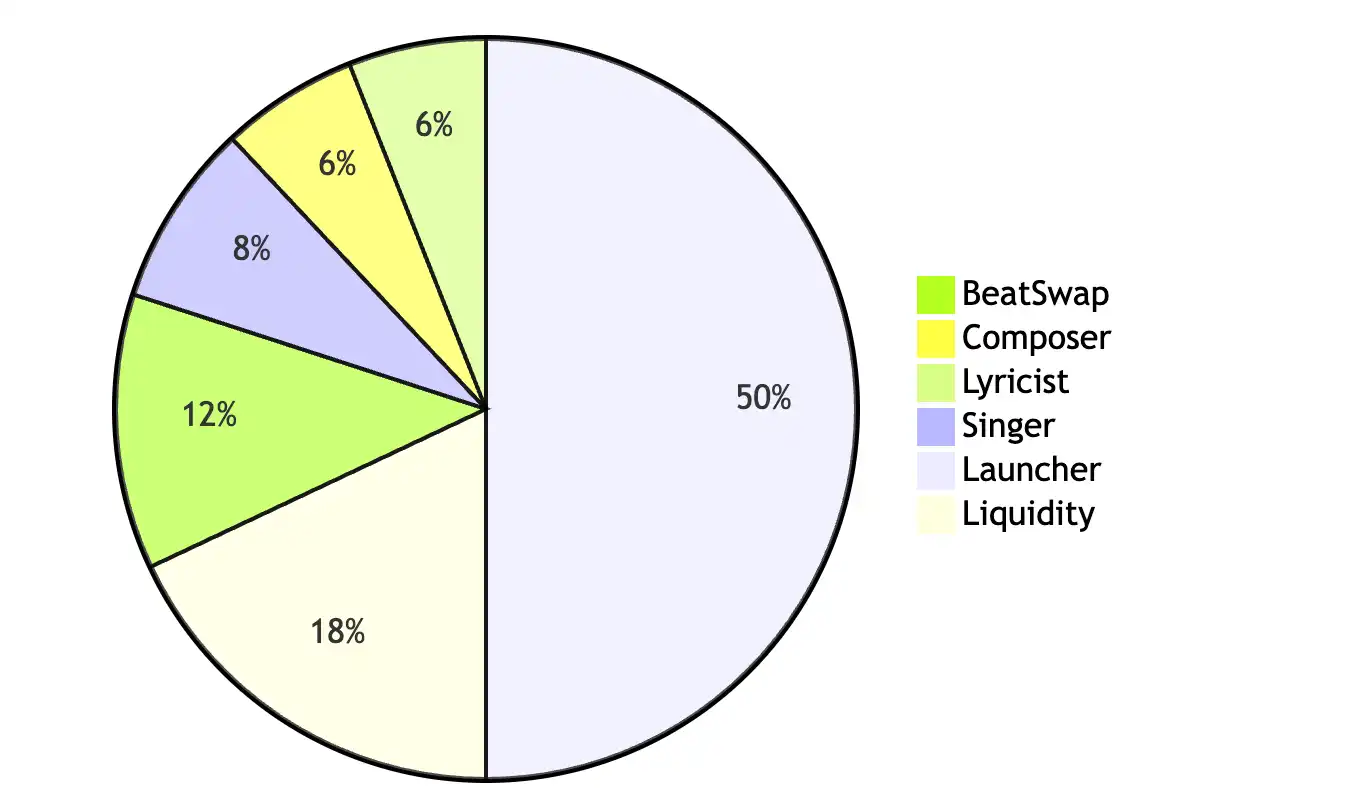
Image source: BeatSwap
This allocation structure ensures the interests of creators, investors, and the platform are highly aligned. What investors purchase is not merely a collectible, but an "IP equity share" with real cash flow. By simply staking RWA tokens, users can receive daily real streaming income from global platforms for the corresponding work.
To ensure continuous liquidity for copyright assets, BTX plays a key driving role in the ecosystem. All RWA token trading, exchanges, and LP pairings use BTX as the settlement unit. As more songs are released and more RWA assets go live, more "RWA–BTX" liquidity pools will form on DEXs. The more songs launched, the larger the liquidity pool, the greater the trading demand for BTX, and the stronger its value support. At the same time, large amounts of BTX will be distributed through platform activities to listeners, content creators, liquidity providers, and RWA token holders who take on rights risks.
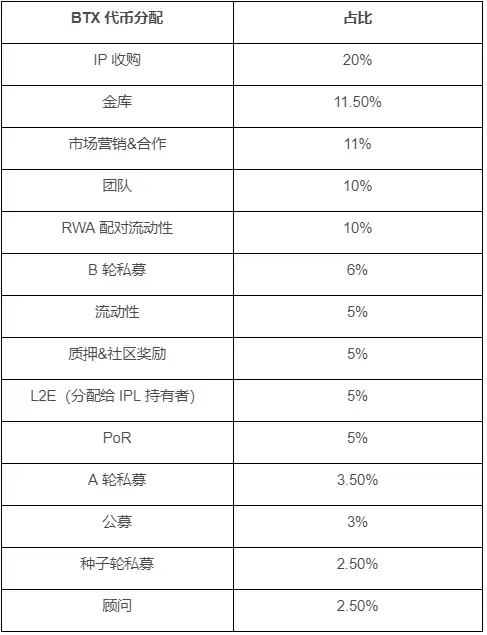
In the overall BTX distribution system, IPL holders will receive 5% of the total BTX token allocation. User behaviors on the platform, such as playing songs, unlocking paid content, sharing works, participating in licensing, and interacting with creators, all accumulate IPL. This not only records contributions but also determines each user's BTX reward ratio.
Because IPL treats every act of ecosystem participation as a "contribution asset," BeatSwap was able to take first place in the RWA category ranking on BNB Chain DappBay. On-chain data shows that BeatSwap's cumulative transaction count has exceeded 6.4 million, with over 420,000 users, surpassing Ondo among similar projects. In addition, BeatSwap has successfully released 660 songs, including K-POP, electronic music, indie music, and experimental music, making it the most complete and fastest-growing platform in the music copyright RWA sector.
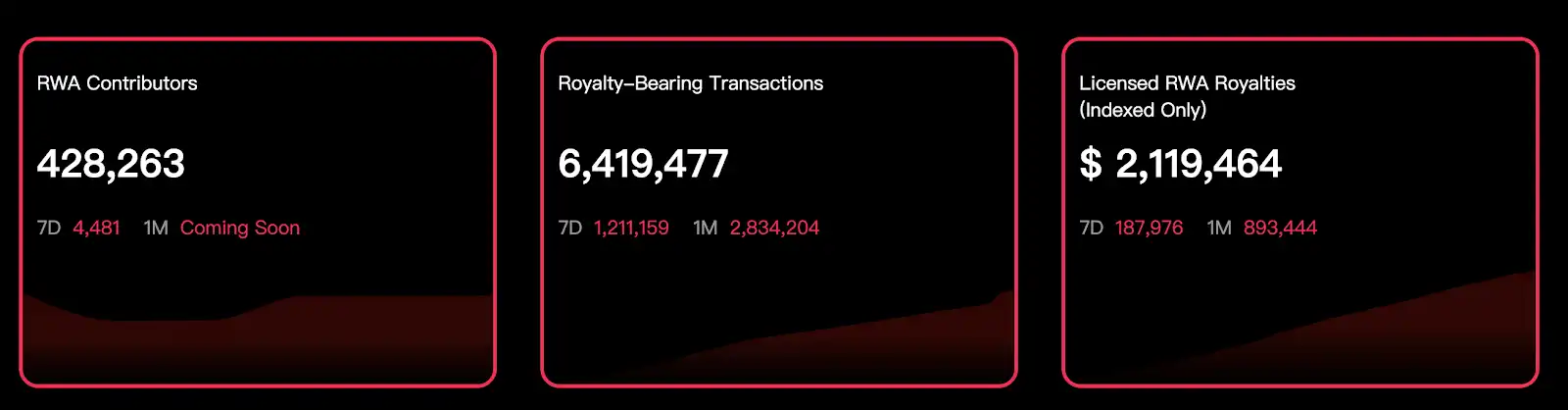
Data source: beatswap.io/dashboard
International Patent: How to Properly Manage and Trade RWA
In today's narrative, RWA is seen as one of the most promising growth engines. However, when traditional assets, especially those with real cash flows, are brought directly on-chain, the limitations of existing technical systems are exposed. AMM mechanisms designed for cryptocurrencies are not equipped to handle complex RWAs.
To enable proper trading, pricing, and secure settlement of RWAs on-chain, BeatSwap has chosen an unprecedented path. BeatSwap has submitted an international patent application to the United Nations World Intellectual Property Organization (UN WIPO) titled "Collateralized Liquidity Management System and Method for Real-World Asset Decentralized Exchanges" (International Application No.: PCT/KR2025/015673).
BeatSwap's patent application is not just about securing a position, but about creating foundational infrastructure tailored for the RWA era. Traditional AMM models are designed for highly volatile assets like ETH and DeFi tokens, and can support markets with simple curve models. But when applied to RWA, structural flaws become immediately apparent. RWA values fluctuate slowly and do not have hourly price volatility, while AMM liquidity pools respond rapidly to every trade, causing prices to deviate from real value. For example, the real value of a music work may change very little, but the AMM mechanism could cause the price to become distorted after just a few trades.
More critically, RWAs are collateralized, have cash flows, and have payment cycles. If collateral value drops, cash flows are delayed, or there is redemption pressure, traditional AMMs cannot perform any risk management actions. There is no liquidation, no penalty mechanism, no price stabilizer, and no dynamic adjustment based on user risk exposure. Such "risk-free AMMs" are clearly incapable of handling real-world assets.
BeatSwap realized that for IP copyrights and similar assets to truly enter the on-chain financial system, a new AMM structure must be created—one that understands risk, manages collateral, and tracks cash flows. Therefore, they chose to apply for a patent, solidifying this structured mechanism to not only protect innovation but also lay the foundation for future industry institutionalization.
According to the patent description, the BeatSwap AMM is a risk-adjusted hybrid AMM that combines collateral ratio, price volatility, and liquidity slope, making liquidity provision dynamic according to risk rather than passive. When the streaming data of an IP work fluctuates, copyright revenue drops, or collateral value depreciates, the system automatically adjusts the pool's price curve to bring prices back in line with real value. The patent also designs a complete risk disposal mechanism. When collateral value falls into a danger zone, the system triggers automatic penalties, price corrections, or even liquidation to protect the market from disorderly trading shocks. Traditional AMMs are powerless in such situations, but BeatSwap's system can act as a safety valve like traditional financial clearinghouses, preventing systemic risk in the market.
BeatSwap's patent not only makes IP copyrights the first RWA type that can be stably traded in AMMs in a true sense, but also provides a technical model for more categories of real assets in the future.
In the future, when the industry looks back at the history of RWA, this patent will likely be seen as an important watershed. It marks a key step for RWA from being mapped on-chain to being properly traded and managed.
Disclaimer: The content of this article solely reflects the author's opinion and does not represent the platform in any capacity. This article is not intended to serve as a reference for making investment decisions.
You may also like
Telegram, the world's largest social platform, launches major update: Your graphics card can now mine TON
Telegram’s ambition for privacy-focused AI

A well-known crypto KOL is embroiled in a "fraudulent donation scandal," accused of forging Hong Kong fire donation receipts, sparking a public outcry.
Using charity for false publicity is not unprecedented in the history of public figures.

An overview of two new projects in the Polkadot ecosystem and what they will bring to Polkadot Hub

HIC: Continue to bring truly valuable new projects to Polkadot in a sluggish market!

Trending news
MoreCrypto prices
More





