Written by: David, TechFlow, Deep Tide
Recently, the crypto market has entered a typical garbage time, with market sentiment swinging repeatedly between weakness and anxiety.
During this silent period lacking obvious wealth effects, focusing on local hot narratives is a cost-effective choice, such as those infrastructures that are still being built or even quietly iterated.
About 1-2 months ago, we were among the first to introduce Coinbase's x402 protocol and the related ERC-8004 protocol. At that time, there was also a 1-2 week opportunity window, and tokens within the related narrative saw decent gains.
(Related reading: Google and Visa are both making moves—what investment opportunities are hidden in the undervalued x402 protocol? )
In the analysis back then, I judged that the core narrative of x402 v1 was about solving the problem of "AI owning a wallet," allowing AI Agents to complete on-chain payments through simple API calls. This was seen as a key move for the Base chain in the AI track at the time.
Although the logic was validated, x402 was limited by a single-chain environment and a single settlement model, and did not experience large-scale breakout.
Just yesterday, what most people missed was that the developer of x402 quietly released the V2 version.
If V1 was just an experimental tool that allowed AI to "make payments," then the V2 update log reveals much greater ambition:
Full-chain compatibility, hybrid crypto and non-crypto payment rails, and the crucial "work first, pay later" credit capability. These features are not just simple patches, but an attempt to build a true financial foundation for a "machine commercial society."
It fits perfectly with the AI narrative.
You could say the crypto market no longer has much profit effect, but getting to know the updates of protocols that are still alive in advance is never a bad thing.
What if you find another Alpha?
From giving AI a wallet to enabling AI to "enjoy first, pay later"
For those who have forgotten what x402 is, here’s a one-sentence explanation of the original purpose of the 402 protocol:
"Revive the dormant 402 code in Internet protocols, allowing AI to purchase data and services automatically via API calls through a crypto wallet, just like humans swiping a card."
Although V1 made this logic work, it was rather clunky in practice.
If your AI Agent has to sign on-chain and pay Gas every time it makes an inference or calls data, this "pay as you go" atomic transaction model is extremely inefficient and costly.
This made V1 more like a technical demo rather than infrastructure capable of handling commercial traffic.
The core change in V2 is that it tries to normalize AI's commercial behavior.
After carefully reading the V2 documentation, I believe the most noteworthy change is the introduction of the delayed payment mechanism.
In the original text, it says:

This sounds technical, but if translated into financial language, it’s roughly:
Allowing service providers and AI to establish a "bookkeeping" relationship: AI can use services after verification (such as calling a computing interface 1,000 times in a row), the system keeps track in the background, and finally settles in one go.
This may seem like just saving Gas fees, but from a narrative perspective, it means AI Agents are beginning to have "credit."
Once "enjoy first, pay later" is allowed, the sub-narratives for speculation expand. For example, the market needs to assess the default risk of this Agent, so someone needs to provide guarantees for newly born Agents.
This is actually laying the foundation for AgentFi, evolving from a pure payment tool to the credit and financial layer.
Besides this hidden "credit layer," V2 has two other significant updates at the infrastructure level:
-
From "Base first" to "multi-chain by default": V1 had a strong Base ecosystem experimental flavor, while V2 defines a general HTTP header interaction standard. This means that as long as the standard is adapted, it can be accessed on Solana, Ethereum mainnet, or L2. This breaks the "cross-chain island" of funds.
-
Hybrid Rails: V2 bridges the gap between fiat and crypto. Agents can pay in USDC, and through the x402 gateway, traditional cloud service providers (AWS, Google Cloud) can directly receive fiat. This is a key step for AI to move from on-chain self-entertainment to real-world procurement.
To better understand the leap in this iteration, I’ve compiled a core comparison table between V1 and V2:
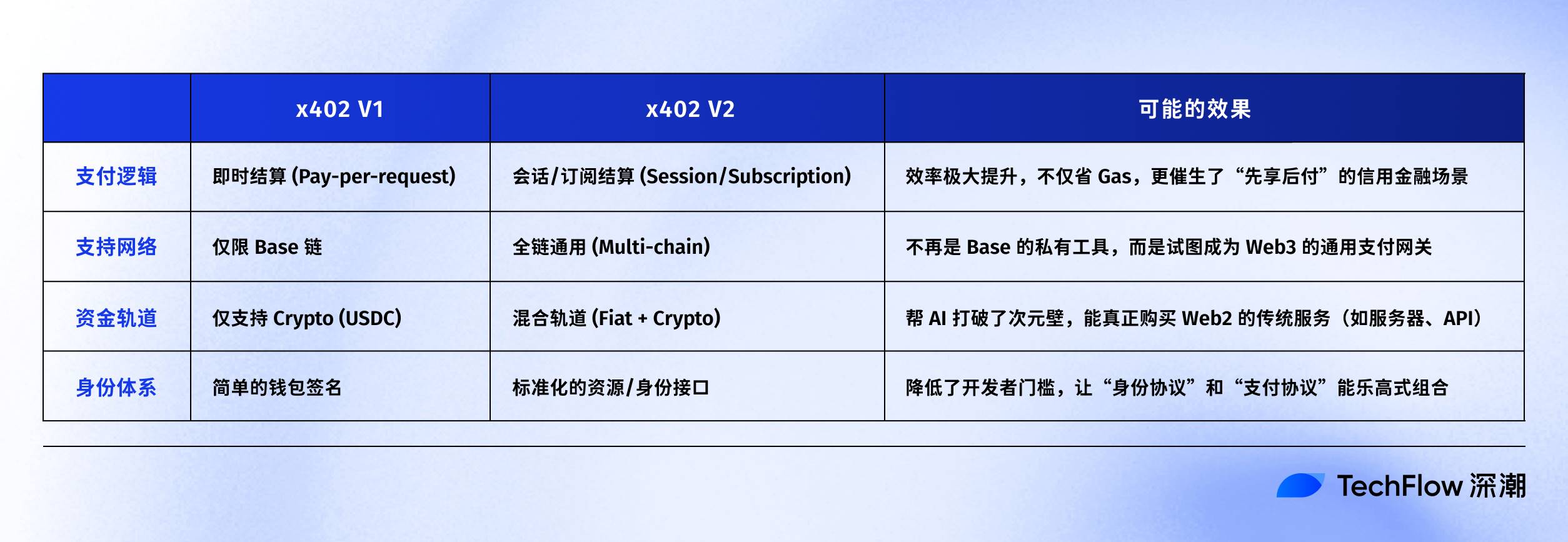
In summary, V2 doesn’t want to be just a toy on the Base chain, but rather the VISA network of the AI economy, trying to give AI a universal "credit card" for the entire network:
-
Solving the efficiency problem of high-frequency transactions with "delayed payment."
-
Solving the funding source problem with "multi-chain compatibility."
For those seeking Alpha, I predict this may hint at two tracks about to be revalued:
-
Who will provide credit ratings and guarantees for these AIs? That is, the AI credit layer
-
Who can be the first to sellcomputing powerto AI through this streaming payment? Possibly related to DePIN payment adoption
Following the clues, which projects are standing at the forefront of V2?
After clarifying the core upgrade logic of x402 V2, the idea for finding targets becomes clear.
If x402 V2 is the "Visa settlement network" in the AI economy, then the following three types of protocols form the key nodes that keep this network running.
Category One: AI's Credit Bureaus and Fulfillment Layer
V2 introduces a "work first, settle later" subscription model, which directly brings a challenge:
Why should a service provider trust that an anonymous AI Agent will pay at the end of the month as agreed?
Solving this requires two layers of assurance: first, credit score to judge if you can pay, and second, fulfillment verification to judge if the work was done well. This is exactly where x402 and ERC-8004 narratives intersect, as we introduced before.
Some obviously narrative-aligned projects include:
-
Spectral ($SPEC), @Spectral_Labs
Positioning: On-chain credit scoring and machine intelligence network.
Connection: Spectral's core product is the MACRO score (similar to on-chain FICO). In the x402 V2 environment, service providers can set thresholds: only Agents with qualifying credit scores can enable the "postpaid" mode. This is the premise for the "credit" logic to work.
Spectral's ongoing Inferchain aims to solve the Agent verification issue, which matches the settlement needs of x402 V2.
-
Bond Credit, @bondoncredit
Positioning: Credit lending layer designed specifically for AI Agents.
Connection: Currently one of the very few projects with the slogan "Credit for Agents." When a new Agent wants to use cloud computing via x402 V2 but lacks funds, Bond Credit uses TEE to monitor its historical performance and provides credit guarantees, enabling service providers to confidently enable "delayed payment."
Note that the project is in its early stages, so DYOR. However, the track is very vertical and fills the gap in AI lending.
-
CARV ($CARV), @carv_official
Positioning: Modular data and identity layer.
Connection: Solves the "who am I" problem. x402 V2 supports multi-chain, and CARV's ID standard allows Agents to maintain a unified identity across different chains.
Official Twitter shows actual payment scenario testing has already taken place.
By the way, the "fulfillment verification" logic here once again confirms our judgment in the previous article on the ERC-8004 standard.
x402 V2 is responsible for the settlement of "capital flow," while the ERC-8004 standard is responsible for the verification of "business flow."
Only after confirming that the service has been delivered will delayed payment be triggered. The related track logic we mentioned at the time is equally applicable in this wave of x402 V2 updates. Here's the diagram again:
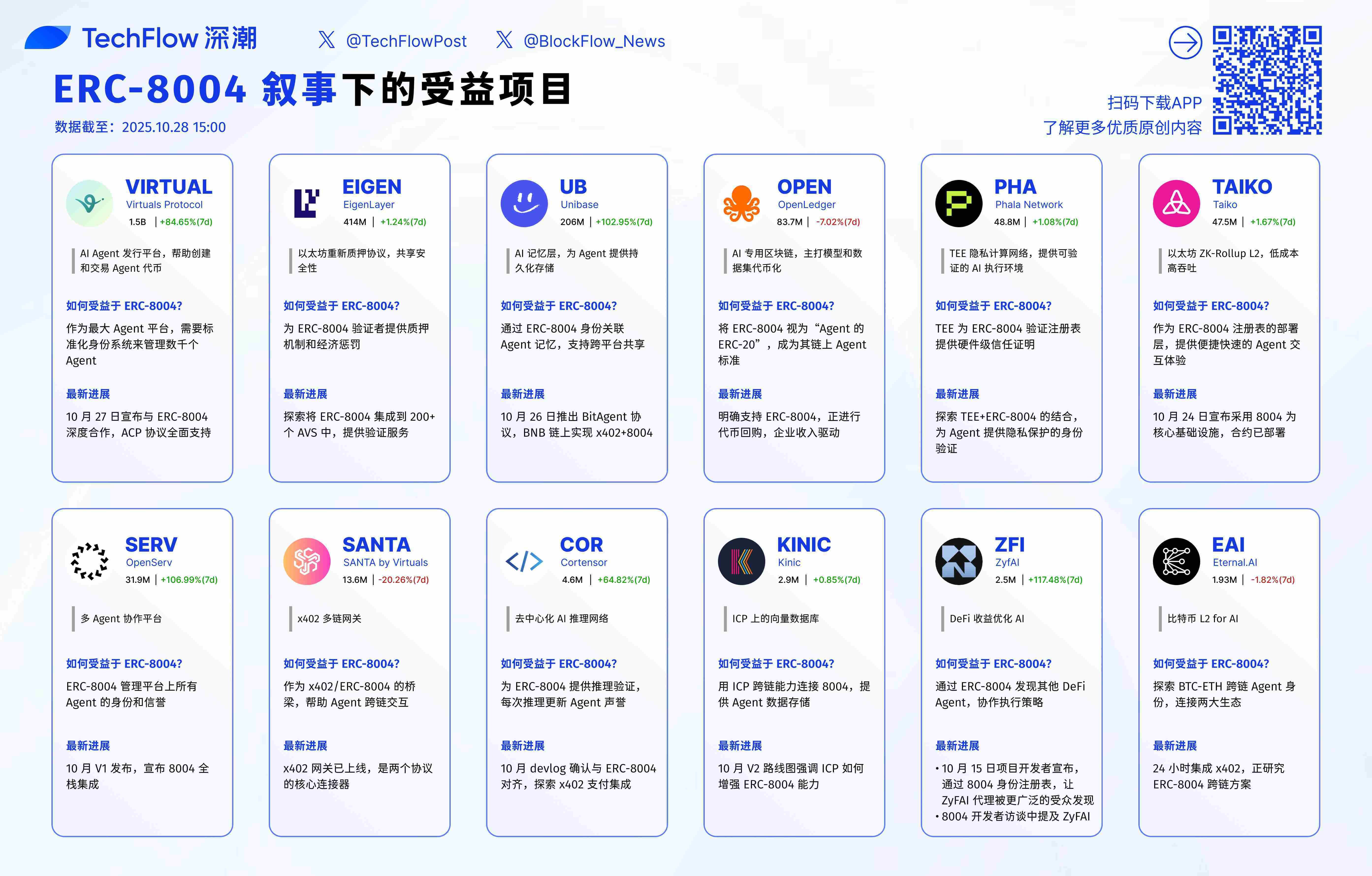
(Related reading: x402 is becoming increasingly competitive—discover new asset opportunities in ERC-8004 in advance )
Category Two: AI's "Utilities" and Inspectors
x402 V2's "session-based settlement" greatly reduces the friction of high-frequency payments. In theory, this benefits DePIN projects selling computing power, as well as protocols that verify "no fake computing power."
Typical established protocols include:
-
Akash Network ($AKT)
Positioning: Decentralized computing power marketplace.
Connection: Computing power leasing is a typical "per second/per unit" billing scenario. x402 V2 allows AI to pay directly with USDC or even fiat channels, greatly lowering the threshold for AI to procure computing power.
Logically, this is more of a passive benefit, with less direct connection.
-
Giza ($GIZA), @gizatechxyz
Positioning: Verifiable machine learning protocol (ZKML) and DeFi Agent applications.
Connection: Giza has a dual identity. As a technical layer, it acts as the "inspector" before payment settlement. Before paying expensive inference fees via x402, Giza's ZKML technology can prove that "the model indeed ran as required."
As an application, its flagship products (such as ARMA) themselves are DeFi Agents operating on payment rails like x402.
Category Three: AI's "Asset Side" and Execution Layer
The narrative logic here is: if x402 v2 makes AI payments better, then who is producing these Agents? Who is using these tools to help users make money?
Old friend, we're back to Virtuals Protocol ($VIRTUAL).
As a leading AI Agent issuance platform, x402 V2 is equivalent to giving Agents on Virtuals a "cross-chain passport." Users holding VIRTUAL-based Agents can, in the future, use the x402 protocol to direct Agents to participate in Solana launches or arbitrage on the mainnet.
-
Brahma, @BrahmaFi
Positioning: On-chain execution and strategy orchestration layer.
Connection: Since Brahma's core business is to help users automate complex DeFi strategies, they can use x402 to unify payments for various Keepers (executors) for Gas and execution fees, achieving full automation.
This also opens up a category of DeFAI scenario adaptation. It's a key infrastructure for DeFi's transition to AgentFi.
Summary
Finally, let's take a step back and calmly consider the signal sent by the release of x402 V2.
Technically, x402 is a payment protocol, but in the crypto context, it can actually lead to many financial innovations.
By introducing "delayed payment (credit)" and multi-chain accounts, V2 actually gives AI the concept of a balance sheet.
When an Agent is allowed to "provide service first, pay later," it has liabilities; when it can hold multiple assets across chains, it has equity.
Once there are assets and liabilities, AI is no longer just a code script, but becomes an independent economic entity, opening up new possibilities.
This is the true origin of the AgentFi (Agent Finance) narrative.
For speculation, during the current market downturn, there’s no need to fantasize about how AI will build complex business empires in the future—just focus on the most fundamental narrative logic changes:
Previously, we invested in AI at the model layer, i.e., "who is smarter"; in the future, we will invest in AI at the financial layer, i.e., "who is wealthier."
x402 V2 is just the starting gun. Once the market picks up, keep a close eye on those issuing IDs to AI, providing credit to AI, and turning computing power into retail products.
These projects are the kind that sound sexy, are hard to disprove, and have forward-looking narratives.
As AI upgrades its narrative from tool to economic entity, these "pick-and-shovel" projects will collect the first wave of tolls, regardless of whether the market is bullish or bearish.