
Opinion: Why Lighter Is Seriously Undervalued

Original Title: The Case of Lighter
Original Author: PlayRisk
Original Translation: SpecialistXBT, BlockBeats
TL;DR
Lighter is undervalued compared to other Perp Dexes.
Currently, most circulating tokens are priced by early users of Hyperliquid. This group got rich by holding Perp Dex tokens, and even to hedge risks, they will buy Lighter. 99% of VCs missed out on $HYPE, and they are desperate for the next target.
Narrative accounts for the majority of a token’s valuation, and Lighter’s signals are already very clear.
Today’s token price is supported entirely by “programmatic” spot buying (such as automatic buybacks). Unless spot buying is strong enough, tokens are unlikely to rise (see the lessons from ETHFI and GRASS). Currently, only the Perp Dex sector has truly made this logic work.
Lighter’s Vlad has close ties with Robinhood’s Vlad, and it’s highly likely that Robinhood will direct order flow to Lighter in the future.
The zero-fee business model is very popular among users.
Whales all need privacy; no one wants their liquidation price to be broadcast to the entire network.
Valuation Analysis
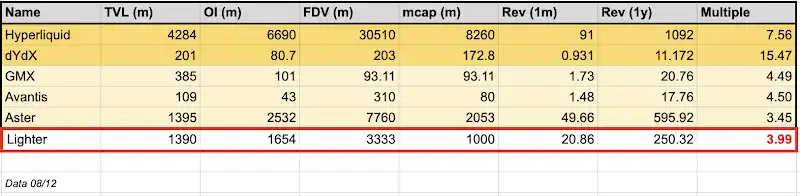
From the current OTC market, Lighter’s FDV is about $3.3 billion. Assuming an airdrop ratio of 30%, its initial circulating market cap is about $750 million. By comparison, Hyperliquid’s circulating market cap is as high as $8.2 billion.
Looking solely at revenue (note: Lighter’s revenue has not yet been validated by a year of market performance like Hyperliquid), if we simply annualize the past month’s revenue, Lighter’s annualized revenue could reach $250 million. This means Lighter’s price-to-sales (market cap/revenue) multiple is only 2.5x, far lower than Hyperliquid’s 7.6x—ridiculously cheap.
Let’s look at a closer competitor, Aster. Aster’s TVL is comparable to Lighter’s, and its open interest (OI) is about $1 billion higher, but its FDV is as high as $7 billion, with a circulating market cap of about $2 billion. In comparison, Lighter’s trading price is only one-third of Aster’s.
Ask yourself: Even considering Aster has the Binance/CZ halo, is it reasonable for Lighter to be priced at only one-third of it? In my view, at current valuations, Lighter is severely undervalued on fundamentals.
Looking at fundamentals, you’ll find only two tokens can maintain a high revenue multiple over the long term: Hyperliquid and DYDX. Why? The former has the most transparent buyback mechanism, and the latter has stood the test of time in this industry. Unlike other listed Perp Dexes, Lighter doesn’t have a top-tier shill like CZ, nor does it have liquidity support from Coinbase to artificially prop up the price, nor does it face the “lack of real users” dilemma of other competitors.
Also note, the OTC market (SOTC) usually trades at a discount because buyers bear default risk (if the opening price is twice the OTC price, sellers are incentivized to default), which makes people reluctant to pay high prices OTC and instead wait to see actual listing performance.
I choose to annualize based on the past month’s revenue for a reason: In crypto, everyone has a 7-second memory, and no one can see or trade a year into the future. So, only the most recent month’s real-time revenue is the most important metric.
Capital Flows
The reason Hyperliquid was able to carve out its own market was that many market makers didn’t believe in its model early on. This allowed sharp retail investors to scoop up all the tokens, then sell at the top to latecomers.
In conversations with many VCs over the past few months, I’ve noticed one thing: except for Paradigm, almost everyone missed out on Hyperliquid. This means every VC with a liquidity fund (which is most of them) will try to catch the next $HYPE.
Who is the next Hyperliquid? Simple—if you “pattern match” Lighter’s storyline with Hyperliquid’s, you’ll find it’s Lighter.
Look at the points distribution and you’ll see: Hyperliquid’s largest holders have also become Lighter’s whales and power users. Their secret to wealth is simple: Hold.
Ask yourself, if these people are unwilling to sell tokens, and even want to buy more (because Lighter’s momentum is similar to HYPE’s back then), what will happen? Selling pressure disappears, buying increases. Even if you’re a whale like Paradigm with a $700 million HYPE position, you must buy its competitor—the one who could dethrone you. If Lighter goes up 2x, 3x, or even 10x, and you don’t allocate to it, that’s negligence. Paradigm now only looks at trading infrastructure/exchange projects, which fits Lighter perfectly... Buying $50 million as a hedge isn’t too much, is it?
Yes, Lighter once raised $68 million at a $1.5 billion FDV (equity valuation $1 billion), which did price in some VC capital flows. But note, each LP’s cap in this round was only $2 million, with terms of a 1-year lockup + 3-year vesting. This means many participants will still view this token from a liquidity trading perspective, not just as an investment. And that round was oversubscribed 6x—unless you had strong ties with the team, you couldn’t get in.
“Every year, there are always one or two tokens that force everyone to rebalance their portfolios.”
Similarly, most retail investors also missed out on Hyperliquid’s wealth creation, left only to watch Hyperliquid community members parade their victories on Twitter. For a whole year, Hyperliquid was the only choice in the market, the only outlet for people to express “short CEX / long DEX.” Until Aster TGE, but after they botched post-TGE expectations management, a lot of capital flowed out and sat idle OTC, waiting for the next attractive target.
Narrative Premium
I believe this is the biggest factor determining price, especially in the first two weeks after TGE. Any asset’s pricing at TGE and subsequent valuation in the first two weeks is meaningless, because the market is full of buyers insensitive to price. This creates a dynamic: people over-shill, overvalue. As Jeff said: “Price is short-term human emotion.”
Just for this, Lighter deserves a higher valuation. By any metric, it’s the most anticipated token launch of the year-end.
Key metrics at valuation peak
Token Buybacks
Passive spot buying is the only thing that can support token prices. BTC has MicroStrategy’s Saylor, ETH has Tom Lee, but for altcoins, the market only recognizes revenue buybacks. If you want your token price to hold up, you need passive buying in the form of buybacks. Hyperliquid understands this well.
Lighter is essentially a replica of Hyperliquid. Founder Vlad has made it clear they will do buybacks. While you can’t expect them to buy back 97% of tokens, a 30% or 50% buyback is reasonable. As long as there’s eight-figure (tens of millions) passive buying, that’s attractive enough.
Note: In their $68 million raise (mainly for the insurance fund), the team has already allocated some funds for token buybacks at TGE. This is like Hyperliquid’s early $75 million spot buying.
Deep Ties with Robinhood
Vlad Tenev (Robinhood’s Vlad1) once interned at Addepar for Vlad (Lighter’s Vlad2), and that’s how they met. Robinhood is an investor in Lighter, and Vlad1 is also an advisor to Lighter.
There have been multiple rumors about using Lighter on Robinhood’s chain. Lighter’s goal is composability and will integrate into Ethereum L1, ultimately enabling LLP token lending. This composability fits Robinhood’s vision of “tokenizing everything” and putting everything on-chain.
While this is speculation, I support this argument: Robinhood will acquire a large stake in Lighter (whether through tokens or equity). Since both have similar “payment for order flow” (PFOF) models, I speculate that once Robinhood holds Lighter equity, it will direct a large portion of its traffic to Lighter. This will further reinforce this storyline.
RWA Trading
Although not limited to Lighter, RWA contract trading has proven to be a key early product-market fit. Data shows Lighter’s daily trading volume for all RWA products is $517 million, with open interest (OI) at $271 million. Compared to Hyperliquid, Lighter is catching up rapidly and even surpassing it.
A key difference is: Lighter’s RWA services are not provided by third parties in the ecosystem, but are self-operated. This makes coordination and launching new tokens smoother and faster. In addition, most of Lighter’s trading volume comes from its forex contracts, while Hyperliquid’s is mainly index contracts (80%). Ultimately, this will evolve into a pure competition of liquidity and order book depth to win users.
Hyperliquid’s First Real Competitor
The derivatives market is growing extremely fast. Although there’s a group of die-hard fans on Twitter chanting “Hyperliquid is the only one,” the market is big enough for multiple top players. Robinhood has also opened up contract trading because contracts dominate crypto and are indeed a superior trading method to options.
Solving the cross-margin problem is the most important challenge Hyperliquid has outsourced to Flood and Fullstack Trade. As far as I know, Flood is at least six months away from solving this. Lighter’s larger team is likely to tackle this problem. Yes, Hyperliquid has a first-mover advantage, but if Lighter can quickly integrate this feature, it could take a big slice of their pie.
Privacy
Although Hyperliquid has built a cult-like community culture, its architecture has a fatal flaw for whales: complete transparency.
On Hyperliquid, leaderboards and on-chain data broadcast every large position, entry price, and liquidation point to the world. This turns trading into a PvP arena, where predatory players like me can specifically hunt whale liquidations and frontrun large funds. Using liquidation data to predict short-term tops and bottoms is traceable, and I know many traders who consistently make money with this strategy.
Lighter positions itself as the antidote to this risk. By obfuscating trade flow and hiding position data, its operation is closer to an on-chain dark pool than a standard DEX. For “smart money” and large funds, anonymity is not just a feature—it’s a necessity. If you have a large amount of capital, you absolutely cannot trade in a place that hands your cards and liquidation points directly to the counterparty. As DeFi matures, venues that protect users’ alpha will inevitably attract the largest capital flows.
Disclaimer: The content of this article solely reflects the author's opinion and does not represent the platform in any capacity. This article is not intended to serve as a reference for making investment decisions.
You may also like
Jito Foundation Returns to US: A Hopeful Signal for Crypto’s Regulatory Future
Revolutionary XRP Algorithmic Trading Service Launches for Accredited Investors
Trending news
MoreCrypto prices
More





