What Is KAIO (KAIO)? The Compliance-First RWA Protocol for Institutions
The tokenization of real-world assets (RWAs) is rapidly emerging as one of the most compelling narratives in crypto. Industry estimates suggest the market could scale into the trillions as assets like government bonds, private credit, and money market funds transition onto blockchain rails. The value proposition is straightforward. Tokenization can unlock liquidity, broaden investor access, and introduce programmability into traditionally rigid financial instruments. Still, a major hurdle remains. Most decentralized finance infrastructure was not built with institutional compliance in mind, limiting its ability to onboard regulated capital at scale.
KAIO (KAIO) is positioning itself to address this gap with a compliance-first approach to RWA tokenization. The protocol is designed to bridge traditional finance and blockchain ecosystems by embedding regulatory frameworks, investor permissions, and asset lifecycle management directly into its infrastructure. Rather than focusing solely on issuing tokenized assets, KAIO aims to provide the underlying rails institutions need to operate on-chain with confidence. In this article, we will learn what is KAIO, how it works, who created it, and its tokenomics.
What Is KAIO (KAIO)?
KAIO (KAIO) is a cross-chain, compliance-first protocol designed to bring real-world assets (RWAs) onto blockchain networks. Formerly known as Libre Capital, the project focuses on enabling institutions to tokenize financial products such as private credit, funds, and money market instruments while ensuring that regulatory requirements are enforced throughout the process. By embedding compliance mechanisms such as investor verification and jurisdictional controls directly into its infrastructure, KAIO aims to make on-chain finance accessible to regulated capital.
Beyond token issuance, KAIO provides a full-stack system for managing the lifecycle of financial assets on-chain. This includes subscription, redemption, settlement, and reporting, all handled through programmable smart contracts. Its cross-chain design allows tokenized assets to move across multiple blockchain ecosystems, improving liquidity and accessibility. By combining compliance with interoperability, KAIO positions itself as a bridge between traditional finance and decentralized markets, with a strong focus on institutional use cases.
Who Created KAIO (KAIO)?
KAIO (KAIO) was founded in 2023 by Avtar Sehra, who serves as the project’s CEO. Sehra brings a background in traditional finance, with experience in investment banking, financial engineering, and risk management. His expertise reflects KAIO’s core mission of building compliant infrastructure for institutional adoption of blockchain technology. The project was initially launched under the name Libre Capital before rebranding to KAIO as it expanded its vision for on-chain capital markets.
The leadership team also includes Olivier Dang as chief operating officer, alongside a group of engineers focused on smart contracts and protocol design. In terms of funding, KAIO has raised capital through multiple rounds, including a reported $11 million seed round, with participation from both crypto-native and institutional investors. Backers include Laser Digital, the digital asset arm of Nomura, and WebN Group, among others. This combination of experienced leadership and institutional funding underscores KAIO’s positioning as a protocol built for regulated financial markets rather than purely retail-focused DeFi use cases.
How KAIO (KAIO) Works
KAIO (KAIO) operates as a modular, compliance-driven infrastructure that enables the issuance and management of tokenized real-world assets across blockchain networks. At its core, the protocol embeds regulatory logic directly into smart contracts, ensuring that every transaction follows predefined rules such as investor eligibility, jurisdictional restrictions, and transfer conditions. Rather than relying on off-chain enforcement, KAIO integrates compliance into the asset itself, allowing institutions to maintain control while benefiting from blockchain efficiency. This approach supports the full lifecycle of financial products, from onboarding and issuance to redemption and reporting, creating a seamless bridge between traditional finance systems and decentralized networks.
Key components include:
-
Investor onboarding and verification: Users must pass KYC/AML checks and meet eligibility criteria before accessing tokenized assets, ensuring compliance with regulatory frameworks.
-
Tokenized asset issuance: Financial products such as funds or credit instruments are converted into permissioned tokens, representing ownership or exposure.
-
Embedded compliance rules: Smart contracts enforce transfer restrictions based on investor status, geography, and regulatory requirements.
-
Lifecycle management: The protocol supports subscriptions, redemptions, settlements, and NAV reporting through automated processes.
-
Cross-chain interoperability: Tokenized assets can move across multiple blockchain networks, increasing liquidity and accessibility.
-
Institutional gateway integration: APIs and platform interfaces allow asset managers and financial institutions to interact with the protocol without deep blockchain expertise.
By combining programmable compliance with cross-chain functionality, KAIO creates an infrastructure layer that aligns blockchain innovation with institutional requirements. This design positions it as a practical solution for scaling real-world asset adoption in regulated markets.
KAIO (KAIO) Tokenomics
KAIO is the native utility and governance token of the KAIO protocol. It is designed to coordinate access to institutional-grade tokenized assets while supporting governance, staking, and ecosystem growth. As KAIO builds an open infrastructure layer for real-world assets, the token plays a central role in aligning incentives across asset managers, investors, developers, and the broader community.
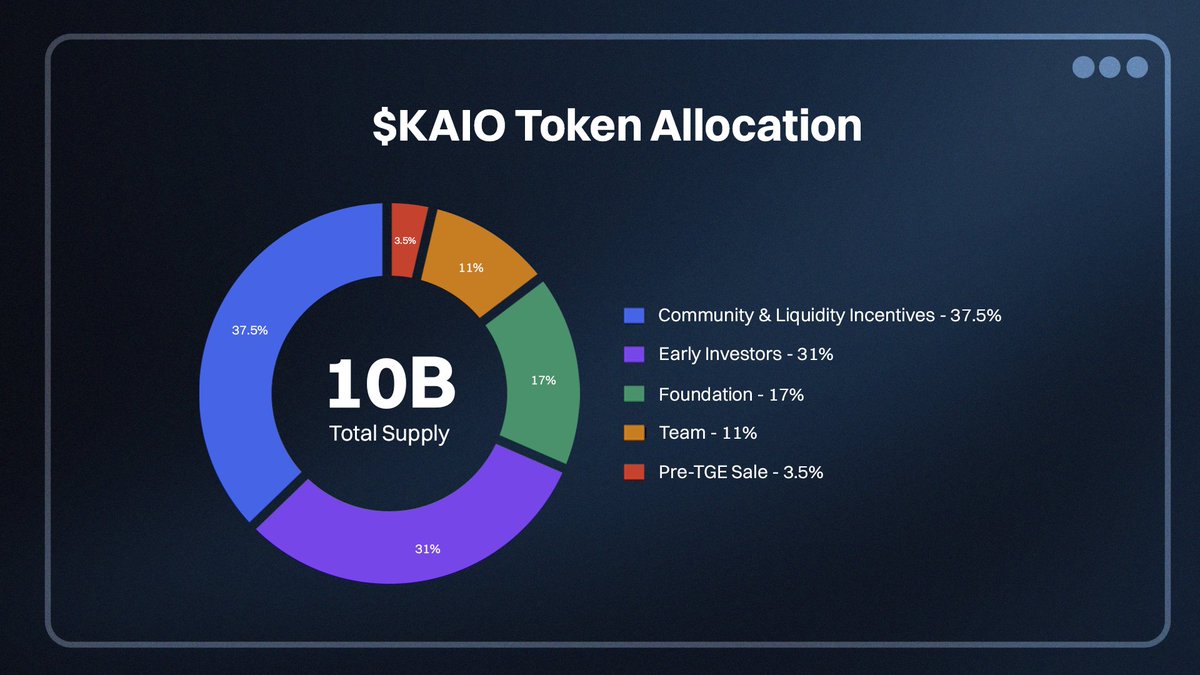
Token Details
-
Token Ticker: KAIO
-
Total Supply: 10,000,000,000 KAIO (fixed supply)
-
Initial Circulating Supply: 633,000,000 KAIO
Token Distribution
-
Community and Liquidity (37.5%): The largest allocation, designed to drive adoption, incentivize participation, and support liquidity across ecosystems. Includes an initial unlock at TGE followed by long-term vesting.
-
Team, Investors, and Pre-TGE Sale (45.5%): Allocated to core contributors and early backers. Subject to a 12-month cliff with gradual unlocking over 24 months to ensure long-term alignment.
-
Foundation (17%): Managed by the KAIO Foundation to support governance, ecosystem development, partnerships, and treasury operations. Includes an initial unlock followed by a structured vesting schedule.
Unlock Schedule
-
Community & Liquidity: 12.5% unlocked at TGE, followed by a 6-month cliff and linear monthly unlock over 60 months.
-
Foundation: 12.5% unlocked at TGE, followed by a 6-month cliff and linear unlock over 36 months.
-
Team & Investors: 0% unlocked at TGE, with a 12-month cliff and linear unlock over 24 months.
Token Utilities
-
Access to Products: KAIO acts as a coordination layer for accessing tokenized investment products and enabling institutions to bring assets on-chain.
-
Governance: Token holders can vote on protocol upgrades, treasury allocations, and key ecosystem decisions.
-
Staking and Rewards: Holders may stake KAIO to earn incentives and increase governance participation as the ecosystem evolves.
-
Ecosystem Growth: The token supports incentives for users, partners, and developers, helping expand adoption of KAIO’s RWA infrastructure.
-
Protocol Traction: As total value locked (TVL) grows, the protocol generates fees from tokenized assets, which may be directed toward ecosystem development through governance decisions.
KAIO’s tokenomics structure emphasizes long-term alignment, gradual distribution, and ecosystem-driven growth. Its design reflects the protocol’s broader goal of building compliant, scalable infrastructure for institutional participation in tokenized real-world assets.
KAIO (KAIO) Goes Live on Bitget
We are thrilled to announce that KAIO (KAIO) will be listed in the RWA zone. Check out the details below:
-
Deposit: Open
-
Trading: Opens on May 6, 2026, 13:00 (UTC)
-
Withdrawal: Opens on May 7,2026, 13:00 (UTC)
-
Spot trading link: KAIO/USDT
Convert: Opens within 10 minutes after trading begins. You can exchange tokens for BTC, ETH, and other tokens supported by Bitget Convert, with no transaction fees.
KAIO (KAIO) to be listed on Bitget Launchpool - Lock BGB, USDGO and KAIO to share 10,000,000 KAIO
Bitget Launchpool will be listing KAIO (KAIO). Eligible users can lock BGB, USDGO and KAIO to share 10,000,000 KAIO.
-
Locking period: May 6, 2026, 13:00 – May 13, 2026, 13:00 (UTC)
-
Locking pool 1 - BGB, USDGO and KAIO: Lock BGB, USDGO and KAIO to share 7,000,000 KAIO
-
Locking pool 2 - USDGO: Lock USDGO to share 2,000,000 KAIO
-
Locking pool 3 - KAIO: Lock KAIO to share 1,000,000 KAIO
Conclusion
KAIO (KAIO) is positioning itself at the intersection of two powerful trends: the rise of real-world asset tokenization and the institutionalization of blockchain finance. Rather than chasing short-term narratives, the protocol focuses on solving a structural problem. Compliance remains one of the biggest barriers preventing large-scale capital from entering DeFi, and KAIO is building the infrastructure to address it directly.
With institutional backing, live tokenized funds, and a cross-chain architecture already in place, KAIO is moving beyond theory into execution. Its success will ultimately depend on adoption and its ability to scale alongside regulatory clarity and market demand. If the tokenized asset market reaches its projected potential, protocols like KAIO could play a defining role in shaping how traditional finance operates in an increasingly on-chain world.
Disclaimer: The opinions expressed in this article are for informational purposes only. This article does not constitute an endorsement of any of the products and services discussed or investment, financial, or trading advice. Qualified professionals should be consulted prior to making financial decisions.


- What Is KAIO (KAIO)?
- Who Created KAIO (KAIO)?
- How KAIO (KAIO) Works
- KAIO (KAIO) Tokenomics
- KAIO (KAIO) Goes Live on Bitget
- KAIO (KAIO) to be listed on Bitget Launchpool - Lock BGB, USDGO and KAIO to share 10,000,000 KAIO
- Conclusion