
Polymarket’s Silent Gold Rush: How Sharp Traders Are Earning Risk-Free Profits

Polymarket’s explosive growth reveals a hidden layer of crypto arbitrage where skilled traders and bots profit from inefficiency, not chance—turning prediction markets into precision engines for liquidity and price discovery.
Sharp traders on Polymarket are securing risk-free gains by exploiting mispriced odds and lightning-fast trades, while most users struggle to keep up. Arbitrage strategies, from sweeping nearly certain outcomes to capturing market imbalances, are quietly driving millions in profit behind the scenes.
Decentralized prediction markets now attract retail and professional money, intensifying the race for hidden profits. Automated bots, well-funded traders, and new yield incentives are shaping a competitive arena where speed and insight are crucial for success.
Polymarket Arbitrage: How Risk-Free Profits Emerge
Few platforms have attracted as much intrigue or profit potential as Polymarket in the decentralized prediction markets.
Polymarket has quietly become a battleground for a new breed of crypto-native arbitrage players exploiting micro-inefficiencies in human sentiment and market timing.
A recent Cornell University research described it as an arbitrage engine, not a casino. Dependent outcome prices on Polymarket can sometimes add up to less than $1, creating a guaranteed profit opportunity.
If an event offers four possible outcomes, say, “interest rate cut,” “no change,” “rate hike,” and “other,” and their combined prices total $0.995, traders can buy one share of each and earn $0.005 when one resolves. That’s a 0.5% risk-free return; while it is tiny, it becomes meaningful at scale.
“Don’t underestimate that 0.5%,” said a veteran Polymarket player known as Fish in an interview with BlockBeats. “If you invest $10,000 and do dozens of these trades daily, the annualized return can be astonishing.”
However, these fleeting inefficiencies, often lasting seconds, are now largely dominated by bots running on Polygon nodes.
These automated systems monitor thousands of markets, instantly executing trades the moment prices fall out of balance. What sounds like a clean arbitrage loop has developed into a high-frequency arms race of latency, coding skill, and on-chain execution speed.
Endgame Sweep: Time for Certainty
Another favorite among seasoned players is the “Endgame Sweep” strategy. It entails buying outcomes that have surged to near certainty, typically priced between $0.95 and $0.99, and waiting for final market resolution.
“The logic is simple: time in exchange for certainty,” said Fish. “When retail investors rush to cash out at $0.997, they leave a few basis points for whales to scoop up.”
Yet even this supposedly safe play carries “black swan” risk. Events that seem settled can suddenly reverse, a misjudged sports call, a last-minute legal challenge, or a scandal upending a political forecast.
Whales can also manipulate sentiment by dumping large orders or seeding misinformation in Polymarket’s own comment section, where traders often post long, emotional analyses.
Arbitrage as Market-Making
Ultimately, these profit loops are not just parasitic. Rather, they perform a function similar to market-making. Arbitrageurs rebalance odds, tighten spreads, and improve liquidity.
“From this perspective, Polymarket can actually be considered very friendly to market makers,” Fish noted, estimating that liquidity providers earned more than $20 million in the past year alone.
As Polymarket continues to expand, with a 4% yield program for the 2028 US election market and speculation of a future IPO or token airdrop, the game is only getting bigger. Each new market brings more liquidity, more inefficiency, and more arbitrage space.
Still, the playing field is steeply tilted. Data from BlockBeats shows that only 0.51% of users have profits above $1,000, and just 1.74% trade over $50,000 in volume.
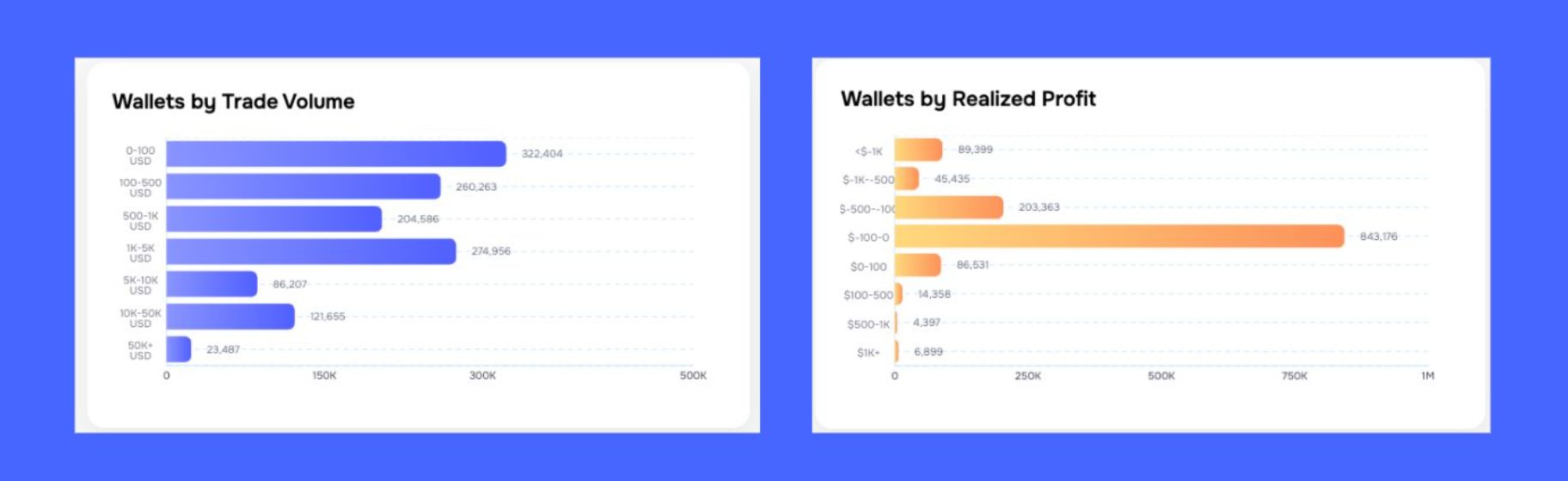 Polymarket User Trading Volume and Realized Profits. Source:
DidiTrading on X
Polymarket User Trading Volume and Realized Profits. Source:
DidiTrading on X
Most traders lose money, while a silent minority scripts, monitors, and sweeps their way to quiet, consistent returns.
“Arbitrage on Polymarket isn’t gambling, it’s engineering. You’re not betting on outcomes. You’re betting on inefficiency itself,” wrote Jeremy Whittaker on Medium.
Disclaimer: The content of this article solely reflects the author's opinion and does not represent the platform in any capacity. This article is not intended to serve as a reference for making investment decisions.
You may also like
The Value of Including CFTC-Approved Clean Energy Marketplaces in Contemporary Investment Portfolios
- CFTC-approved clean energy platforms like CleanTrade enable institutional investors to hedge risks, diversify portfolios, and align with ESG goals through renewable energy derivatives. - CleanTrade's $16B in two-month notional value highlights urgent demand for scalable, transparent infrastructure to access low-carbon assets with real-time analytics and risk tools. - These platforms reduce market fragmentation by standardizing VPPAs, PPAs, and RECs, offering verifiable decarbonization pathways and dynami

The Influence of Educational Institutions on the Development of AI-Powered Industries
- Farmingdale State College (FSC) invests $75M in AI infrastructure , doubling tech enrollment and launching an AI Management degree blending technical and business skills. - Industry partnerships with Tesla and cybersecurity firms, plus 80% graduate employment rates, highlight FSC's success in aligning education with AI-driven workforce demands. - FSC's RAM mentorship program and NSF-funded AI ethics research foster interdisciplinary innovation, addressing supply chain and healthcare challenges through ap

Academic Programs Driving Growth in Green Energy Jobs and Investments Across the U.S.
- U.S. academic institutions drive renewable energy innovation through interdisciplinary programs and workforce training. - Policy frameworks like the Inflation Reduction Act (IRA) boost investments and job growth in solar, wind, and storage sectors. - Collaborations with industry and government address skills gaps, but workforce shortages and hybrid role demands persist. - Academic research influences green energy investments, though policy shifts risk project funding. - Case studies highlight universitie
The Emergence of MMT Token TGE and Its Impact on Institutional Embrace of Blockchain
- Momentum Finance's MMT token TGE on November 4, 2025, unlocked 20.41% of its supply, driving an 885% price surge to $0.8859 within hours due to a 376x oversubscribed Binance Prime Sale. - Institutional backing, including a $10M HashKey Capital investment and U.S. digital asset reserve inclusion, validated MMT's governance and incentive utility for its CLMM decentralized exchange. - MMT outperformed Solana and Ethereum in 2025 with rapid liquidity and regulatory clarity, leveraging deflationary tokenomics

Trending news
MoreCrypto prices
More





