Google is committing $15 billion to establish a 1-gigawatt data center and artificial intelligence hub in India, at a time when the Indian government is encouraging reduced dependence on American technology companies.
On Tuesday, Google revealed plans to construct the data center in Visakhapatnam, a port city in the southern state of Andhra Pradesh. The company stated that the investment will be made over the next five years, through 2030. This initiative represents Google’s most significant financial commitment to India to date, following its initial $10 billion pledge to the country in 2020.
A few weeks after President Donald Trump introduced a 50% tariff on goods from India in August, Prime Minister Narendra Modi began advocating for the use of “swadeshi” (meaning “made in India”) products. In response, Indian officials and ministries started promoting domestic alternatives to Google, such as Zoho Corporation from Chennai, which provides services competing with Google Cloud and Gmail, and more recently, Arattai, a messaging app rivaling WhatsApp, as well as MapMyIndia, a competitor to Google Maps. Although the immediate effects have been modest, these efforts could eventually create significant political challenges for companies like Google and Microsoft operating in India.
Google employs 14,000 people in India and has maintained a presence in the country for 21 years. Delhi and Mumbai are also recognized as official cloud regions by the company.
According to Google Cloud CEO Thomas Kurian, the new AI hub in India will be Google’s largest investment outside the United States, and it is expected to expand to “multiple gigawatts” in the future.
“This is part of a worldwide network of AI centers spanning 12 countries,” Kurian stated during the AI hub’s inauguration in New Delhi. “Additionally, we are excited to announce that Vishakhapatnam will become a global connectivity hub.”
Google also shared its intention to extend its undersea cable infrastructure to Visakhapatnam. The American tech company is collaborating with Indian telecom giant Bharti Airtel to develop both the data center and the cable landing station in the city. Furthermore, Google is working with AdaniConneX, supported by the Adani Group, to build the necessary infrastructure for the data center.
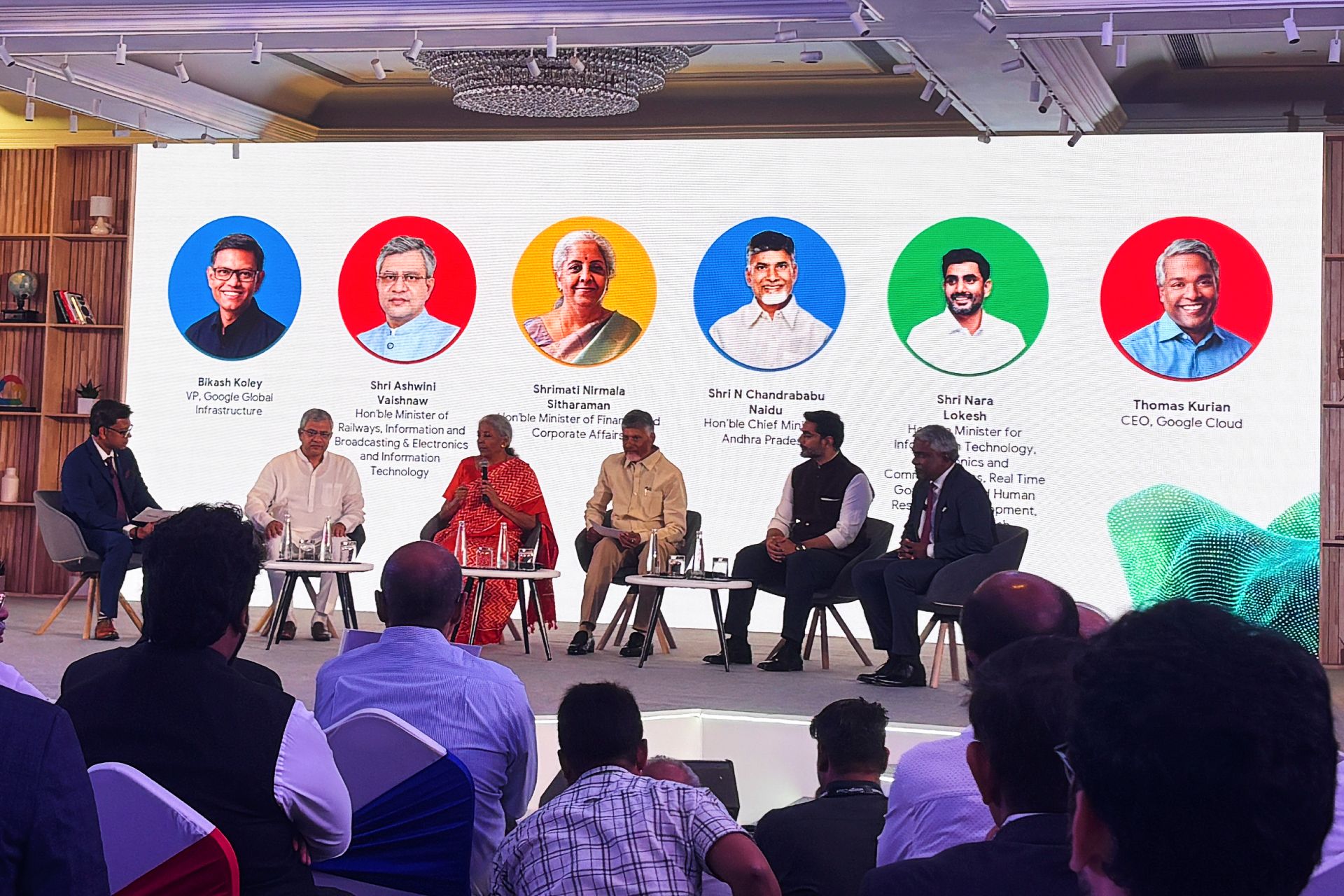 Google launches its AI hub in India alongside Indian government officials
Image Credits:Jagmeet Singh / TechCrunch
Google launches its AI hub in India alongside Indian government officials
Image Credits:Jagmeet Singh / TechCrunch
“We envision this site not only as a landing point for numerous cables, but also as a digital backbone that will connect various regions across India,” Kurian remarked.
Google mentioned that the AI hub will provide a “comprehensive suite of solutions,” featuring its proprietary Tensor Processing Units (TPUs) to support local AI computation.
The company, headquartered in Mountain View, will also make its AI models — including Gemini — and its development platform for agents and applications available. The hub will further enhance consumer offerings such as Google Search, YouTube, Gmail, and Google Ads.
“We anticipate this hub will not only serve India, but also extend its reach to Asia and other global regions,” Kurian added.
Google’s selection of Visakhapatnam in Andhra Pradesh is expected. The southern state, led by Chief Minister N. Chandrababu Naidu, has previously attracted international tech companies like Oracle and Microsoft to establish operations in Hyderabad, which was Andhra Pradesh’s capital before Telangana was formed. Naidu, a significant political ally who supported Prime Minister Modi’s re-election, has played a crucial role in shaping national policy debates.
“This AI hub will make a vital contribution to the goals of India’s AI mission in several respects,” commented Indian IT minister Ashwini Vaishnaw.
The minister encouraged Google to consider the Andaman Islands as a future major hub for global internet data transfer, pointing out that Singapore is “overburdened,” and promised full government backing. He also suggested connecting Visakhapatnam with Sittwe in Myanmar to enhance connectivity for India’s northeastern regions.