
Polymarket Cracks Down on Airdrop Farmers Ahead of Token Launch

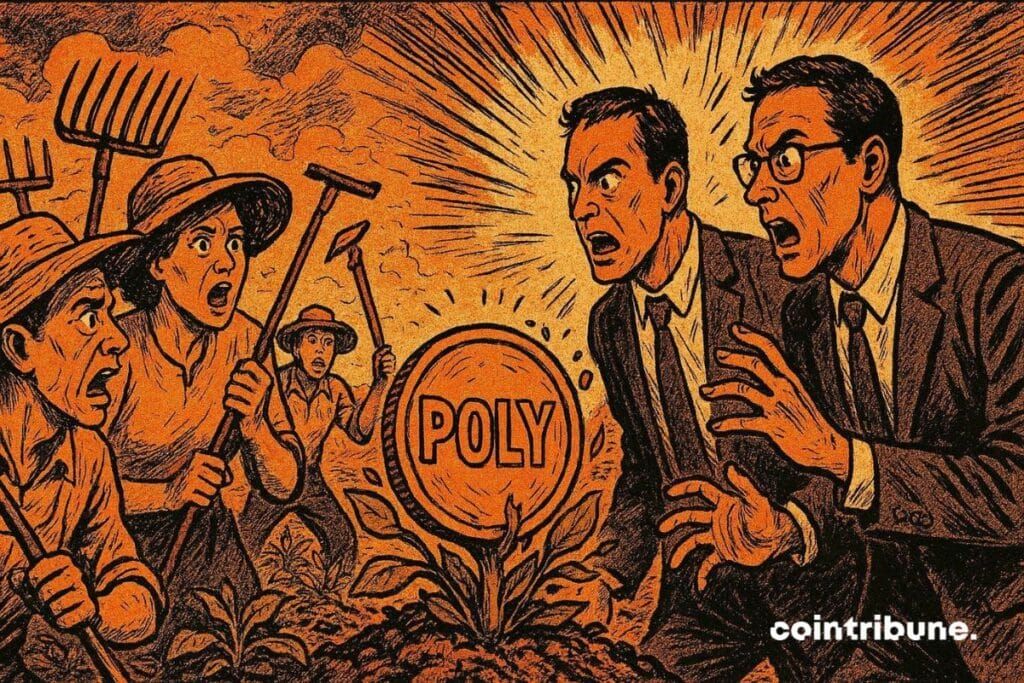
As the highly anticipated launch of its POLY token approaches, Polymarket sees its users redoubling their ingenuity to maximize their chances of getting a slice of the pie. Between sophisticated farming techniques and challenges for the platform, the crypto ecosystem is witnessing a new battle.
In brief
- Polymarket farmers are sophisticating their techniques to maximize their gains before the launch of the POLY token scheduled for 2026.
- Polymarket must innovate to distinguish real users from speculators, under penalty of controversies.
- POLY/ETH comparison: two opposing distribution models, with major implications for the future of crypto airdrops.
Polymarket facing the influx of farmers: a cat-and-mouse game that intensifies
Since 2024, Polymarket has been in the spotlight. The rapidly expanding prediction platform is actively developing its POLY token, scheduled for 2026. This prospect has triggered a rush towards crypto airdrops, those free token distributions aimed at rewarding the most active users.
Last year, farming techniques were still rudimentary: users made round trips on the same positions to artificially inflate their trading volumes. These practices, easy to spot, ended up saturating feeds and harming the experience of legitimate traders. In 2025, the landscape changed. Polymarket farmers have refined their methods , making their activities far more discreet.
Influential figures like Fhantom Bets and CSP Trading, experienced traders on Polymarket, confirm this evolution. According to them, obvious wash trading patterns have almost disappeared, replaced by subtler strategies. Users now optimize their activity to resemble ordinary crypto traders while maximizing their chances to be among the airdrop beneficiaries.
Crypto: a token in the crosshairs — Can Polymarket win the game?
Polymarket’s timeline is clear: the POLY token should not see the light of day before 2026. The platform first wants to consolidate its position in the United States, a strategic market after years of absence. This wait has not discouraged crypto farmers, quite the opposite. It simply pushed the platform to double down on vigilance.
The challenge is huge. Polymarket must identify real users among a crowd of increasingly organized farmers. Traditional detection methods, like spotting suspicious volumes, are no longer enough. The platform must innovate to preserve the fairness of its reward system without discouraging legitimate engagement from its crypto users.
A paradox emerges: the more farmers perfect their techniques, the more Polymarket must refine its detection tools. This technological arms race could well define the platform’s future. If it fails to separate the wheat from the chaff, the launch of POLY risks being marred by controversies, as has happened with other crypto projects.
POLY vs ETH: two opposing visions of token distribution
Ethereum made crypto history in 2014 with a successful token sale, without resorting to airdrops. ETH tokens were distributed via a public sale, reserving 60% of the funds for the foundation and early contributors. This approach allowed Ethereum to build a solid community focused on network utility:
- Smart contracts;
- DeFi;
- NFT.
Today, Ethereum is a safe bet, despite criticism on initial centralization.
Polymarket, on the other hand, is betting on an airdrop to reward its most active users. A risky strategy because it inevitably attracts farmers willing to do anything to maximize their gains. The challenge for POLY will be to prove its utility beyond speculation. Without clear governance or concrete advantages (fee reductions, access to exclusive features), the crypto token could struggle to establish itself.
The upcoming introduction of the POLY token promises to be a pivotal moment for Polymarket, which also wants to launch its own stablecoin . Between the ingenuity of farmers and the platform’s challenges, finding balance will be difficult. One thing is certain: if POLY wants to endure, it will have to offer much more than just a speculative reward. And you, do you think airdrops remain an effective tool for building crypto communities?
Disclaimer: The content of this article solely reflects the author's opinion and does not represent the platform in any capacity. This article is not intended to serve as a reference for making investment decisions.
You may also like
Zcash Halving: What It Means for Cryptocurrency Investors in 2025
- Zcash's 2028 halving will reduce annual inflation to 1%, reinforcing its deflationary model after prior 50% block reward cuts in 2020 and 2024. - The 2024 halving triggered 1,172% price surge followed by 96% drop, highlighting volatility risks despite growing institutional investments like Grayscale's $137M Zcash Trust. - Privacy-focused hybrid model (shielded/transparent transactions) attracts institutional interest but faces EU MiCA regulatory scrutiny, requiring selective compliance strategies. - Inve
CleanTrade and the Evolution of Clean Energy Markets: Market Fluidity, Openness, and the Role of the CFTC
- CleanTrade, a CFTC-approved SEF, transforms clean energy markets by integrating VPPAs, PPAs, and RECs under institutional-grade transparency. - The platform unlocks liquidity through real-time pricing and centralized trading, accelerating net-zero transitions for corporations and utilities . - Enhanced transparency via project-specific REC data combats greenwashing, while regulatory alignment boosts investor confidence and market legitimacy. - By bridging traditional and renewable energy markets, CleanTr

The CFTC-Authorized Clean Energy Marketplace: An Innovative Gateway for Institutional Investors
- REsurety’s CleanTrade platform, CFTC-approved as a SEF, addresses clean energy market illiquidity and opacity by centralizing VPPAs, PPAs, and RECs. - Within two months of its 2025 launch, it attracted $16B in notional value, enabling institutional investors to streamline transactions and reduce counterparty risk. - By aggregating market data and automating compliance, CleanTrade enhances transparency, aligning with ESG priorities and regulatory certainty for institutional portfolios. - It democratizes a

SOL Drops 50%: Is This a Healthy Market Adjustment or the Onset of a Major Sell-Off?
- Solana's 50% price drop sparks debate over whether it signals a bear market correction or deeper structural selloff. - On-chain metrics show liquidity contraction and reduced exchange supply, but ETF inflows and validator activity suggest structural resilience. - Corporate transfers and the Upbit hack highlight volatility risks, while Solana's alignment with Bitcoin's trend underscores macroeconomic influence. - Key watchpoints include liquidity recovery timelines, ETF inflow sustainability, and potentia
Trending news
MoreCrypto prices
More





