
Virtuals Robotics: Why Did We Enter the Embodied Intelligence Field?

Digital intelligence acquires entity, where thought and action converge in the realm of robotics.
Original Title: Introducing Virtual Robotics.
Original Author: Virtuals Protocol
Original Translation: DeepTech TechFlow
Since its inception, Virtuals' core goal has always been to build a society of AI agents—a network where agents can collaborate, transact, and create value.
· Through ACP, we have achieved business transactions between agents.
· Through Butler, we have built a collaboration bridge between humans and agents.
· Through Unicorn, we have addressed the capitalization issue for agents.
Each layer is expanding the boundaries of digital intelligence. And now, this network extends into the physical world through robotics, where intelligence has taken on a tangible presence, and action has become tangible.
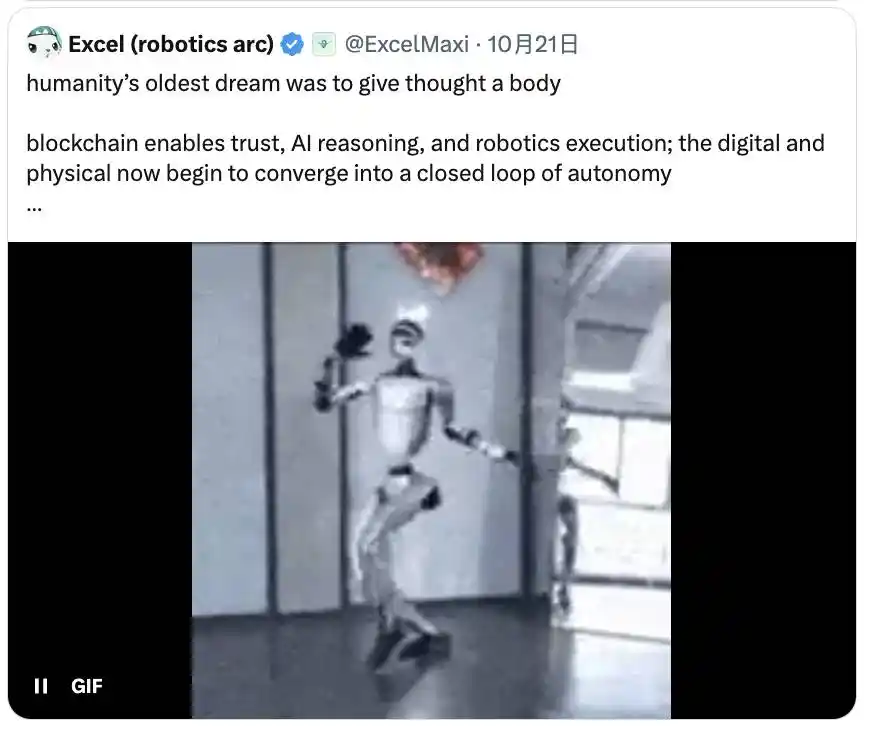
Artificial intelligence has automated reasoning, blockchain has empowered large-scale collaboration, and robotics has approached physical execution.
These three forces together form a closed loop, constructing a self-sustaining system where thoughts, actions, and transactions can autonomously propagate.
This fusion defines Agentic GDP (aGDP), the total output generated by the collaboration of humans, agents, and machines in the digital and physical domains.

Our exploration of robotics began within our internal venture capital division, investing in cutting-edge teams at the intersection of perception, control, and automation. These early experiments revealed the two core bottlenecks limiting the materialization of agents:
· Data: Without rich spatial datasets, embodied AI cannot learn to perceive or act effectively.
· Capital: Without scalable funding mechanisms, innovation in robotics will remain slow and fragmented.
Addressing these two issues is key to accelerating the development of physical intelligence.
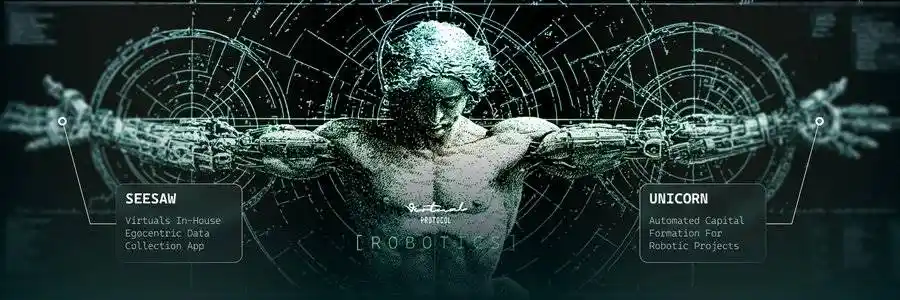
Virtuals have chosen a "Middle Way" strategy to tackle the challenges of robotics.
We are not directly involved in hardware or model development, but instead focus on the invisible yet pivotal levers, building data and capital infrastructure that supports the ecosystem.
· Through SeeSaw: We have introduced a self-centric data platform that redefines how the world is captured and learned, enabling robots to "see" and understand space through human-recorded experiences.
· Through Unicorn: We have reimagined the funding mechanism for cutting-edge technologies.
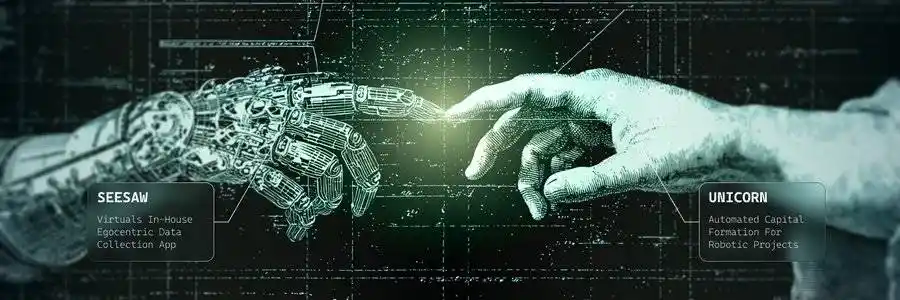
With the integration of these systems, Virtuals have evolved from a digital agent platform into a full-stack intelligent engine.
If the past decade was defined by information technology, the next decade will be defined by materialization, representing a moment where ideas take on physical form.
Through robotic technology, the agent's internet extends into the physical world, completing the loop between intelligence, collaboration, and existence.

Disclaimer: The content of this article solely reflects the author's opinion and does not represent the platform in any capacity. This article is not intended to serve as a reference for making investment decisions.
You may also like
Renewable Energy Learning: An Unseen Driver of Expansion in 2025
- 2025 wind energy education programs are critical for addressing a 100,000-technician labor gap and advancing green infrastructure. - Institutions like STL USA and NREL integrate AI analytics, blade recycling, and hands-on turbine training to meet industry demands. - Industry partnerships with OEMs and $36M+ in federal funding accelerate workforce development but face policy risks from DOI land-use restrictions. - Global clean energy investment reached $2.1T in 2024, with U.S. renewables accounting for 93
Investing in EdTech and Skills Training to Empower Tomorrow's Workforce
- Global high-growth sectors like AI, renewables, and biotech are reshaping workforce demands, driving rapid STEM education evolution through edtech and vocational training. - AI-powered adaptive learning and immersive VR/AR tools now personalize education, with 36% of 2024 edtech funding directed toward workforce-specific skill development. - Vocational programs and industry partnerships (e.g., U.S. EC4A, EU Green Deal) are closing STEM skills gaps, creating direct pipelines to 16.2M+ clean energy jobs by
The Rising Influence of EdTech on Career-Focused Investment Prospects
- Global EdTech market grows at 20.5% CAGR to $790B by 2034, driven by STEM/digital skills demand. - STEM workers earn 45% higher wages; 10.4% occupation growth vs 4.0% non-STEM, reshaping labor markets. - 2025 EdTech VC investments show 35% YoY decline, concentrating on AI tools and scalable upskilling platforms. - MENA/South Asia EdTech sees 169% funding growth, addressing equity gaps through global platforms. - AI-driven EdTech and M&A activity (e.g., ETS-Ribbon) highlight sector's shift toward outcome-
KITE Price Forecast Following Listing: Managing Post-IPO Fluctuations and Institutional Investor Outlook
- Kite Realty Group (KITE) fell 63% post-IPO despite strong retail occupancy and NOI growth, highlighting valuation disconnect between real estate fundamentals and tech IPO expectations. - Institutional sentiment split: COHEN & STEERS boosted holdings by 190% amid industrial pivot, while others divested $18. 3M , reflecting uncertainty over hybrid retail-industrial strategy execution. - Analysts remain divided on $24–$30 price targets, balancing KITE's 7.4% dividend increase and industrial shift against ma

Trending news
MoreCrypto prices
More





