
Bitcoin News Update: Tether's CEO Challenges S&P's Rating Cut: Innovation Faces Off Against Conventional Finance
- Tether CEO Paolo Ardoino criticized S&P's USDT downgrade, claiming the agency misunderstands its financial model and traditional finance resists innovation. - S&P cited USDT's 5.6% Bitcoin exposure (exceeding its 3.9% buffer) and insufficient reserve transparency as risks to stability, warning of undercollateralization during asset declines. - Tether defends its $181.2B reserves and zero "toxic" assets, while critics highlight a 3.7% equity cushion and potential insolvency if Bitcoin/gold drop 30%. - Chi
Tether CEO Responds to S&P Global Ratings' Downgrade
Paolo Ardoino, CEO of Tether, has strongly criticized S&P Global Ratings following their recent decision to lower the stablecoin's rating. Ardoino accused the agency of misinterpreting Tether's financial structure and suggested that the traditional financial sector is resistant to innovative approaches. S&P's downgrade, which assigned USDT a "weak" stability rating on a five-level scale, was attributed to the company's growing investments in riskier assets such as Bitcoin and gold, as well as concerns over the transparency of its reserve management.
S&P highlighted that Bitcoin now makes up 5.6% of USDT's total supply, surpassing the 3.9% overcollateralization margin. The agency warned that significant drops in the value of Bitcoin or other volatile holdings could leave USDT undercollateralized.
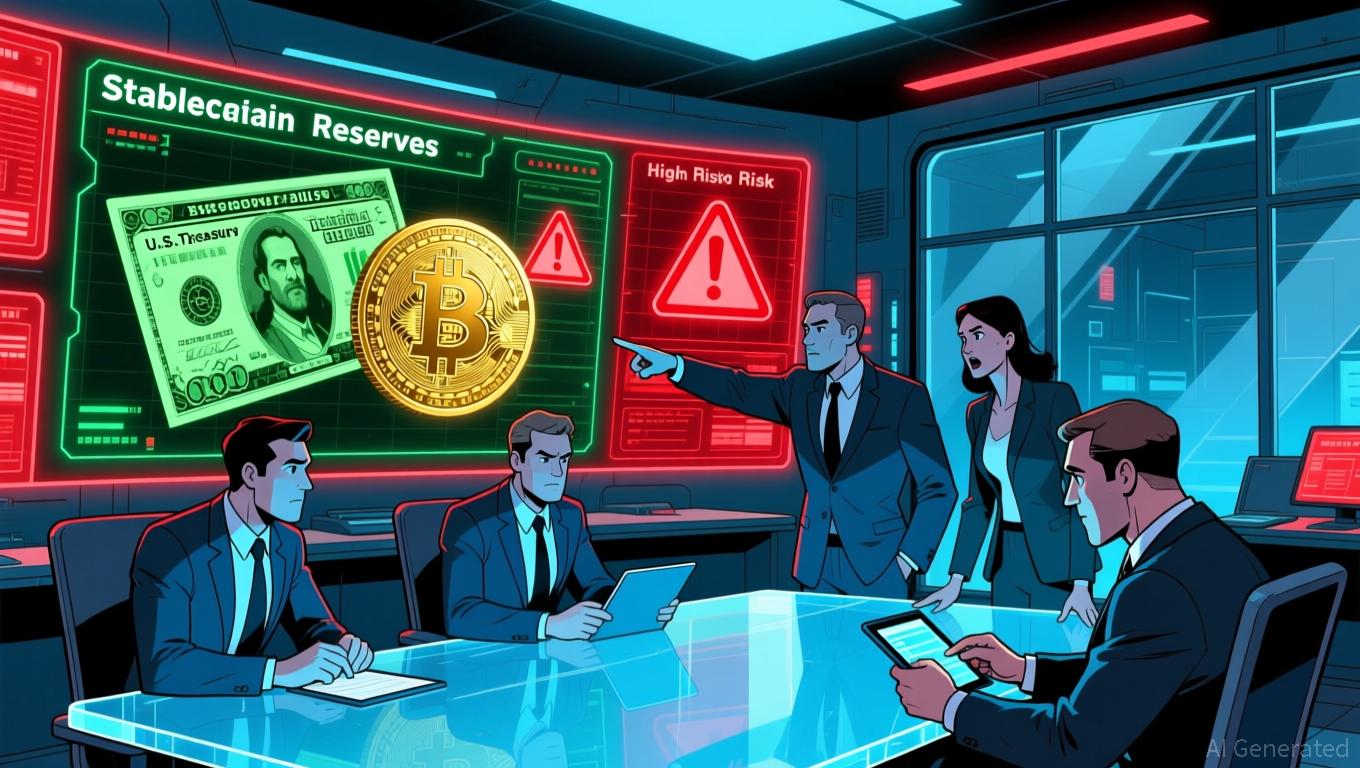
Ardoino dismissed these criticisms as part of a broader reluctance from established financial institutions to accept new financial models, describing the traditional system as "broken." He emphasized that Tether is "overcapitalized" and holds no risky assets in its reserves. Tether claims to back its $184.4 billion in liabilities with $181.2 billion in reserves and has released independent quarterly attestations since 2021, asserting that it has always honored redemption requests, as verified by external audits.
Concerns Over Reserve Strategy
The downgrade has brought renewed attention to Tether's reserve management, especially its increased allocation to Bitcoin and gold. Arthur Hayes, co-founder of BitMEX, cautioned in a recent post that a 30% decline in these assets could eliminate Tether's equity and potentially render USDT insolvent. According to Tether's third-quarter 2025 report, the company holds $12.9 billion in gold and $9.9 billion in Bitcoin as part of a strategy to hedge against possible interest rate cuts by the Federal Reserve. While Tether also maintains $112.4 billion in U.S. Treasury bills and $21 billion in repo agreements, Hayes pointed out that the company's equity buffer—estimated at just 3.7% of assets—may not be sufficient to withstand severe market downturns.
Industry Reactions and Defenses
Many in the industry have challenged these warnings. Tran Hung, CEO of UQUID Card, highlighted that Tether's reserves are primarily held in highly liquid, low-risk assets, with more than $140 billion in cash equivalents available to meet redemption requests, even during crises. Former Citi analyst Joseph noted that Tether earns $10 billion annually in interest from its Treasury holdings and may have a corporate equity buffer exceeding $50 billion. He argued that Tether's liquidity position is more conservative than that of traditional banks, which typically operate with only 5-15% liquidity, and that the company could recapitalize if necessary.
Impact in China and Market Sentiment
The downgrade has sparked a range of reactions in China, where USDT is widely used for underground cryptocurrency trading. Despite the 2021 ban, over 20 million users rely on USDT to access digital assets. Some traders dismissed the S&P downgrade as an overreaction, referencing USDT's stability during previous crises, while others voiced concerns about potential systemic risks if the token were to lose its peg.
Calls for Greater Transparency
Looking forward, Tether is under increasing pressure to enhance transparency, particularly regarding its custodians and counterparties. S&P has urged the company to reduce its exposure to high-risk assets and provide clearer disclosures. Regulators worldwide are also moving toward stricter oversight of stablecoin reserves. Despite these challenges, Ardoino remains steadfast, arguing that traditional rating agencies have repeatedly failed to foresee financial crises and asserting that Tether is "the first overcapitalized company in the financial sector."
Disclaimer: The content of this article solely reflects the author's opinion and does not represent the platform in any capacity. This article is not intended to serve as a reference for making investment decisions.
You may also like
Bitcoin News Today: Has Bitcoin's Drop to $87K Signaled a Temporary Pullback or the Onset of a More Significant Decline?
- Bitcoin fell below $87,000 amid ETF outflows, whale selling, and macroeconomic pressures, marking its largest correction since spot ETFs launched. - Institutional withdrawals, including $151M in ETF outflows and BlackRock's $2.47B IBIT losses, reflect waning confidence and profit-taking amid tightening monetary policies. - On-chain data shows mixed signals: mid-sized wallets accumulate Bitcoin while whales offload, while regulatory uncertainties in the U.S. and EU amplify selling pressure. - Technical in
Stellar News Update: Technology-Fueled Commodity Markets Grow Through Stellar and Abaxx Collaboration
- Stellar Trading Systems partners with Abaxx Exchange to expand global commodity trading access via Singapore-based USD gold futures. - Intralot S.A. reports EUR 548M revenue in Q3 2025 but faces UK 40% remote gaming tax hike threatening pro forma EUR 1B revenue goals. - Strive Asset Management and Polymarket advance crypto adoption through institutional BTC treasury models and CFTC-approved prediction markets. - Market developments highlight evolving interplay between digitized commodity infrastructure a
Bitcoin News Update: Bitcoin's Value Drops in Parallel with Declining Political Clout of Trump
- Bitcoin maintains market dominance with Altcoin Season Index at 24, indicating most altcoins lag behind. - Bitcoin’s price decline correlates with waning Trump support, as highlighted by economist Paul Krugman. - BlackRock’s IBIT ETF sees $3.2B unrealized gains as Bitcoin rebounds to $90,000. - Technical indicators show mixed near-term prospects, while a few altcoins like Aster surged over 1,200%. - Analysts suggest regulatory clarity or tech breakthroughs could trigger next altcoin season after prolonge

XRP News Today: Is the $2.25 Barrier for XRP the Gateway to a Bullish Surge or a Signal for a Bearish Turn?
- XRP stabilized near $2.226 support, showing ETF-driven demand and improved technical indicators amid market rotation. - A $2.25 breakout is critical for confirming an upward trend, with failure risking a retest of $2.15 support. - Broader crypto-USD rotation and Bitcoin halving anticipation create favorable conditions but remain sensitive to equity market shifts. - Traders must monitor $2.25 resistance and maintain tight risk management as ETF inflows and macroeconomic factors shape near-term volatility.

Trending news
MoreCrypto prices
More





