
PENGU USDT Sell Alert and Its Impact on the Stablecoin Market
- PENGU USDT's 2025 depegging to $0.715 and $66.6M team withdrawals exposed systemic risks in algorithmic stablecoins. - Cascading failures in Ethena USDe and Staked Stream USD revealed liquidity crises exacerbated by smart contract flaws and macroeconomic shocks. - The U.S. GENIUS Act mandated 1:1 fiat backing for stablecoins, accelerating market shift toward compliant fiat-backed alternatives like USDC . - Investors now prioritize stablecoins with transparent reserves and robust governance amid regulator
Algorithmic Stablecoins Under Scrutiny: The PENGU USDT Sell-Off and DeFi’s Structural Weaknesses
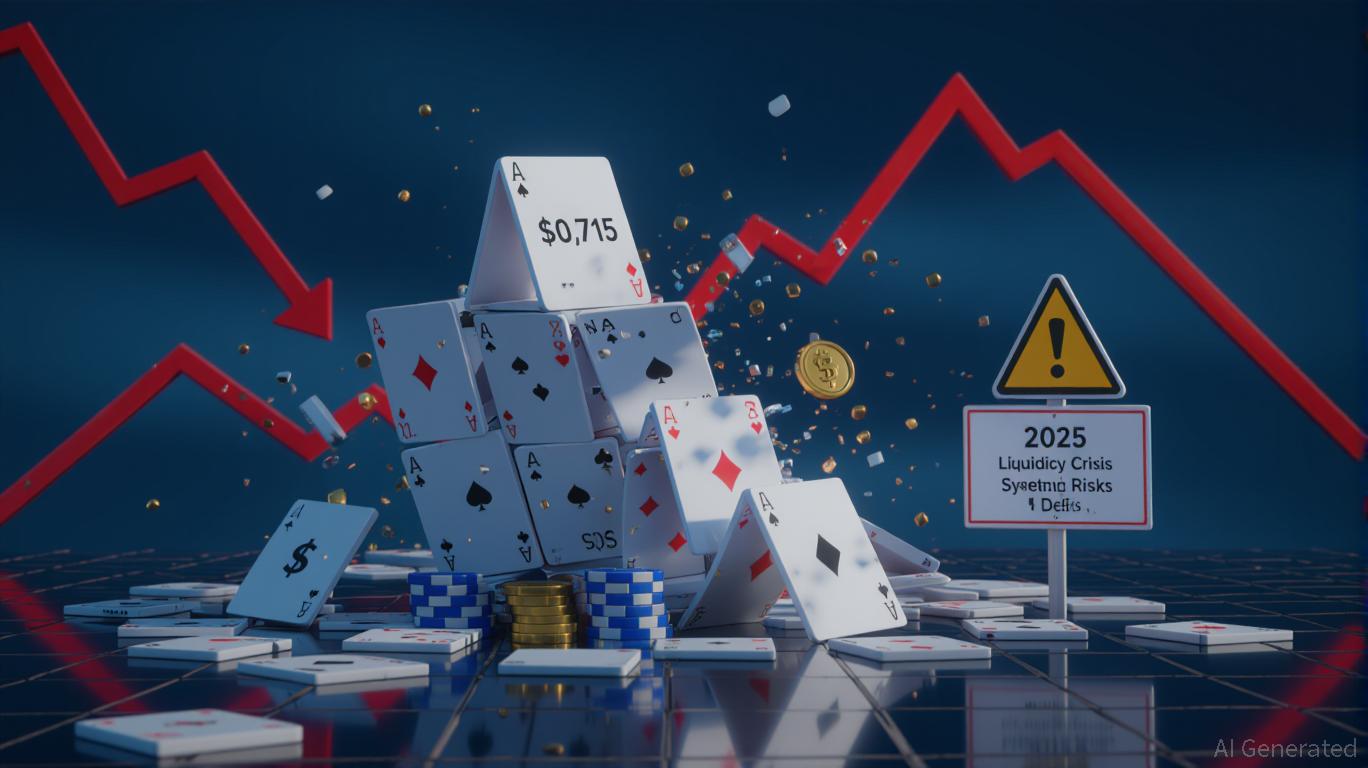
Recent market activity surrounding PENGU USDT has reignited concerns about the stability of algorithmic stablecoins within the decentralized finance (DeFi) ecosystem. As the broader crypto market faces a liquidity crunch in 2025, PENGU USDT’s sharp drop to $0.715 and the subsequent $66.6 million withdrawal from team-controlled wallets have highlighted deep-rooted flaws in algorithmic models. These developments, alongside failures in protocols such as Ethena USDe and Staked Stream USD, have intensified calls to reassess risk management strategies for DeFi stablecoins.
The 2025 DeFi Stablecoin Crisis: Volatility and Liquidity Challenges
The third quarter of 2025 proved pivotal for algorithmic stablecoins, with PENGU USDT’s instability reflecting a broader sector-wide unraveling. Multiple stablecoins lost their dollar pegs during this period. For example, Ethena USDe briefly plunged to $0.65 in October 2025 amid escalating U.S.-China trade tensions, demonstrating how external economic shocks can undermine algorithmic stability.
These stablecoins depend heavily on market trust and finely tuned algorithms. When confidence wanes, it often triggers a cascade of sell-offs that existing stabilization mechanisms cannot contain. Technical vulnerabilities further aggravated the crisis—smart contract bugs and oracle errors, such as those seen during a $60 million USDe sell-off, led to erroneous liquidations and heightened volatility. The interconnected nature of DeFi platforms amplified these risks, as lenders on protocols like Aave and Morpho, who used stablecoins for leveraged trades, faced forced liquidations during market downturns, further destabilizing pegs. This scenario echoed the 2023 USDC depegging, which was partly attributed to exposure to the collapse of Silicon Valley Bank.
Risk Management Failures: Technical and Cross-Chain Vulnerabilities
PENGU USDT’s liquidity crisis exposed significant shortcomings in its risk mitigation framework. Throughout 2025 and 2026, the token’s cross-chain features failed to contain systemic threats. The depegging event to $0.715 prompted massive withdrawals from team wallets, eroding user trust and deepening the liquidity shortfall.
While cross-chain solutions are designed to expand access, they also introduce new risks, including bridge exploits and unclear governance. Smart contract issues further destabilized the system, as the Q3 2025 sell-offs revealed PENGU USDT’s dependence on an opaque collateral structure that could not withstand market pressure. Experts advocate for overcollateralization and real-time risk monitoring, but many DeFi projects lack the necessary infrastructure. Hybrid approaches that blend blockchain technology with traditional finance—such as those proposed for trade finance—could enhance risk management, though adoption remains limited.
Regulatory Developments: The GENIUS Act’s Impact
The U.S. GENIUS Act, passed in July 2025, marked a significant regulatory intervention targeting stablecoin risks. The law requires payment stablecoins to maintain full backing with high-quality liquid assets and undergo monthly audits, aiming to rebuild public trust. However, algorithmic stablecoins are excluded from these regulations, leaving them in a regulatory gray zone. This gap has accelerated the migration toward fiat-backed alternatives like USDC and EURe, which now dominate compliant markets.
The Act also introduces executive accountability, mandating that CEOs and CFOs certify reserve reports—a move reminiscent of Sarbanes-Oxley requirements. The effectiveness of these measures, however, depends on rigorous enforcement. Meanwhile, the Basel Committee’s ongoing review of crypto prudential standards could pave the way for broader institutional participation, provided that risk controls are robust. Smaller protocols, lacking adequate infrastructure for overcollateralization and real-time oversight, remain particularly exposed.
Investor Considerations and the Road Ahead
The recent sell signal for PENGU USDT serves as a stark warning for investors. The token’s 12% price drop in early December 2025 underscored its vulnerability to both macroeconomic turbulence and evolving regulatory landscapes. While collaborations with platforms like Bitso and cross-chain integrations with Ethereum offer some hope for recovery, long-term success hinges on addressing technical and governance shortcomings.
The market is increasingly favoring fiat-backed stablecoins and central bank digital currencies (CBDCs), which provide greater transparency and regulatory compliance. Nonetheless, stablecoins that pay interest remain in a legal gray area, raising concerns about potential disruptions to traditional banking. Investors should also keep a close eye on Bitcoin’s performance and global economic trends, as these will influence PENGU’s future prospects.
Conclusion
The PENGU USDT sell-off encapsulates the systemic risks facing DeFi. Algorithmic instability, liquidity shortages, and opaque governance structures have exposed the fragility of current stablecoin models, even as new regulations like the GENIUS Act attempt to bring order to the sector. For investors, the key takeaway is to prioritize stablecoins with transparent reserves, secure smart contracts, and strong regulatory oversight. As DeFi continues to evolve, the balance between innovation and regulation will determine whether the sector can deliver on its promise of financial inclusion without repeating past mistakes.
Disclaimer: The content of this article solely reflects the author's opinion and does not represent the platform in any capacity. This article is not intended to serve as a reference for making investment decisions.
You may also like
Ethereum Activates Fusaka as First Automated BPO Fork Set for Dec 9
Quick Take Summary is AI generated, newsroom reviewed. The Fusaka upgrade activated smoothly on the Ethereum mainnet, despite a brief, quickly patched participation drop among Prysm client validators. The first automated Blob Parameter-Only (BPO) hard fork is scheduled for December 9 to allow for more efficient, non-manual tuning of data availability parameters. Developers rejected 14 EIPs for the next major upgrade, Glamsterdam, narrowing the scope to favor five core EIPs to lower technical risk. The cont
BlackRock Sees Major ETF Exits as Investors Dump BTC and ETH Holdings
Quick Take Summary is AI generated, newsroom reviewed. BlackRock investors pulled $107.7M from BTC and ETH ETFs. Rising crypto ETF outflows sparked market-wide discussions. Institutional crypto flows signaled caution among major investors. Heavy BlackRock ETF withdrawals shaped short-term market sentiment.References 🚨 BIG ETF SELL-OFF BlackRock investors just dumped $32.5M $BTC ETF and $75.2M $ETH ETF.
MIRO and Aether Network Join Forces to Transform Web3 Payments and Blockchain Infrastructure
Ethereum Price Signals Bearish Reversal as 1K–10K ETH Wallets Keep Selling
Trending news
MoreCrypto prices
More





