
The Influence of Vitalik Buterin's Support for ZKsync on the Advancement of Scalable Blockchain Technologies: Evaluating the Prospects for Long-Term Investment in Pr
- Vitalik Buterin's 2025 endorsement of ZKsync accelerated its rise as a scalable Ethereum Layer-2 solution with 30,000 TPS and $3.3B TVL. - ZKsync's EVM compatibility and institutional partnerships contrast with StarkNet's quantum-resistant STARK proofs and Aztec's privacy-first architecture. - Analysts project ZK token prices at $0.40–$0.60 by 2025, while StarkNet faces adoption barriers and Aztec navigates regulatory challenges in privacy-focused DeFi. - The $7.59B ZKP market (2033 forecast) hinges on b
The Evolution of Layer-2 Blockchain Solutions: ZKsync, StarkNet, and Aztec Network
The blockchain sector has consistently grappled with the challenge of delivering scalable, secure, and privacy-focused solutions. This delicate balance between groundbreaking innovation and real-world application took a significant turn in 2025 when Vitalik Buterin publicly praised ZKsync. His recognition of the platform’s “underrated and valuable” progress—especially the Atlas upgrade—spotlighted the transformative role of zero-knowledge (ZK) rollups in enhancing Ethereum’s scalability, security, and cost-efficiency. This endorsement, alongside ZKsync’s growing institutional collaborations and technical achievements, has established it as a foundational player in the Layer-2 landscape. However, to truly gauge its investment prospects, ZKsync must be evaluated within the broader context of privacy-oriented Layer-2 networks, such as StarkNet and Aztec Network.
ZKsync: Advancing Scalability and Enterprise Integration
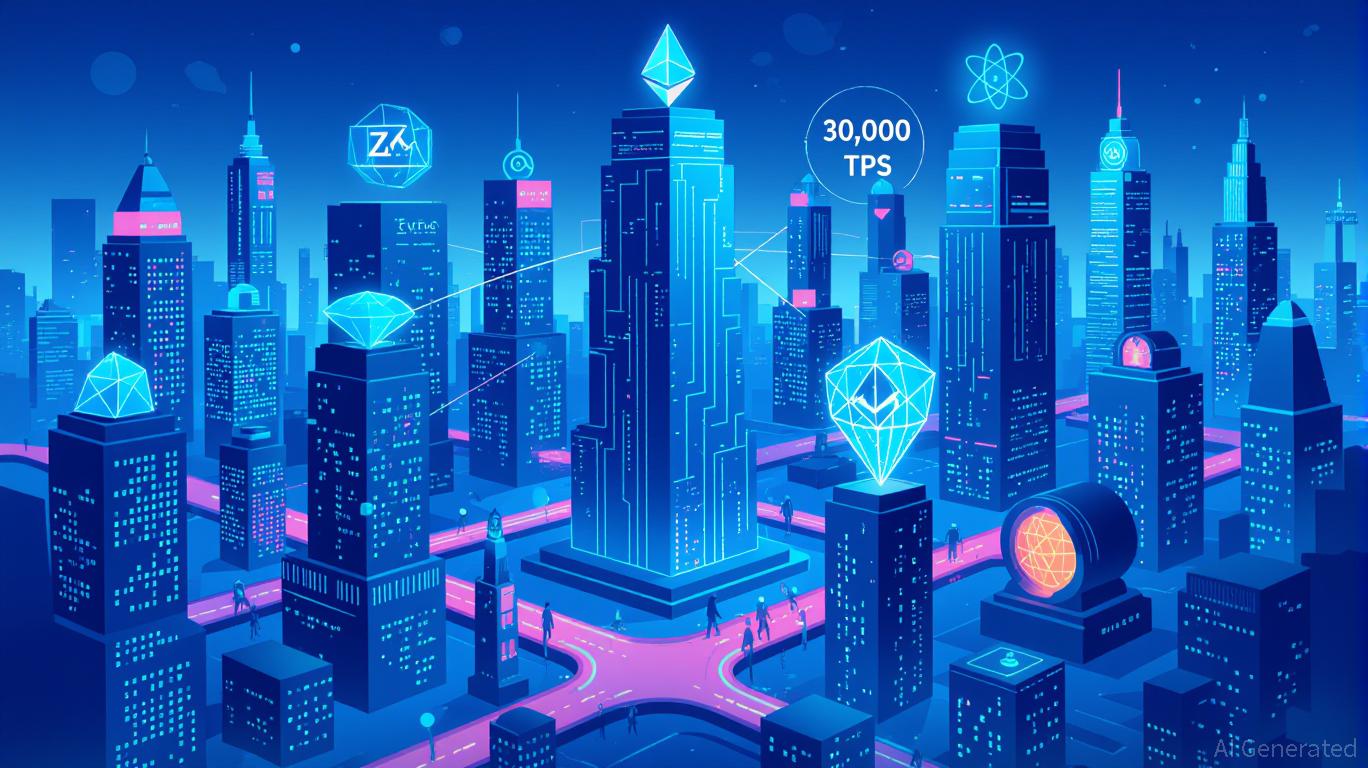
The Atlas upgrade propelled ZKsync to new heights, enabling it to process up to 30,000 transactions per second (TPS) while maintaining full compatibility with the Ethereum Virtual Machine (EVM). This leap forward, combined with Buterin’s support, has spurred significant institutional interest, including partnerships with major entities like Deutsche Bank and Sony. By mid-2025, ZKsync’s Total Value Locked (TVL) reached $3.3 billion. Its deflationary token model and seamless EVM integration make it easier for Ethereum-based applications to migrate, all while dramatically reducing gas fees.
Despite these achievements, ZKsync’s continued growth will depend on its ability to maintain momentum. Market analysts anticipate that the ZK token could trade between $0.40 and $0.60 in 2025, though this outlook is influenced by overall market trends and competition from platforms like Arbitrum and Optimism. Potential enhancements to tokenomics—such as introducing staking and token burn features—could increase scarcity and adoption, but challenges like token unlock events and regulatory oversight remain significant risks.
StarkNet: Pioneering Quantum-Resistant Technology
StarkNet distinguishes itself by utilizing STARK proofs, which offer resistance to quantum attacks and support high transaction throughput—processing over 10 million transactions each month. Its Cairo Virtual Machine (VM) allows for advanced account abstraction, though it requires developers to learn a new programming language, which can slow adoption. Unlike ZKsync, StarkNet does not inherently support private transactions, necessitating additional solutions for confidentiality.
Nevertheless, StarkNet’s innovative features—including Bitcoin staking and a dual-token consensus mechanism—position it for future expansion. Price predictions for its token range from $0.275 to $8.64 by 2026, but the platform faces volatility and potential sell-offs from airdrop recipients. While its focus on high-performance applications may attract institutional users, the lack of EVM compatibility could limit its competitive edge.
Aztec Network: Prioritizing Privacy Amid Regulatory Complexity
Aztec Network is designed with privacy at its core, enabling confidential transactions and private DeFi operations. This approach addresses a significant need in the blockchain space, reducing front-running losses for institutional traders by 67%. Integrations with platforms like Aave and Uniswap have helped Aztec establish a foothold in enterprise and compliance-focused environments. Its testnet success and $100 million in secured funding highlight its promise, though adoption still trails behind ZKsync and StarkNet.
Aztec’s architecture offers customizable privacy settings, a key feature for institutional uptake. However, its dependence on strategic partnerships and supporting infrastructure introduces execution risks. Additionally, regulatory hurdles—especially in regions that emphasize transparency—could impede its expansion.
Competitive Landscape and Risk Assessment
The zero-knowledge proof (ZKP) market is expected to expand at a compound annual growth rate of 22.1%, reaching $7.59 billion by 2033. ZKsync’s EVM compatibility and strong institutional ties give it a scalability advantage, while StarkNet’s quantum-resistant technology and Cairo VM cater to high-performance needs. Aztec’s privacy-first model, though more specialized, aligns with shifting regulatory requirements.
Investors must carefully consider these factors alongside inherent risks. ZKsync faces stiff competition from Arbitrum and Optimism, StarkNet contends with volatility, and Aztec’s adoption model remains largely untested. Regulatory changes, technological challenges, and market sentiment could further influence outcomes.
Conclusion: Navigating the Future of Layer-2 Solutions
Vitalik Buterin’s support has accelerated ZKsync’s rise as a leading scalable Layer-2 solution, but the broader ecosystem’s trajectory will depend on how StarkNet and Aztec address their respective challenges. For long-term investors, success hinges on balancing technical breakthroughs with adoption rates and risk management. While ZKsync’s institutional momentum and evolving tokenomics present attractive opportunities, its future is not assured. Similarly, StarkNet’s quantum-resistant approach and Aztec’s privacy-focused design offer unique advantages, albeit with greater execution risks.
As the ZKP sector evolves, the most successful projects will be those that effectively integrate scalability, privacy, and regulatory compliance—a goal that ZKsync, StarkNet, and Aztec are each striving to achieve.
Disclaimer: The content of this article solely reflects the author's opinion and does not represent the platform in any capacity. This article is not intended to serve as a reference for making investment decisions.
You may also like
Solana becomes second-largest chain for tokenized stocks
NEAR Protocol achieves 1 million transactions per second in major scalability milestone

Polymarket integrates Monad for native deposit support

MetaMask offers free Solana ID minting ahead of Breakpoint 2025

Trending news
MoreCrypto prices
More





