
How A Token Sale Gone Wrong Turned Into a 100% Rally For HumidiFi (WET)

HumidiFi (WET) has emerged as the top daily gainer in the cryptocurrency market today, rising over 100% in the past 24 hours. The Solana-based token’s surge coincides with its latest market debut, which has drawn significant interest from the crypto community. Why is HumidiFi (WET) Token’s Price Surging? BeInCrypto Markets data showed that WET’s value
HumidiFi (WET) has emerged as the top daily gainer in the cryptocurrency market today, rising over 100% in the past 24 hours.
The Solana-based token’s surge coincides with its latest market debut, which has drawn significant interest from the crypto community.
Why is HumidiFi (WET) Token’s Price Surging?
BeInCrypto Markets data showed that WET’s value has increased by 104.5% in the past 24 hours. At the time of writing, the altcoin was trading at $0.25.
WET’s market capitalization has also exceeded $50 million. Moroever, trading activity remains strong, with daily volume surpassing $150 million.
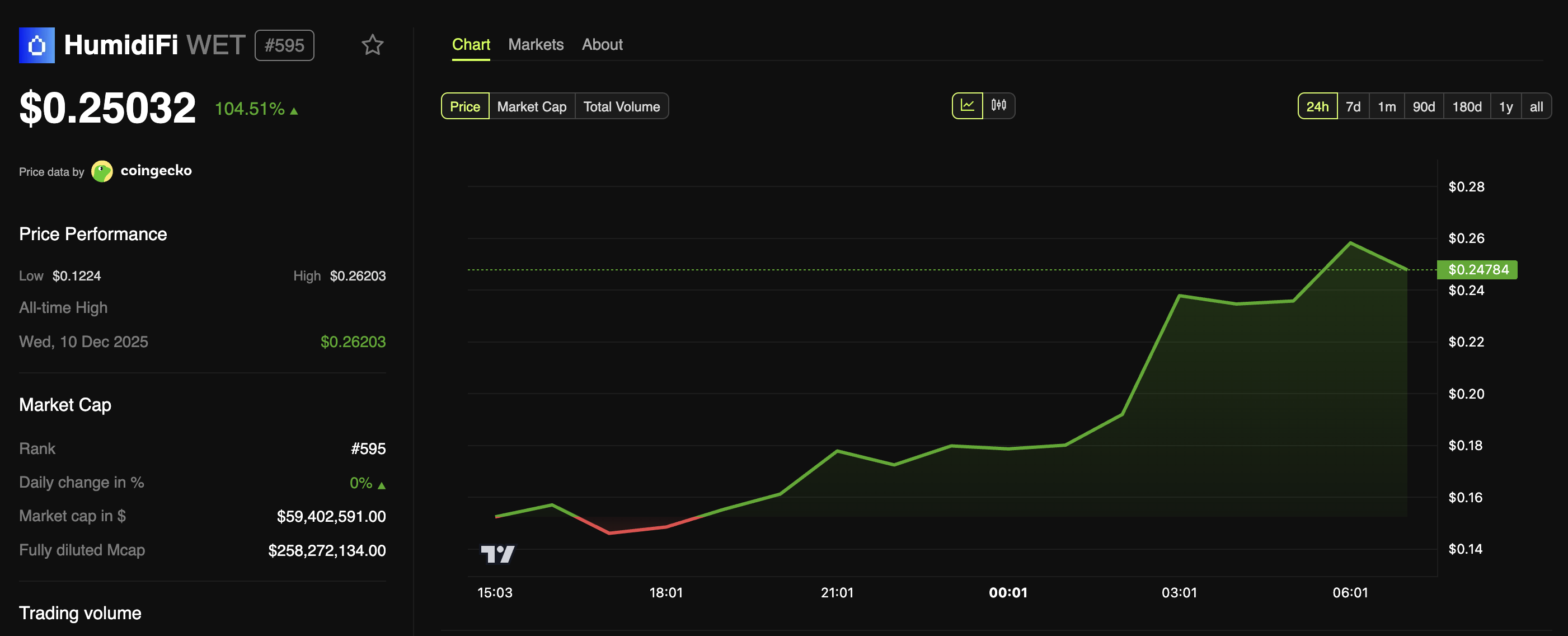 HumidiFi (WET) Price Performance. Source:
BeInCrypto Markets
HumidiFi (WET) Price Performance. Source:
BeInCrypto Markets
The token’s rise has sparked notable community buzz, earning it the top spot on CoinGecko’s trending lists. Sentiment data indicates an 80% bullish and 20% bearish outlook among traders.
But what exactly is HumidiFi, and what’s causing this hype? HumidiFi operates as a proprietary automated market maker (prop AMM) on Solana.
According to its litepaper, HumidiFi is Solana’s largest decentralized exchange, handling over $1 billion volume per day and accounting for more than 35% of Solana’s spot DEX activity. Furthermore, the protocol is integrated with Jupiter, DFlow, Titan, and OKX Router, serving as a key liquidity layer in the network.
WET is the platform’s native token. It is the first token launched via Jupiter’s Decentralized Token Formation (DTF) platform.
Yet, the launch was disrupted. On December 5, blockchain analytics firm Bubblemaps revealed that a single entity “Ramarxyz” used over 1,000 wallets to claim 70% of the initial offering. HumidiFi and Jupiter acknolwdged the incident swiftly.
“They set up thousands of wallets, each having 1000 USDC. For each wallet, there was an instruction created, that triggered the deposit of funds into the DTF smart contract. This is like a button that says put 1000 USDC into DTF to buy WET. Then a transaction was made that pressed 6 of these buttons at the same time. Per bundle sent (a lot of bundles were sent), 4 transactions were executed. 4 transactions that triggered 6 instructions each, for a total of 24,000 USDC or ~350,000 WET for each bundle,” HumidiFi explained.
In response, the team announced a complete relaunch with a new token. This move showed a clear commitment to fair access and a community-driven process over opportunistic trading.
“As the currently deployed WET tokens are in the completed initial offering vaults and cannot be retrieved, a new token will be minted to facilitate the relaunch of the public sale. The current WET token (WETcX1wAahwVbuJ9HihE8Uwf3dwmJBojGphAZPSVpJP) is VOIDED, and WILL NOT be the official token of HumidiFi,” Jupiter added.
Relaunch Success With Anti-Bot Mechanisms
The public relaunch went live on December 8 at 10:00 a.m. EST, with anti-sniping features. These included permissioned signing through the DTF frontend and Cloudflare, increased compute units per deposit, and mechanisms to disable revert protection.
These strategies worked. The relaunch raised 2.07 million USDC from genuine buyers, with 60,000 visitors on the DTF platform. HumidiFi’s analysis showed that 20% of depositors contributed less than the maximum $500 cap, signaling real user participation rather than automated scripts.
“Each of the 4000+ users that managed to purchase WET had to go through the DTF application’s front-end. Based on initial wallet-age analysis, we are very confident that legitimate users at their battle stations (with rapid refresh and fast fingers) won today and only about 5% were from potentially suspicious addresses,” Jupiter posted.
The successful relaunch helped restore community confidence after the initial manipulation. In addition, the WET token secured listings on major exchanges including Coinbase, OKX, Bybit, and Gate. These listings substantially enhance its visibility, deepen liquidity, and open the door to a much broader investor base.
Thus, these developments have fueled WET’s sharp upward momentum and solidified its position as one of the market’s standout performers today.
Disclaimer: The content of this article solely reflects the author's opinion and does not represent the platform in any capacity. This article is not intended to serve as a reference for making investment decisions.
You may also like
Zcash Halving: What It Means for Cryptocurrency Investors in 2025
- Zcash's 2028 halving will reduce annual inflation to 1%, reinforcing its deflationary model after prior 50% block reward cuts in 2020 and 2024. - The 2024 halving triggered 1,172% price surge followed by 96% drop, highlighting volatility risks despite growing institutional investments like Grayscale's $137M Zcash Trust. - Privacy-focused hybrid model (shielded/transparent transactions) attracts institutional interest but faces EU MiCA regulatory scrutiny, requiring selective compliance strategies. - Inve
CleanTrade and the Evolution of Clean Energy Markets: Market Fluidity, Openness, and the Role of the CFTC
- CleanTrade, a CFTC-approved SEF, transforms clean energy markets by integrating VPPAs, PPAs, and RECs under institutional-grade transparency. - The platform unlocks liquidity through real-time pricing and centralized trading, accelerating net-zero transitions for corporations and utilities . - Enhanced transparency via project-specific REC data combats greenwashing, while regulatory alignment boosts investor confidence and market legitimacy. - By bridging traditional and renewable energy markets, CleanTr

The CFTC-Authorized Clean Energy Marketplace: An Innovative Gateway for Institutional Investors
- REsurety’s CleanTrade platform, CFTC-approved as a SEF, addresses clean energy market illiquidity and opacity by centralizing VPPAs, PPAs, and RECs. - Within two months of its 2025 launch, it attracted $16B in notional value, enabling institutional investors to streamline transactions and reduce counterparty risk. - By aggregating market data and automating compliance, CleanTrade enhances transparency, aligning with ESG priorities and regulatory certainty for institutional portfolios. - It democratizes a

SOL Drops 50%: Is This a Healthy Market Adjustment or the Onset of a Major Sell-Off?
- Solana's 50% price drop sparks debate over whether it signals a bear market correction or deeper structural selloff. - On-chain metrics show liquidity contraction and reduced exchange supply, but ETF inflows and validator activity suggest structural resilience. - Corporate transfers and the Upbit hack highlight volatility risks, while Solana's alignment with Bitcoin's trend underscores macroeconomic influence. - Key watchpoints include liquidity recovery timelines, ETF inflow sustainability, and potentia

Trending news
MoreCrypto prices
More





