
Juventus Rejected Tether’s Record-Breaking Offer, Backed by Exor

Exor rejects Tether’s offer to buy Juventus, marking the end of what could have been a turning point in the relationship between crypto and football. As cryptocurrencies seek to establish themselves in sports, this refusal raises the question: is the world of football ready to accept these new players?

In brief
- Tether offered a cash buyout of 65.4% of Juventus for over $1 billion, but Exor rejected the offer outright.
- This rejection slows Tether’s ambitions in football, but other crypto-friendly clubs could become targets.
- After Tether’s failure to acquire Juventus, could supporters grow more wary of USDT and cryptos?
Tether will not have Juventus: a bold offer, a rejection without appeal
Tether, the issuer of the USDT stablecoin, attempted to buy 65.4% of Juventus’s shares , held by Exor, the Agnelli family’s company. The offer, entirely in cash, included a promise to invest an additional $1 billion to modernize the club. An enticing proposal, but it was rejected without hesitation by Exor’s board of directors.
For Exor, the refusal is explained by a historic attachment to Juventus. Indeed, the Old Lady has been owned by the Agnelli family for over a century. In a statement, Exor reaffirmed its long-term commitment and support for the club’s new management. Tether’s offer, described as “unsolicited“, did not convince, despite the crypto company’s stated ambitions.
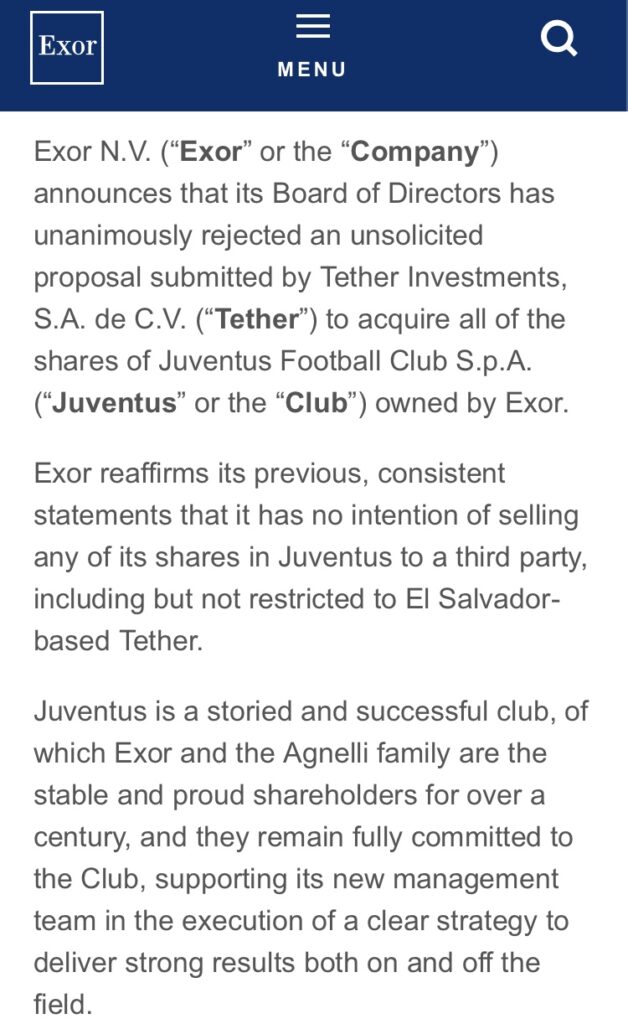 Exor refuses Tether’s buyout offer for Juventus.
This rejection highlights a mistrust of outside players, especially in a sector as traditional as Italian football. For Tether, this is a first failure in its sports expansion strategy but likely will not mark the end of its ambitions.
Tether: which football clubs could succumb to the crypto temptation?
Exor’s refusal represents a setback for Tether, which saw Juventus as a major gateway into European football. However, other clubs, struggling financially, might be more open to investors like Tether. FC Barcelona, in debt, or Inter Milan, seeking stability, could become prime targets.
Some clubs have already taken the step into crypto. PSG, Manchester City, and others have partnered with platforms like Socios.com to launch fan tokens. These partnerships show that football is not immune to financial innovation, even if full acquisitions remain rare. Tether could therefore turn to more receptive clubs or focus on less ambitious collaborations.
Tether (USDT): Could Juventus buyout refusal hurt the stablecoin?
USDT, Tether’s stablecoin, is already controversial due to its lack of transparency. Could this refusal by Juventus worsen that distrust? Supporters, attached to their club’s history, might view crypto’s intrusion into traditional football negatively. For Tether, the challenge is twofold: improve its image and convince fans that crypto can add value.
Partnerships with clubs, if well executed, could help legitimize USDT. But following this refusal, the task looks tougher. Juventus fans, in particular, might be reluctant to adopt USDT out of loyalty to Exor and the Agnelli family. This rejection could therefore impact cryptocurrency adoption in sport, at least in the short term.
Tether’s rejection by Exor shows that football remains cautious about crypto in general and stablecoins in particular. Yet, with indebted clubs and an industry seeking innovation, this alliance might become inevitable. The question remains: at what cost? The debate about the future of cryptocurrencies in sport is far from over.
Disclaimer: The content of this article solely reflects the author's opinion and does not represent the platform in any capacity. This article is not intended to serve as a reference for making investment decisions.
You may also like
The HYPE Token Crypto Rally: Unveiling the Driving Force Behind Its Week-Long Surge
- HYPE Token's 7-day surge in late 2025, reaching $35.08, was driven by protocol upgrades, institutional backing, and retail FOMO. - Institutional investments like Paradigm’s $581M stake and retail-driven momentum mirrored the 2021 Dogecoin rally. - However, looming token unlocks and bearish indicators, including a $11B unlock of 237M tokens, raised sustainability concerns. - Technical analysis showed mixed signals, with consolidation near support levels and short-term volatility risks, while broader trend

How CFTC-Recognized Platforms Such as CleanTrade Are Transforming the Landscape of Clean Energy Investments
- CFTC-approved CleanTrade introduces a regulated SEF for clean energy derivatives, addressing market fragmentation and liquidity gaps. - The platform enables institutional-scale trading of vPPAs/RECs, achieving $16B notional volume in two months by aggregating demand/supply. - Integrated risk analytics (e.g., CleanSight) enhance transparency, allowing investors to hedge project-specific risks like grid congestion and curtailment. - Dual investment pathways attract hedge funds/pension funds through direct

The Rise of CFTC-Regulated Clean Energy Markets: Opening a New Chapter for Institutional Investors
- CFTC's 2025 approval of REsurety's CleanTrade as a SEF marks a landmark shift in clean energy markets by introducing standardized, transparent trading for VPPAs and RECs. - The platform attracted $16B in notional value within two months, enabling rapid institutional-grade transactions that previously took months to negotiate. - By addressing liquidity gaps and enabling precise risk modeling, CleanTrade is accelerating capital flows into decarbonization while bridging ESG investment gaps for institutional

The Increasing Overlap Between Health and Financial Wellbeing in Managing Personal Finances
- Global wellness economy to hit $9 trillion by 2028, driven by holistic well-being trends. - Millennials/Gen Z prioritize wellness as lifestyle, with 55% spending over $100/month on health. - Employers integrate financial wellness into health programs to reduce burnout and boost productivity. - Investors target wellness-driven SaaS, healthcare tech , and financial literacy platforms for holistic solutions.

Trending news
MoreCrypto prices
More





