
Russell 2000 Sets New Highs, Rekindling a Familiar Bitcoin Pattern

The Russell 2000 Value index has officially surged to a new all-time high (ATH), reigniting debate across financial markets about what this milestone means for Bitcoin and the broader crypto market. The move highlights a renewed appetite for risk assets, but cracks beneath the surface suggest the signal may not be as straightforward as past
The Russell 2000 Value index has officially surged to a new all-time high (ATH), reigniting debate across financial markets about what this milestone means for Bitcoin and the broader crypto market.
The move highlights a renewed appetite for risk assets, but cracks beneath the surface suggest the signal may not be as straightforward as past cycles.
Russell 2000 Hits New All-Time High — Is Crypto Next?
Market commentator Kevin Gordon highlighted the breakout this week, noting that the Russell 2000 Value is “soaring to a new all-time high.” However, the Head of Macro Research and Strategy at Schwab Center for Financial Research also cautioned that past performance offers no guarantees.
Russell 2000 Value soaring to a new all-time high (Past performance is no guarantee of future results) pic.twitter.com/uTjpu3b8Pc
— Kevin Gordon (@KevRGordon) December 12, 2025
Still, for crypto traders, the development is difficult to ignore. Historically, strength in small-cap equities has often coincided with bullish phases for Bitcoin and altcoins.
The Russell 2000, which tracks approximately 2,000 US small-cap companies, is widely regarded as a gauge of investor risk appetite. Unlike the S&P 500’s large-cap dominance, the Russell 2000 tends to outperform when investors rotate toward higher-risk, higher-reward assets. Notably, this dynamic closely mirrors behavior in crypto markets.
Earlier this month, BeInCrypto reported that the index’s decisive break above long-term resistance marked a classic “risk-on” signal.
In previous cycles, such breakouts have preceded major crypto rallies. According to The Bitcoin Vector, an institutional research report by Swissblock, a similar setup in late 2020 saw the Russell 2000 turn prior resistance into support, after which Bitcoin surged roughly 380%.
“Last time this setup appeared, BTC delivered over 390% upside,” the report noted, adding that while today’s structure is different, markets are again positioned ahead of a potential liquidity expansion — historically favorable conditions for risk assets.
Other analysts echo that view, with RogueMacro pointing out that in the three prior instances where the Russell 2000 reached new highs, Bitcoin followed with its own breakout.
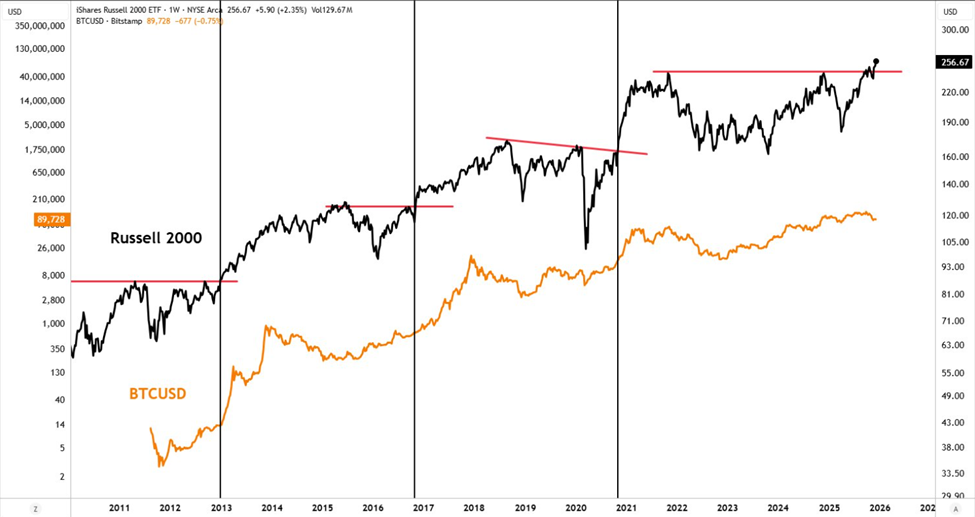 Bitcoin vs Russell 2000. Source:
RogueMacro on X
Bitcoin vs Russell 2000. Source:
RogueMacro on X
Ash Crypto went further, arguing that the index’s latest ATH has historically been followed by strength in Ethereum as well.
Russell 2000 hit a new ATH this week.Historically, $ETH always follows it. pic.twitter.com/cLH66LEZ6r
— Ash Crypto (@AshCrypto) December 14, 2025
Altcoins May Stand to Benefit Even More
Analyst Cryptocium highlighted a recurring pattern where the total altcoin market capitalization (excluding Bitcoin and Ethereum) tends to surge after the iShares Russell 2000 ETF breaks above prior highs, a phenomenon observed in both 2017 and 2021.
$OTHERS – An Altseason?Historically, the start of a $OTHERS rally, the altcoin market cap, has lined up with $IWM breaking out of its previous ATH.$IWM is the iShares Russell 2000 ETF, which tracks US small-cap stocks. That’s why it’s highly correlated with altcoins.Just… pic.twitter.com/DYCWUKtptB
— Cryptocium (@Cryptocium_id) December 8, 2025
If the correlation holds, some traders are already looking ahead to a potential altcoin boom in 2026.
However, not everyone is convinced the rally paints a clean bullish picture. Duality Research noted that despite the index’s rise, small-cap ETFs have seen roughly $19.5 billion in net outflows this year. This represents a sharp contrast to previous rallies, which were supported by strong capital inflows.
Fundamental data also raises red flags. According to The Kobeissi Letter, approximately 40% of companies in the Russell 2000 reported negative trailing 12-month earnings in Q3 2025, at near-record levels and comparable to post–financial crisis peaks.
Many US small-cap firms are struggling:40% of Russell 2000 companies reported negative 12-month earnings in Q3 2025, near the highest percentage on record.This percentage has more than doubled since 2007 and has remained in a clear upward trend.This is also in line with the… pic.twitter.com/BdV088tpHl
— The Kobeissi Letter (@KobeissiLetter) December 14, 2025
The figure has more than doubled since 2007, indicating a significant structural weakness within the small-cap segment.
Responding to comparisons between altcoins and the Russell 2000, investors caution that timing matters more than correlation.
“It’s a useful analogy; both tend to lag until liquidity broadens and risk appetite rotates down the curve. The timing usually matters more than the correlation,” wrote Surya.
For crypto investors, the Russell 2000’s new ATH is a compelling signal, but not a guarantee.
While history suggests upside potential for Bitcoin and altcoins, underlying fragilities in small-cap fundamentals could still complicate the narrative if risk-on sentiment fades.
Disclaimer: The content of this article solely reflects the author's opinion and does not represent the platform in any capacity. This article is not intended to serve as a reference for making investment decisions.
You may also like
US Bitcoin Session Leads December Returns After Weak November

Russia's largest bank, Sberbank, has announced it is testing DeFi products! Here are the details.
The Final Trade of 2025: What Wall Street’s Rotation Means for Crypto
Quantum Threat Overhyped: Grayscale Sees No Immediate Impact on Crypto Markets
Trending news
MoreCrypto prices
More





