
Gold has dropped, the euro has weakened, where should the money go?

Huitong Network, January 7 — On Wednesday (January 7), EUR/USD traded around 1.1690 during the European session, with its movement clearly suppressed by the US dollar. On the surface, this looks like a simple exchange rate fluctuation, but in reality, there is a clear logical chain driving it. This round of US dollar appreciation is not caused by a single factor, but rather the combined effect of three major driving forces.
On Wednesday (January 7), EUR/USD traded around 1.1690 during the European session, with its movement clearly suppressed by the US dollar. On the surface, this looks like a simple exchange rate fluctuation, but in reality, there is a clear logical chain driving it. This round of US dollar appreciation is not caused by a single factor, but rather the combined effect of three major driving forces.
First, the market is optimistic about US labor data. Whenever key economic data is about to be released, funds often position themselves in advance, forming a "buy the rumor" trading habit. Currently, the market generally expects the job market to remain resilient, which has already supported the US dollar even before the data is released. Second, changes in the interest rate path are reshaping asset attractiveness. The market now expects the probability of a Fed rate cut in March to drop to 45%, meaning policy will remain tight for a longer period. The high interest rate environment enhances the relative return on US dollar assets, attracting international capital inflows. The third clue is the rise in risk aversion. Amid a globally unstable geopolitical landscape and fluctuating risk appetite, traders are once again favoring the US dollar as a core safe-haven asset.
The combination of these three forces has led the dollar to a phase of strength. But it's worth noting that this rise reflects "pricing in expectations" rather than actual outcomes. If subsequent data fails to meet expectations or policy shift signals emerge, the market could quickly reverse.
“Buy the rumor, sell the fact”: What is the market playing out?
The market often moves counterintuitively—good news can cause a drop, while bad news can lead to a rally. This phenomenon is known as "buy the rumor, sell the fact." The current strength of the US dollar is a typical manifestation of this logic.
Before important data is released, traders open positions based on forecasts. For example, since most believe US employment data won't be too bad, they buy US dollars in advance. When the data is actually released, even if the result is indeed good, the market may choose to take profits, causing prices to fall. This is why sometimes "good news becomes bearish."
Currently, the market focus is no longer limited to a single meeting or data point, but on whether there will be a structural change in monetary policy over the coming year. Some argue that if political pressure increases, it could prompt the Fed to take unconventional action, such as cutting rates sharply even amid strong economic growth. Although this scenario contradicts traditional macro logic, it is not impossible if inflation falls significantly or the financial system comes under stress. More importantly, if there is a precedent for administrative intervention in central bank decisions—such as the recent Lisa Cook case—market concerns over policy independence will increase, thereby raising the uncertainty premium.
In such an environment, funds tend to "choose safety first, then wait for confirmation." In other words, before the truth comes out, investors would rather hold stable assets like the US dollar and observe. However, analysts remind that this support is often temporary; once the situation becomes clear, capital may quickly shift to other assets.
Why is the euro passively under pressure? The dilemma of internal and external pressures
By contrast, the euro appears weak. In addition to the passive depreciation caused by the strong US dollar, the euro's own fundamentals and policy outlook are also dragging down its exchange rate.
European inflation continues to fall, especially with Germany's December consumer price growth slowing from 2.6% to 2%. This trend has led the market to reassess the European Central Bank's policy space. If the disinflation process continues to expand, the market will naturally speculate whether the ECB will restart an easing cycle earlier than expected. Once rate cut expectations heat up, the yield appeal of euro assets will diminish, and capital outflow pressure will increase.
Meanwhile, Europe's internal growth and fiscal issues are also exacerbating risk concerns. German Chancellor Friedrich Merz publicly stated that some industries are in a critical state, and the government has not responded adequately over the past eight months; the French Ministry of Finance warned that if parliament cannot reach a budget compromise, the deficit could rise to 5.4%, even risking a credit rating downgrade. These comments have deepened international market doubts about the fiscal sustainability of the eurozone, leading traders to demand higher risk premiums, further weighing on the euro's performance.
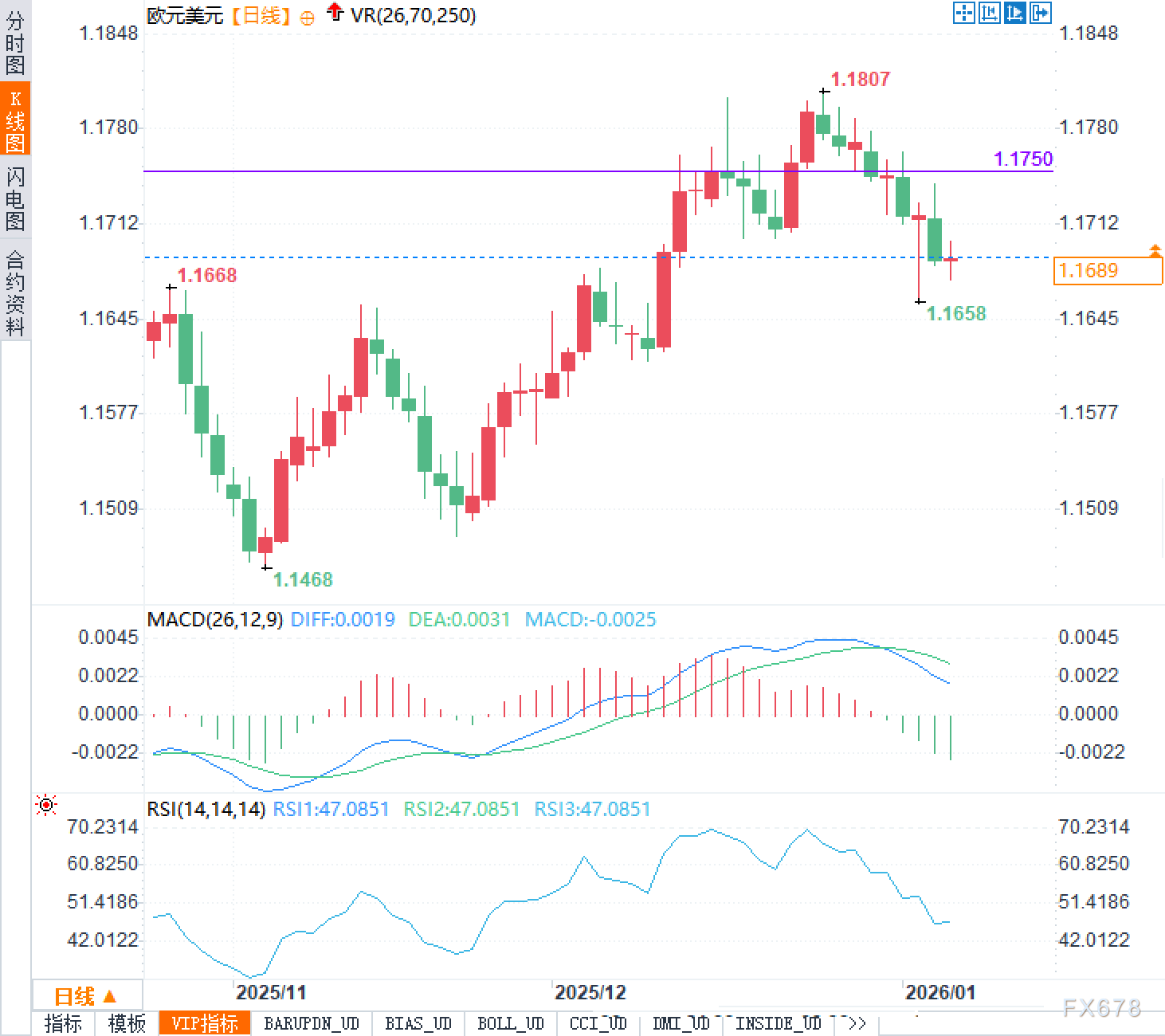
Technically, EUR/USD previously encountered resistance and fell back at 1.1807, indicating heavy selling pressure above. The area around 1.1750 has become a battleground between bulls and bears; if it cannot be effectively broken and held, any rebound is likely to be a correction rather than a trend reversal. On the downside, 1.1658 has been tested recently, showing some support. Although the current exchange rate is still above this level, it is not far away; if volatility increases, technical selling could be triggered. The MACD indicator shows short-term momentum is weakening, with DIFF at 0.0019, DEA at 0.0031, and the MACD bar at -0.0025. The RSI is about 47.0851, in a neutral to slightly weak range, indicating the market is not oversold and still has room to fall.
Gold retracement, exchange rate tug-of-war: What's next?
The strengthening US dollar not only affects the euro but has also led to a pullback in gold. This is a typical "pricing currency effect"—when the US dollar appreciates and real interest rate expectations rise, gold priced in US dollars naturally comes under pressure.
However, gold's medium-term resilience has not disappeared. Against the backdrop of a more fragmented global landscape, many central banks are quietly adjusting their reserve structures and increasing their allocation to precious metals. This long-term rebalancing provides some bottom support to gold prices during pullbacks. Therefore, gold's decline is more about rhythm than a trend reversal.
Back to EUR/USD itself, it is more likely to oscillate in a range than trend unilaterally at present. The short-term movement will depend on the difference between upcoming data and market expectations. If labor market data is strong and the probability of a rate cut in March remains below 50%, the dollar could remain strong and the euro may further test 1.1658 or even lower; conversely, if the data is clearly weak or policy expectations loosen, the exchange rate could return to the 1.1750 region for a rebound.
In the medium term, the euro's fate hinges on two key points: first, whether the ECB will be forced to ease earlier due to rapid disinflation; second, whether the EU can stabilize its fiscal and growth narrative to restore confidence. As for the US dollar, it will depend on whether "high interest rates can be maintained" or "the policy framework changes." In this tug-of-war, the exchange rate will likely fluctuate between 1.1658 and 1.1750, awaiting the next catalyst to break the balance.
Disclaimer: The content of this article solely reflects the author's opinion and does not represent the platform in any capacity. This article is not intended to serve as a reference for making investment decisions.
You may also like
Large bitcoin investors have accumulated more coins than at any time since the FTX crash in 2022
Trump throws UK automakers into turmoil once again
Cryptocurrency Market Stirs Enthusiasm as Bitcoin Holds Strong
DOJ No-Sell on Samourai Bitcoin, Advisor Says – Kriptoworld.com

Trending news
MoreCrypto prices
More






