
Silver plunges, gold prices under pressure and decline

FX678 News, January 8—— In early U.S. trading on Thursday (January 8), gold and silver prices declined, with silver plunging sharply, mainly due to short-term futures traders taking profits and weak longs closing their positions. The bearish technical pattern in the silver market has caused panic among bullish investors in both precious metals. In addition, there is an old trading adage that says a mature bull market requires a continuous influx of new positive news to sustain it. At present, these two precious metals seem to lack such bullish support.
In early U.S. trading on Thursday (January 8), gold and silver prices declined, with silver plunging sharply, mainly due to short-term futures traders taking profits and weak longs closing their positions. The bearish technical pattern in the silver market has caused panic among bullish investors in both precious metals. In addition, there is an old trading adage that says a mature bull market requires a continuous influx of new positive news to sustain it. At present, these two precious metals seem to lack such bullish support. February gold futures (usually priced a dozen dollars above spot gold) were reported at $4,431.7 per ounce, down $30.8; March silver futures were reported at $73.83 per ounce, down $3.783.
Gold and silver traders and investors are preparing for the annual rebalancing of commodity indices, which may see tens of billions of dollars in futures contracts being sold in the coming days. According to reports, Citigroup estimates that about $6.8 billion worth of silver futures may be sold to meet rebalancing requirements, with gold futures outflows being roughly the same. Bloomberg pointed out that the reason for this sell-off is the significant increase in the weighting of precious metals in the commodity benchmark index.
Data from consulting firm Challenger, Gray & Christmas shows that U.S. layoffs in December fell to their lowest level since July 2024. The company announced today that U.S. employers announced 35,553 layoffs in December, the lowest since July 2024, down from 71,321 in November, and 8% lower than in December 2024. Andy Challenger of the company said: "2025 ended with the lowest layoff plans of the year. Although December is usually a quiet month for layoffs, combined with relatively high hiring plans, this is a positive signal after a year of high layoff plans." In 2025, U.S. employers announced a total of 1,206,374 layoffs, up 58% from 2024 and the highest level since 2020. The government sector led all industries with 308,167 layoffs, mainly at the federal level; in the private sector, the tech industry saw the most layoffs at 154,445. Challenger said: "The technology industry is advancing in AI research and application much faster than any other industry. Coupled with over-hiring in the past decade, this has led to a wave of unemployment in the sector." Meanwhile, planned hiring by employers was 507,647, down 34% from 2024 and the lowest level since 2010.
The U.S. Supreme Court may rule on the legality of tariffs as early as Friday. President Trump could find out as soon as Friday whether the Supreme Court will overturn a key part of his tariff policy. The report stated: "The Supreme Court is considering whether Trump can use an emergency law that has never been invoked before to levy import tariffs, and its decision may be included in a series of unspecified cases to be announced soon. Lower courts have ruled that Trump's invocation of the 1977 International Emergency Economic Powers Act to defend his broad 'reciprocal' tariffs on U.S. trading partners, as well as separate tariffs on China, Canada, and Mexico, exceeded his authority." The U.S. tariff policy remains in effect during the legal proceedings. If the Supreme Court rules these tariffs illegal, most of the tariffs imposed by Trump in his second term may be revoked, and the U.S. government could face hundreds of billions in refund liabilities. The report also noted: "However, there are other ways to continue his tariff policies. While the Constitution grants Congress the power to levy taxes and collect tariffs, lawmakers have delegated some of that power to the executive branch through various statutes. These laws provide Trump with at least five different alternatives for imposing tariffs. Overall, these alternatives come with more restrictions and procedural requirements, meaning Trump would hardly be able to impose tariffs immediately or set high rates at will."
Trump proposes to increase the U.S. defense budget by 50%. President Trump stated on social media that he hopes to increase the annual U.S. defense spending by $500 billion to $1.5 trillion and threatened to exclude some companies that could have profited from it. Trump also signed an executive order requiring major defense contractors to stop stock buybacks and dividends, capping executive compensation at $5 million per year until these companies increase investment in plant construction and R&D. Trump's statement led to a drop in major defense contractors' stock prices, with firms such as Raytheon Technologies, Northrop Grumman, Lockheed Martin, and General Dynamics all seeing declines. Trump wrote on social media: "This will enable us to build the 'dream army' we have long deserved, and more importantly, no matter what enemy we face, this army will guarantee our security."
Details of U.S. policy on Venezuelan crude oil emerge. According to reports, after the Trump administration announced it would take control of up to 50 million barrels of Venezuelan crude oil (one of the largest surprise supply shifts in recent years), oil traders and U.S. refiners are scrambling to adjust positions to secure access to Venezuelan crude. President Trump first announced the U.S. strategy late Tuesday night on social media, and Energy Secretary Chris Wright revealed more details on Wednesday. This strategy brings the federal government directly into the international oil market and is expected to reactivate the flow of Venezuelan crude to U.S. refineries after years of sanctions. The return of Venezuelan oil to U.S. buyers could mark one of the most significant shifts in global energy markets in years. The news has already led to a plunge in Canadian crude prices and put pressure on benchmark crude futures prices. Venezuela has the world's largest oil reserves, but after decades of underinvestment, trade sanctions, and economic isolation, its oil output has fallen below 1 million barrels per day. Trump said the U.S. would take over Venezuela and extract its oil profitably in the coming years. He told the newspaper: "We will rebuild Venezuela's oil industry in a highly profitable way." Although major U.S. oil companies plan to meet with Trump at the White House in the coming days, Bloomberg noted that without a clear political and legal framework, many drilling firms may still be cautious about quickly returning to or entering the Venezuelan market.
Today's key external market dynamics: the U.S. dollar index edged higher; crude oil prices rose, trading at around $57.00 per barrel; the benchmark 10-year U.S. Treasury yield is currently at 4.16%.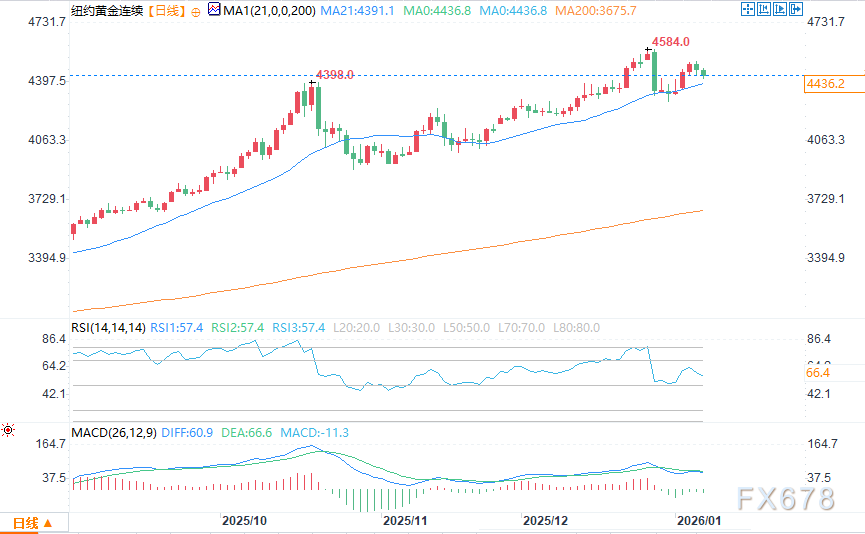
(COMEX Gold Daily Chart Source: FX678)
Technical analysis: The next upside price target for February gold futures bulls is a close above the key resistance level—the contract's all-time high of $4,584.00 per ounce; bears' near-term downside price target is to push futures prices below the key technical support at $4,284.30 per ounce. First resistance is at the overnight high of $4,475.20 per ounce, followed by $4,500.00 per ounce; first support is at $4,400.00 per ounce, followed by this week's low of $4,354.60 per ounce.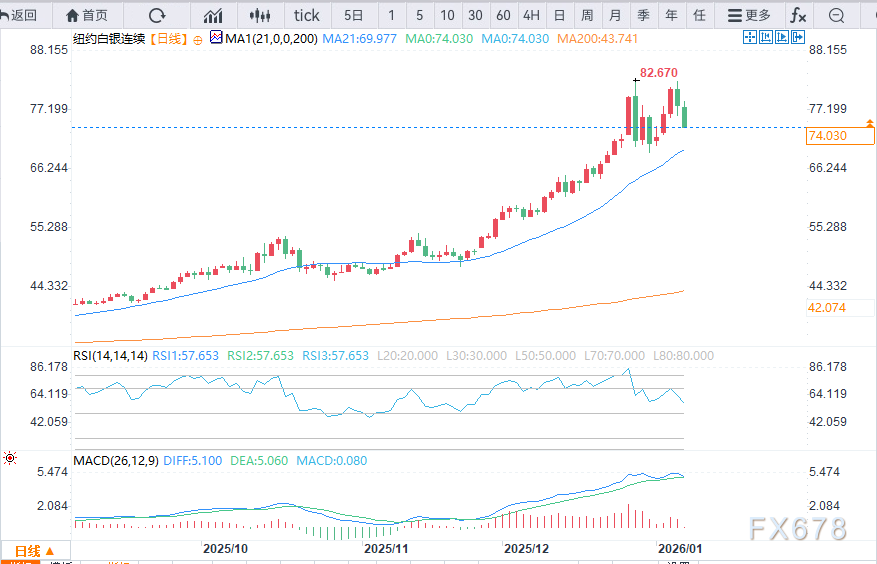
(COMEX Silver Daily Chart Source: FX678)
This week's price movement in March silver futures has sparked concerns about a bearish double-top reversal pattern forming on the daily chart. Bulls' next upside price target is a close above the key technical resistance—the historical high of $82.67 per ounce; bears' next downside target is a close below the key support—the previous week's low of $69.225 per ounce. First resistance is at $75.00 per ounce, followed by $76.00 per ounce; next support is at $74.00 per ounce, followed by $72.50 per ounce.
Note: The gold market mainly operates through two pricing mechanisms. The first is the spot market, where prices are quoted for immediate purchase and delivery; the second is the futures market, which determines the price for delivery at a future date. Affected by year-end position adjustments and market liquidity, the most actively traded contract on the Chicago Mercantile Exchange (CME) is currently the December gold futures contract.
Disclaimer: The content of this article solely reflects the author's opinion and does not represent the platform in any capacity. This article is not intended to serve as a reference for making investment decisions.
You may also like
TechCrunch Mobility: ‘Physical AI’ becomes the latest buzzword

Can Trip.com Bounce Back After Facing Beijing’s ‘Jack Ma’ Style Crackdown?
Dear Intel Shareholders, Save the Date: January 22
Building organizational strength amid a world growing increasingly divided
Trending news
MoreCrypto prices
More






