
LatePost Exclusive | Qianwen Major Update: Shopping, Ordering Takeout, Focusing on Usefulness Over Mere Entertainment



Racing towards the AI super gateway.
Written by丨Guan Yiwen
On the night of January 13, the exterior of Building 5, Area C, Alibaba Xixi Campus in Hangzhou—which has not yet been put into use—was lit up with the slogan “From Question To Action.” This served as an early teaser for Qianwen's functionality update coming two days later, on January 15.
Less than two months after its official launch, the Qianwen App has undergone its largest version update to date. According to an exclusive from LatePost, this update focuses on two main directions:
Life: Qianwen’s main chat interface is now integrated with Alibaba services. The first batch includes Taobao Flash Sale, Alipay, Taobao, Fliggy, and Amap. These features will be open for testing on the 15th, and will be fully available to all users in a few days. Other Alibaba services, such as Tao Piao Piao and Damai, will be integrated in the future;
Tasks: The home page of the Qianwen App now features a “capsule” style “Task Assistant” in the lower left corner, capable of handling complex tasks that require human-like, multi-step workflows, including (but not limited to) making phone calls to book restaurants, research reports, processing financial documents, and developing websites. This feature currently operates by invitation only.

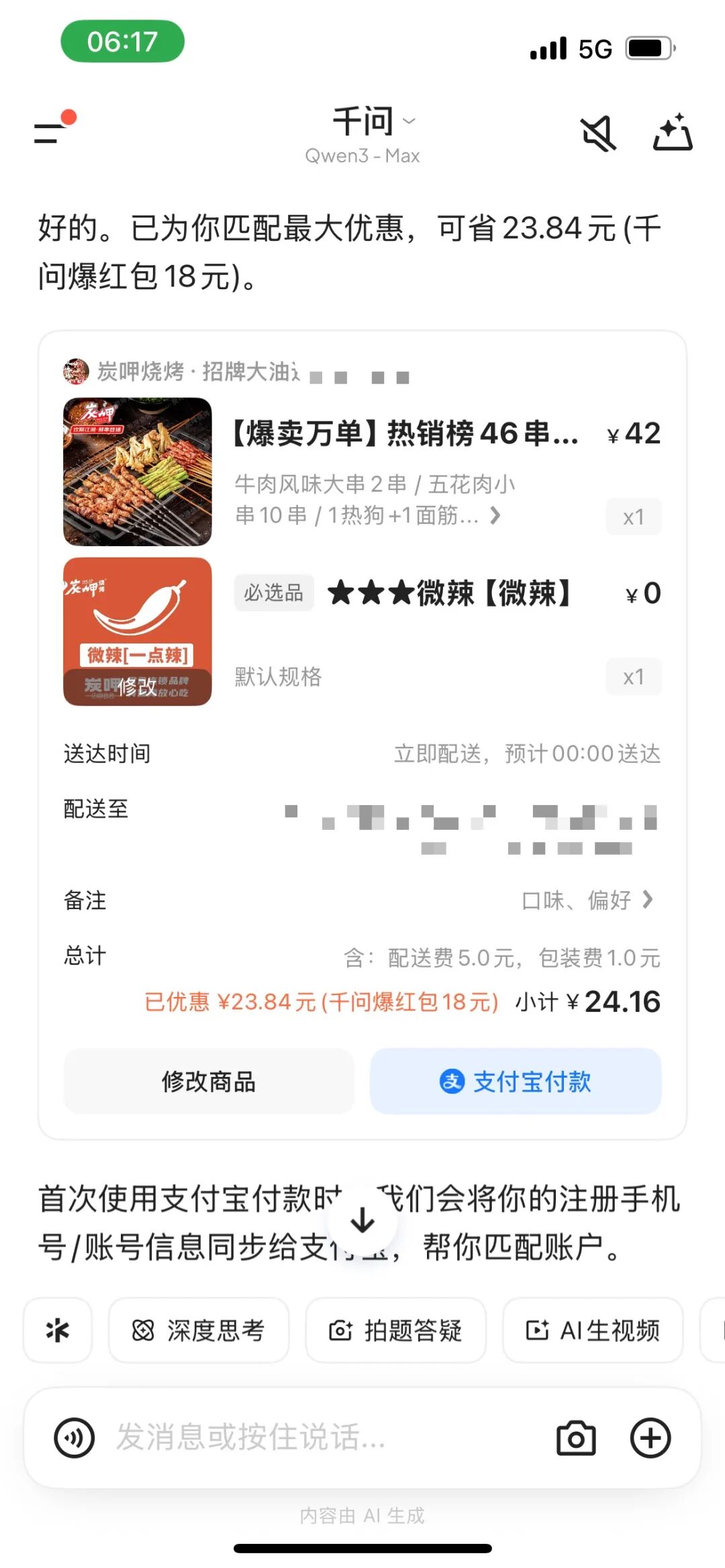
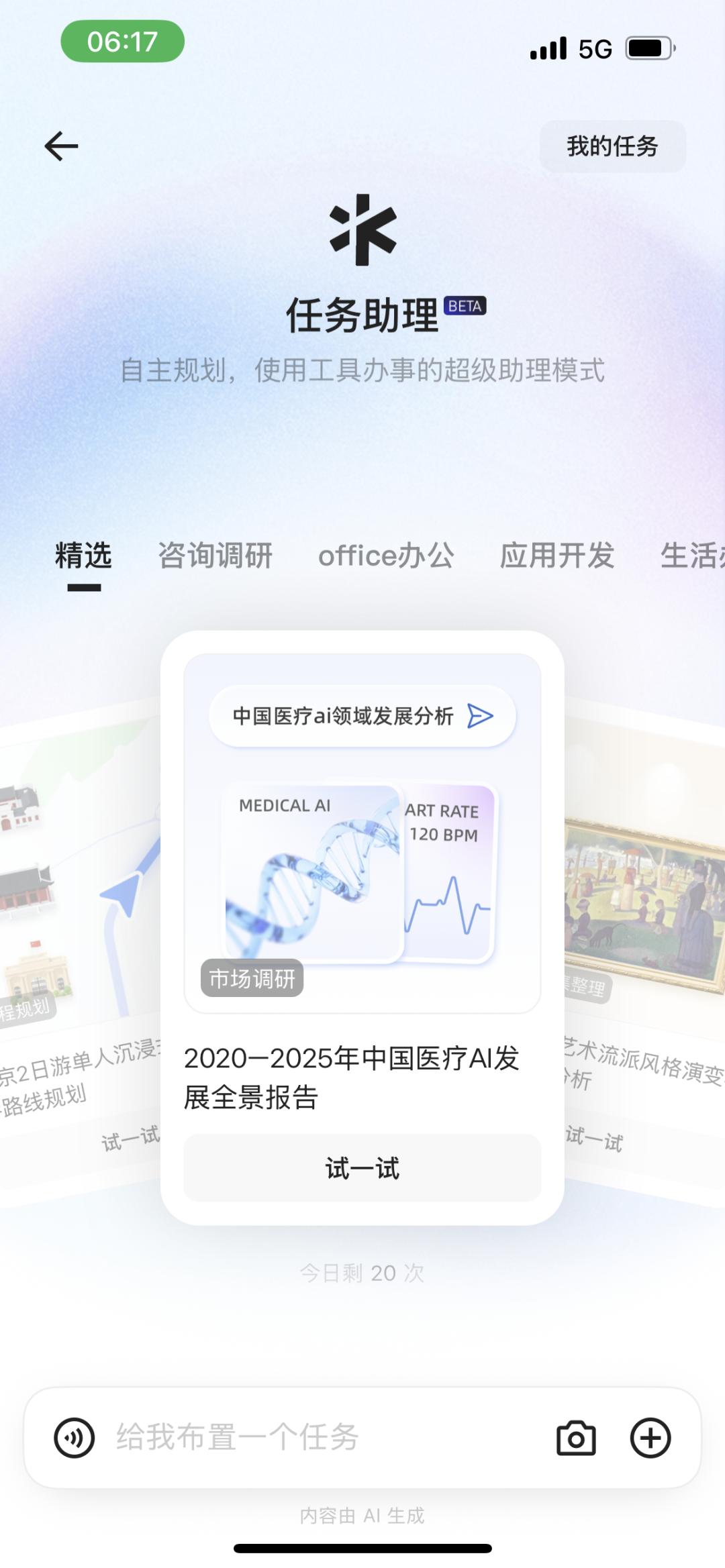
The left image shows the Taobao Flash Sale purchase interface within Qianwen, while the right shows the Task Assistant’s internal test interface.
100 million DAU (Daily Active Users) is a milestone for platform companies’ consumer-grade apps. According to public data, Doubao has already crossed this line first.
Launched in August 2023, Doubao has a broad user base. Users don’t need to explore the possibilities of an AI assistant on their own; Doubao focuses on specific scenarios like homework checking, gaming strategies, and outfit suggestions, accelerating its adoption among lower-tier markets and family users.
Qianwen, which officially launched 27 months after Doubao, does not make DAU its current primary goal. Instead, it pays more attention to the quantity and quality of tasks completed—whether users are truly handing tasks over to AI, and whether Qianwen is truly getting things done.
Beyond tasks, Qianwen has been accelerating the integration of various Alibaba consumer businesses since its launch, especially in life services. According to our sources, Alibaba sees this as a key differentiator in the battle for the AI super gateway. Alibaba owns the Qwen open-source model and an ecosystem with capabilities ranging from payments and shopping to travel and entertainment—so “model” + “ecosystem” are being integrated first. A few days ago, Google also announced AI shopping collaborations with retailers like Walmart.
A member of Alibaba’s large model team said that AI assistants have evolved from chat-based to agent-based task handling, a global consensus at this stage.
Tasks and Life: Qianwen breaks down users’ AI needs in two directions
Faced with the endless possibilities of AI assistants, Qianwen’s selection criteria mainly involve two rules: “First, whether it’s a real user need and how big the potential is; second, whether the large model’s capabilities can further stimulate this need.”
Internally, Qianwen breaks these needs into two main categories: tasks and life.
Task-type needs are “deliverable tasks”—meaning users want a result they can use directly. Qianwen has identified over 100 core general office scenarios, such as “sorting invoices,” “generating PPTs,” “market research,” and so on, and has optimized for these typical scenarios.
“If you initiate 10 requests and 7 or 8 of them are completed versus only 3 or 4, the impression is vastly different. The former is ‘basically usable,’ while the latter is ‘unusable’ and may lead to user churn,” said a Qianwen product manager.
The ultimate goal for task-type needs is “perfect delivery”—meaning the result fully meets expectations and requires no modification. An acceptable completion rate is “basically usable,” where the main part of the result is correct and only minor user tweaks are needed. “Our goal is to maintain a high completion rate for those 100+ key office scenarios, giving users a predictable experience,” the product manager said.
Life-type needs aim to “get closer to each user's real life,” as one major trend in current AI assistant products is increasing personalization. After integrating with Taobao, Qianwen’s goal is not just to recommend more accurate products, but to first understand user needs and translate those needs, and only then to have a deep understanding of the products themselves.
For example, if a user says, “I want to buy a mite remover,” the underlying need is that the user suspects dust mites at home and wants to get rid of them. But there are many ways to remove mites—not just buying a device, but also sprays, or simply airing out bedding. Determining the best way depends on whether the user has children or pets at home, and should be based on user habits and preferences to assist with decision-making.
The updated Task Assistant feature will leverage various Alibaba services to meet user needs. For example, for travel planning, it may coordinate multiple Fliggy and Amap services to directly book tickets, arrange taxis, and provide navigation; after selecting a restaurant, AI can automatically call to reserve a table.
Another example: Qianwen has teamed up with Alipay to launch embedded payment “AI Pay,” with Taobao Flash Sale the first to integrate, allowing users to order takeout directly in Qianwen. ChatGPT’s “Instant Checkout” feature will go live in September 2025, enabling US users to complete shopping and payments within the app.
Of all the integrations with Alibaba services, the product manager mentioned that collaborating with Alipay on “AI Pay” is the most complex, because AI may not place orders or pay instantly. For instance, a user might instruct: “Monitor flights from Shanghai to Beijing, and automatically book if the price drops below 800 yuan.”
This requires authorizing AI to act as an agent for asynchronous payments and building a four-party link among user, AI agent, merchant, and platform. “This is also a new capability for Alipay.” In the future, this could serve complex scenarios such as cross-platform or combined payments. For example: “For a 15-person team reception, order barbecue rice for everyone, no spicy food; all drinks should be milk tea, less sugar, half hot and half cold.”
Competitive strategy: Focus on usefulness, not just entertainment
Qianwen will not set any specific persona in the future. “Once there’s a specific image, it limits user expectations. Our ideal AI assistant should transcend inherent labels like gender, age, cartoon, or real person,” said the aforementioned Qianwen product manager.
The Qianwen app launched on November 17, 2025, by which time Doubao’s DAU had already exceeded 60 million. Continuing to follow a mass-market approach was not the best choice for Qianwen, especially since China’s largest traffic entry points are not within Alibaba.
“Qianwen first became popular in tech circles and the open-source community; it naturally attracts users who are sensitive to quality and have deep task requirements,” said one Qianwen team member. Qianwen first attracted highly educated, tech-savvy users, especially developers, researchers, and enterprise users.
According to our understanding, nearly half of Qianwen’s current users are under 40 years old, more than half are from third-tier and above cities, and the vast majority use Qianwen with clear tasks and productive purposes.
Qianwen’s growth path is clear: use office scenarios as a breakthrough, establish strong task execution capabilities; leverage Alibaba’s ecosystem to get closer to users’ daily lives and provide differentiated services; start with high-knowledge users and gradually expand to a broader audience.
Since its launch last November, Qianwen has been accelerating integration with various Alibaba businesses. The aforementioned Qianwen product manager told us, “This isn’t just because Qianwen is part of Alibaba. Utilizing these services is an important capability for us to solve users’ life problems. Integrating Alibaba’s businesses is a means, not the end goal.”
Gathering 1,000 people, starting up again within Alibaba
In less than two months since its launch, the Qianwen App has already undergone more than a dozen iterations, maintaining an ultra-high update frequency of 2-3 times per week, with some features going from design to launch in just 1-3 days. Compared to a big company business, this efficiency makes Qianwen look like a startup.
In the first-floor lobby of Alibaba’s Xixi Campus Building C4, near the facial recognition entrance, suitcases pile up every Monday morning and Friday evening. Employees from Guangzhou, Beijing, and other cities fly in to “close themselves off” for work, then fly out like “migratory birds” on weekends. This situation will continue at least until the Spring Festival. Since September last year, Alibaba engineers have been developing Qianwen here in a closed environment. With additional staff from other departments, more than 1,000 people are now involved.
In most offices, desks are arranged by function (e.g., product, development), but in the “closed-off” C4 building, they are organized by project team—each subproject has product, development, and algorithm staff working together. A Qianwen HR staffer said, “Product people sit right across from developers, so if you need to discuss something, you just move your chair and chat quickly.”
An Alibaba veteran said that since 2025, the biggest change at Alibaba is that, from Taobao Flash Sale to Qianwen, it has begun to “focus resources on major projects.”
Qianwen’s project team not only includes the Quark product and research team, but also a large number of employees urgently seconded from Amap, Taobao, Alipay, and other departments. According to a coordination staffer, there was no resistance at all when mobilizing these teams—everyone was enthusiastic. Many feel they are “participating in a battle that could change the shape of the internet.”
Qianwen has also abandoned complicated hierarchical reporting.Wu Jia, President of Qianwen C-end Business Grouprarely sits in the meeting room listening to PPTs. Instead, he often stands at the whiteboard with the team, working through feature logic together. The team collaborates on the whiteboard and communicates ideas immediately—instead of preparing thick documents and holding long meetings.
In the AI age, the most probable path for big companies to do AI business is to establish a relatively independent organization and return to the entrepreneurial spirit—believing what they are doing can change the world, and going all-in. At Alibaba, it’s Qianwen, Tongyi Lab, and DingTalk; at other major companies, such changes will become more common.
Cover image source: Dead Poets Society
- FIN -




Disclaimer: The content of this article solely reflects the author's opinion and does not represent the platform in any capacity. This article is not intended to serve as a reference for making investment decisions.
You may also like
DOJ No-Sell on Samourai Bitcoin, Advisor Says – Kriptoworld.com

Macron Plans to Invoke EU Trade Mechanism Amid Rising Demands for Retaliation
Intel bets on fundamentals as rivals push AI in laptop market
TechCrunch Mobility: ‘Physical AI’ becomes the latest buzzword

Trending news
MoreCrypto prices
More






