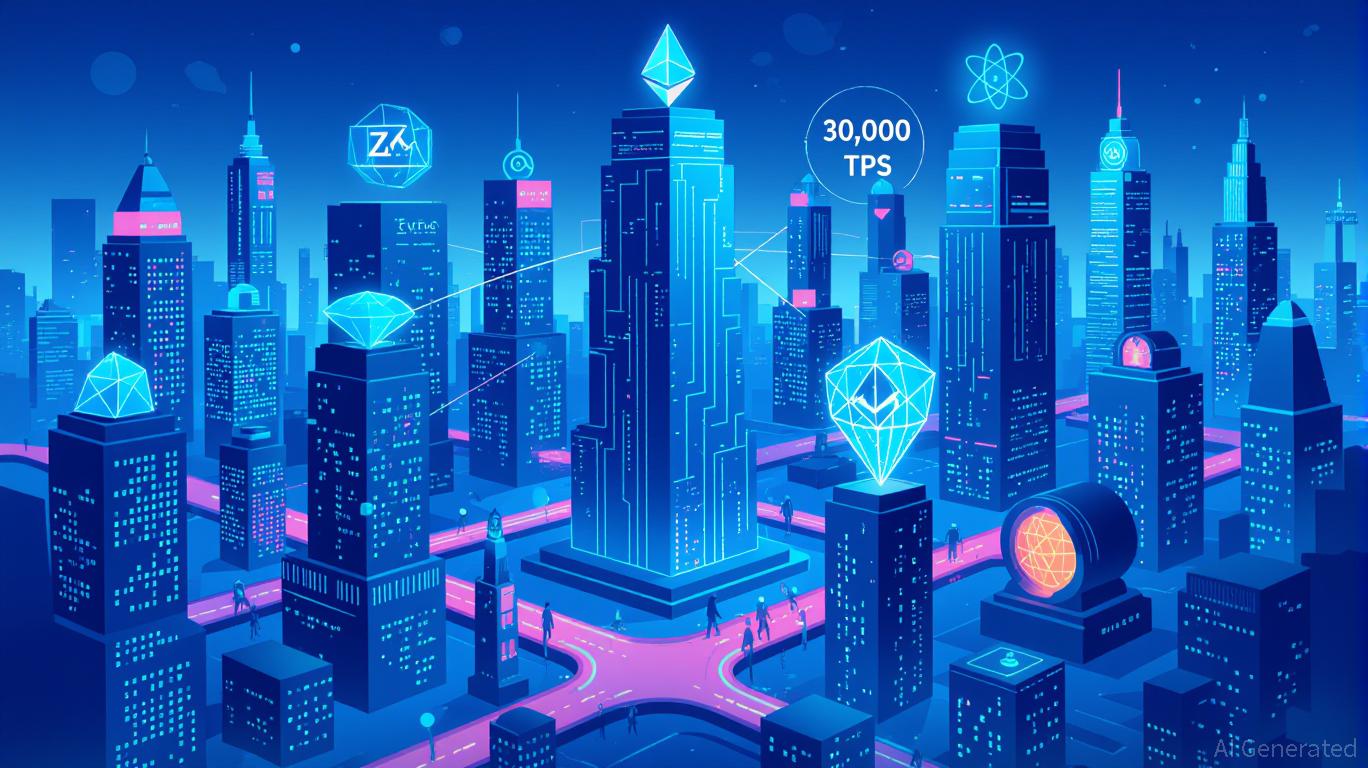
Zero Knowledge Proof (ZKP) works as a blockchain network built with a clear four-layer structure that separates consensus, security, storage, and execution into their own roles. This layout helps the network manage private activity, verify AI tasks, and handle data without exposing sensitive details. Anyone studying top crypto for 2025 choices can see how this four-layer setup makes Zero Knowledge Proof different from usual blockchain launches.
Sponsored
Understanding the Four-Layer System
Traditional chains mix consensus, execution, and storage together, which creates traffic and slows scaling. Zero Knowledge Proof separates these functions to avoid limits.
The four layers include:
- Consensus Layer – Confirms activity through hybrid PoI and PoSp
- Security Layer – Uses cryptographic methods backed by zero-knowledge proofs
- Storage Layer – Handles data with IPFS and Filecoin
- Execution Environment – Works through EVM and WASM for apps
Each part works on its own but stays connected through a coordinated system. Anyone looking into top crypto for 2025 projects will notice this separation as a major strength.
Layer 1: Consensus Layer
Responsible for securing the network and confirming activity, this layer uses a hybrid mix of Proof of Intelligence (PoI) and Proof of Space (PoSp) with Substrate’s BABE and GRANDPA.
BABE handles block making with random VRF selection. GRANDPA finalizes blocks, locking them within 1–2 seconds.
The scoring uses:
Validator Weight = (α × PoI Score) + (β × PoSp Score) + (γ × Stake)
Blocks run every six seconds by default, adjustable between three and twelve seconds. Epochs last around 2,400 blocks (roughly four hours). Rewards come from PoI, PoSp, and stake scores.
Layer 2: Security Layer
This layer ensures privacy and verification without exposing private data. Zero Knowledge Proof uses zk-SNARKs and zk-STARKs.
zk-SNARKs are small (288 bytes) and verify fast (about 2 ms). zk-STARKs are larger (around 100 KB) and verify in around 40 ms, but need no trusted setup.
Extra cryptographic tools include:
- Multi-Party Computation (MPC)
- Homomorphic Encryption
- ECDSA and EdDSA signatures
Proof creation steps:
- Circuit Definition
- Witness Generation
- Proof Creation
- Verification
Parallel proof creation helps the system handle AI tasks in real time. For anyone comparing top crypto for 2025, this layer is already active.

Layer 3: Storage Layer
This layer controls on-chain and off-chain data. On-chain uses Patricia Tries for quick access. Off-chain uses IPFS and Filecoin.
Patricia Tries allows quick checks (about 1 ms). IPFS uses cryptographic hashes, and Filecoin helps store data long-term. Merkle Trees confirm data accuracy.
Off-chain data retrieval runs at around 100 MB per second across 1,000 nodes.
PoSp scoring follows:
- PoSp Score = (Storage × Uptime) / Total Network Storage
- Better storage and uptime mean higher scores.
Layer 4: Execution Environment
This part runs smart contracts and compute tasks using EVM and WASM. EVM supports Ethereum apps, while WASM handles heavy AI tasks.
ZK Wrappers link the Execution Environment with the Security Layer. State management uses Patricia Tries with a 1 ms read/write speed. The system processes 100–300 TPS, scaling to 2,000 TPS.
How the Layers Operate Together
A transaction moves through:
Consensus → Security → Execution → Storage
Synchronization keeps tasks within about 2–6 seconds. Each layer can improve without affecting others.
Energy Use and Performance
Zero Knowledge Proof uses around 10× less energy than Proof of Work chains due to low-power hard drives.
Performance:
- Block time: 3–12 seconds
- Finality: 1–2 seconds
- Base TPS: 100–300
- Scaled TPS: 2,000
- SNARK verification: ~2 ms
Anyone studying top crypto for 2025 can see these real numbers.
Real Use Cases
Private AI Training
Secure Data Markets
Healthcare Data Protection
Financial Privacy
Proof Pods: Hardware for the Network
These Pods link directly to the four-layer infra. Each Pod validates, generates proofs, stores data, and runs AI tasks.
A Level 1 Pod earns about $1 per day, and a Level 300 earns up to $300 per day.
Anyone exploring top crypto for 2025 will note that Proof Pods earn through real compute.
Comparison with Other Projects
Common project patterns:
- Raise funds first
- Build infra later
- Value relies on speculation
- Zero Knowledge Proof Model:
- Build infra first ($17M in Pods built)
- Launch with working hardware
- Value tied to compute
- The live system already processes activity and stores data.
The Final View
Zero Knowledge Proof separates its Consensus, Security, Storage, and Execution layers to create a smooth, private, and efficient system. The infrastructure is already real and active.