
Vitalik Buterin Claims Ethereum has Solved the Blockchain Trilemma Problem

By:BeInCrypto
Ethereum co-founder Vitalik Buterin said new privacy and data-handling technologies have effectively solved the blockchains long-standing scalability challenges. However, he cautioned that a full security rollout of these developments remains a few years away. Buterin Outlines 2030 Roadmap to Ensure Full Security In a January 3 post on X, Buterin said Ethereums integration of zero-knowledge virtual machines has changed the networks capabilities. He added that the shift is driven by the pairing of ZK-EVMs with the data distribution method, PeerDAS. These are not minor improvements; they are shifting Ethereum into being a fundamentally new and more powerful kind of decentralized network, he stated. He claimed this combination resolves the Blockchain Trilemmathe historic engineering difficulty of achieving decentralization, security, and high bandwidth simultaneously. Now that ZKEVMs are at alpha stage (production-quality performance, remaining work is safety) and PeerDAS is live on mainnet, it's time to talk more about what this combination means for Ethereum.These are not minor improvements; they are shifting Ethereum into being a vitalik.eth (@VitalikButerin) January 3, 2026 Buterin compared the upgraded architecture to a BitTorrent with consensus, contrasting it with Bitcoins model, which prioritizes decentralization but struggles with data throughput. With the new upgrades, he noted, Ethereum can now handle data loads comparable to massive file-sharing networks while maintaining the security of a decentralized ledger. The trilemma has been solved not on paper, but with live running code, of which one half (data availability sampling) is on mainnet today, and the other half (ZK-EVMs) is production-quality on performance today safety is what remains, he argued. However, the roadmap for implementing this vision extends well into the future. While Buterin asserted that the technology has reached production-quality performance, he conceded that significant work remains to ensure the systems safety. According to his timeline, ZK-EVMs will not become the primary method for validating blocks until between 2027 and 2030. These systems will enable faster and cheaper transaction verification without exposing underlying data. In the interim, the network plans to implement incremental upgrades. This year, Buterin expects the gas limit to increase. New protocol developments would enable this by separating transaction proposers from block builders and expanding the amount of work each block can handle. Looking further ahead, Buterin outlined a goal for distributed block building. This is a system in which no single entity constructs a complete set of transactions. He said distributing this authority reduces the risk of centralized censorship and ensures transactions are processed more evenly across regions. A long-term ideal holy grail is to get to a future where the full block is never constituted in one single place. This will not be necessary for a long time, but IMO it is worth striving for us at least have the capability to do that, Buterin wrote. The technical pivot comes as Ethereum continues to face stiff competition from faster, lower-cost blockchains, pressuring developers to accelerate the deployment of these next-generation scaling solutions.
0
0
Disclaimer: The content of this article solely reflects the author's opinion and does not represent the platform in any capacity. This article is not intended to serve as a reference for making investment decisions.
PoolX: Earn new token airdrops
Lock your assets and earn 10%+ APR
Lock now!
You may also like
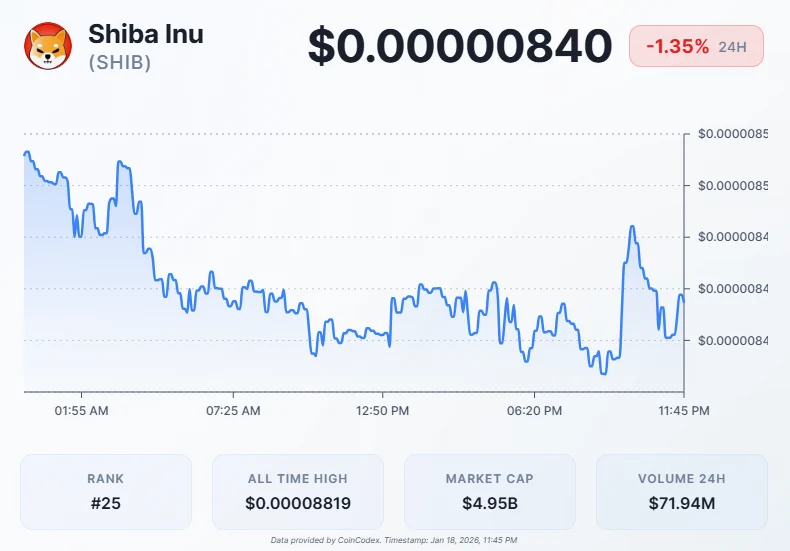
Shiba Inu Faces Sharp Decline as Critical Support Level Breaks
CryptoNewsNet•2026/01/18 21:57
Trove Markets Accused of $10 Million HYPE Token Dump Amid Fraud Concerns
BeInCrypto•2026/01/18 21:42
Trump’s Address, Corporate Results, and Other Major Events to Follow This Week
101 finance•2026/01/18 21:09
Donald Trump’s Memecoin Raises Concerns Over Developer Sales – Here Are the Whale Movements
BitcoinSistemi•2026/01/18 21:06
Trending news
MoreCrypto prices
More
Bitcoin
BTC
$95,377.59
+0.15%

Ethereum
ETH
$3,339.35
+0.88%

Tether USDt
USDT
$0.9996
+0.00%

BNB
BNB
$950.91
-0.02%

XRP
XRP
$2.06
-0.54%

Solana
SOL
$142.61
-1.12%

USDC
USDC
$0.9998
+0.01%

TRON
TRX
$0.3199
+0.47%

Dogecoin
DOGE
$0.1372
-0.96%

Cardano
ADA
$0.3940
-1.13%
How to buy BTC
Bitget lists BTC – Buy or sell BTC quickly on Bitget!
Trade now
Become a trader now?A welcome pack worth 6200 USDT for new users!
Sign up now