Bitget App
Trade smarter
Buy cryptoMarketsTradeFuturesEarnSquareMore

News

Stay up to date on the latest crypto trends with our expert, in-depth coverage.

banner
Bitcoin Updates: Widespread Economic Uncertainty and High Leverage Trigger $40 Billion Crypto Market Plunge

- Global crypto markets crashed in late 2025, wiping $40B as Bitcoin and Ethereum hit multi-month lows amid macroeconomic uncertainty. - Trigger factors included rising U.S. unemployment, U.S.-China trade tensions, and $19B in leveraged liquidations destabilizing investor confidence. - Analysts highlight increased institutional adoption and regulatory shifts differentiating this downturn from the 2022 FTX-driven collapse. - Experts predict potential stabilization by late November but warn of ongoing risks

Bitget-RWA·2025/12/01 09:38
Japan Aims to Solidify Its Position as a Digital Asset Center with 20% Crypto Tax Reform

- Japan will implement a 20% flat tax on crypto gains by 2026, replacing the current 55% progressive rate to boost market participation. - The reform splits the tax between national (15%) and local (5%) authorities, aligning crypto with traditional assets under a separate-taxation system. - Institutional players like SBI and Daiwa are structuring crypto ETFs and investment trusts, signaling confidence in Japan's regulatory clarity. - The move mirrors global trends like OECD's CARF framework, contrasting wi

Bitget-RWA·2025/12/01 09:38
Sony’s stablecoin is redefining the boundaries between traditional banking and commercial sectors

- Sony Bank plans to launch a USD-pegged stablecoin by 2026 to streamline payments in its gaming/anime ecosystem, reducing credit card fees and expanding Web3 presence. - The stablecoin, issued via Connectia Trust's U.S. banking charter and Bastion's blockchain, targets U.S. customers (30% of Sony's sales) for digital content transactions. - Regulatory challenges persist as ICBA criticizes the model for blurring banking-commerce lines, while Sony's Japan Web3 initiatives, including yen-pegged stablecoin pr

Bitget-RWA·2025/12/01 09:22
The Impact of Ethical Disclosure Lapses on Investment Decisions in the Technology and Biomedical Industries

- FDA's "radical transparency" and SANDBOX Act expose gaps in corporate oversight, enabling legal risks and data misuse in AI/healthcare sectors. - 2025 data breaches (e.g., SouthwestCare's 1.2M records leak) highlight systemic vulnerabilities in fragmented regulations like GDPR/CCPA/HIPAA. - Breach costs ($10M avg) and compliance penalties drive 51-163% IT spending spikes, deterring R&D and eroding investor trust in vulnerable firms. - Investors must prioritize companies with AI-driven cybersecurity, regu
Bitget-RWA·2025/12/01 09:21
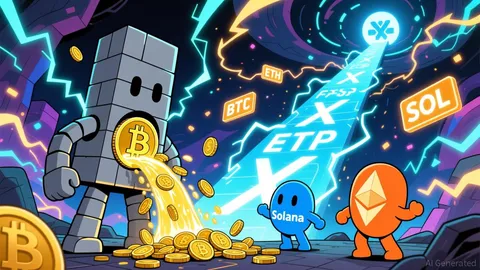
Bitcoin News Update: November Sees Investors Shift from Bitcoin ETFs to Altcoins Amid Diversification Efforts

- Bitcoin ETFs saw $151M outflows in November as investors shifted to altcoin-focused funds like Ethereum and Solana , reflecting strategic diversification amid macroeconomic uncertainty. - XRP ETFs surged with $644M inflows, driven by institutional demand for regulated products with structured supply dynamics, sparking speculation of a 65% price rally toward all-time highs. - Solana ETFs attracted $369M despite low SOL prices, but CoinShares withdrew its staked product due to regulatory complexities, high

Bitget-RWA·2025/12/01 09:08
The New York Times Reveals White House AI and Crypto Czar David Sacks' Insider Trading

《The New York Times》 revealed that David Sacks, while serving as the White House AI and Crypto Policy Director, was also involved in private tech investments, allegedly using his position to benefit himself and his friends, raising serious questions of conflict of interest.

BlockBeats·2025/12/01 08:58
Bittensor's Halving: Putting Decentralized Network Economics to the Test

- Bittensor's (TAO) Dec 13 halving slashes daily token emissions by 50%, aiming to reduce $1.8M in sell pressure. - Validator rewards will halve overnight, risking mass exits as operational costs remain unchanged. - Network faces existential test: validator count below 2,000 could degrade performance and erode user confidence. - Market splits on outcomes: price rallies may offset reduced returns, but subnet utility depends on active computation. - Validator behavior through January will determine if Bitten

Bitget-RWA·2025/12/01 08:34
The Money-Making Effect is Over, Enter the Post-Crypto Twitter Era

Crypto Twitter is no longer the primary engine driving consensus narratives and capital flow. The era of the "monoculture" has ended, and the market is entering a new stage of decentralization and distributed context.

BlockBeats·2025/12/01 08:26
Flash
12:32
The Democratic Republic of the Congo plans to train more than 20,000 mine security personnel
According to Golden Ten Data on June 26, the government of the Democratic Republic of the Congo (DRC) is in talks with a private company to train over 20,000 armed security personnel to protect the country's mining areas, in a bid to improve the reputation of the local mining industry. According to the head of the General Mining Inspectorate, these security personnel will protect large commercial mining areas, help regulate artisanal miners who use rudimentary tools, and enhance the traceability of mineral exports. The official did not specify the name of the private training company. This new force will eventually replace all police and soldiers currently stationed at mining and processing sites. The DRC holds some of the world's largest deposits of copper, cobalt, tin, tantalum, gold, lithium, and zinc. However, individual miners (sometimes protected by soldiers) often conduct illegal mining activities, including within licensed sites owned by international investors. Minerals are also often smuggled out of the country, especially from the conflict-affected eastern regions. Chief Mining Inspector Raphael Kabengele said in an interview in the mining hub of Lubumbashi last week that things are progressing smoothly. Consensus has been reached on principle issues. A decree authorizing the creation of this force should be issued soon.
12:29
Analysis: Spending tightening impacts growth expectations of OpenAI and Anthropic, marking the beginning of a cost-efficiency era in the AI industry.
Odaily reports that as enterprises begin to reassess their AI investment returns, the industry is shifting from a "tokenmaxxing" high-consumption model to a focus on efficiency, with AI large model providers facing new growth constraints. Several companies have already started reducing or optimizing the cost of model calls. For example, Lindy CEO at an AI startup said that they have switched 100% of their traffic from Anthropic's Claude model to the more cost-effective DeepSeek, expecting to save millions of dollars in expenses within a few months. This shift reflects that enterprise AI budgets are tightening, and the previous "unlimited use of model resources" tokenmaxxing approach is gradually being replaced by cost control and ROI-focused strategies. Some companies have even set tiered budgets for AI tool usage; for instance, Uber has set a monthly limit for internal AI expenditures. Analysts point out that as enterprises move from "expanding usage" to "refined calling," the rapid growth models previously relied upon by OpenAI and Anthropic now face challenges. Industry data still shows strong growth: Anthropic’s annualized revenue is approximately at the $4.7 billion level, while OpenAI’s run rate is nearly $2.5 billion, but the market is beginning to focus on the sustainability of this growth. Meanwhile, methods for model calls are changing, with technologies like "model routing" emerging—using low-cost models to handle simple tasks instead of high-end models, in order to optimize overall computing power costs. Industry competition is also intensifying, as Microsoft, Amazon, and Google are all accelerating the launch of low-cost AI models and enterprise-grade tools, further compressing price ranges. In the context of more rational corporate AI spending, large model companies may face both "growth slowdown expectations" and "IPO window pressure." (CNBC)
12:20
Caixin Futures: The chemical sector continues to underperform as crude oil's low-level consolidation weighs on the energy chemical chain
⑴ The United States has exempted Iranian oil and petrochemical product exports, the strait is gradually being reopened, tensions continue to ease, and the market is expected to remain weak; international crude oil prices continue to fluctuate at low levels, with the domestic energy and chemical sector following suit, and the chemical sector expected to remain bearish.⑵ The US and Iran have confirmed the contents of the memorandum of understanding, with all parties finalizing a 60-day roadmap. The agreement will open the Strait of Hormuz and lift Iranian oil sanctions. Although there have been recent geopolitical fluctuations, overall, the situation is developing toward easing, and fuel oil is expected to perform weakly.⑶ In the asphalt sector, Shandong 70# heavy-duty asphalt prices are 4,400 yuan/ton, unchanged from the previous period; during the week, the operating rate of 77 domestic heavy-duty asphalt companies was 15.8%, an increase of 1.8% from the previous period. The total shipment volume of 54 domestic asphalt manufacturing enterprises was 167,000 tons, down 6.2% week-on-week. The total inventory of 54 domestic asphalt sample enterprises stood at 807,000 tons, an increase of 0.6% from May 22 and a year-on-year increase of 3.1%. The total inventory of 104 social warehouses for domestic asphalt was 1.135 million tons, a decrease of 3.3% from June 22 and a year-on-year decrease of 38.4%. Overall, the asphalt market is in a situation of both weak supply and demand. With the easing of the US-Iran situation in the mid-term, asphalt may continue to adjust weakly.⑷ In the glass sector, prices in the North China market remain basically stable, with some companies having good order deliveries, and industry participants mainly restocking at low prices. Current industry daily production is about 146,000 tons, and this week, float glass inventories reached 76.443 million heavy boxes, an increase of 450,000 heavy boxes (+0.59%) from the previous period and a year-on-year increase of 10.44%. The recently released "Three-Year Action Plan for Energy Conservation and Carbon Reduction in Key Industries" involves the glass industry, where technological renovation will raise industry costs and keep supply low, but demand expectations remain weak. Medium-term supply and demand pressure persists, and a short-term strong fluctuation is expected.⑸ The soda ash market lacks upward drivers, with prices consolidating at the bottom, downstream demand being lukewarm, and low-priced restocking occurring towards the end of the month. This week, the comprehensive capacity utilization rate for soda ash was 78.80%, compared to 81.03% last week, a decrease of 2.23%. On Thursday, total inventory at domestic soda ash producers was 1.7324 million tons, an increase of 6,000 tons (+0.35%) compared to Monday. Currently, the basis price offers are: Hebei warehouse delivery for 09-50, Shahe delivered for 09-10, and Inner Mongolia manufacturer offers for 09-290 to 300. Looking to the medium term, supply-side drivers and unchanged demand suggest that the market will continue to fluctuate at low levels in the short term.⑹ In the methanol market, spot prices in Taicang are 2,750 yuan/ton, and the North Line of Inner Mongolia is at 2,340 yuan/ton, down by 50. Methanol prices are showing mixed performance, with futures fluctuating slightly upward, port prices supported by tight liquidity, and the near-term basis has shown strength.
Markets