Bitget App
Trade smarter
Buy cryptoMarketsTradeFuturesEarnSquareMore

News

Stay up to date on the latest crypto trends with our expert, in-depth coverage.

banner
All
Crypto
Stocks
Commodities & Forex
Macro
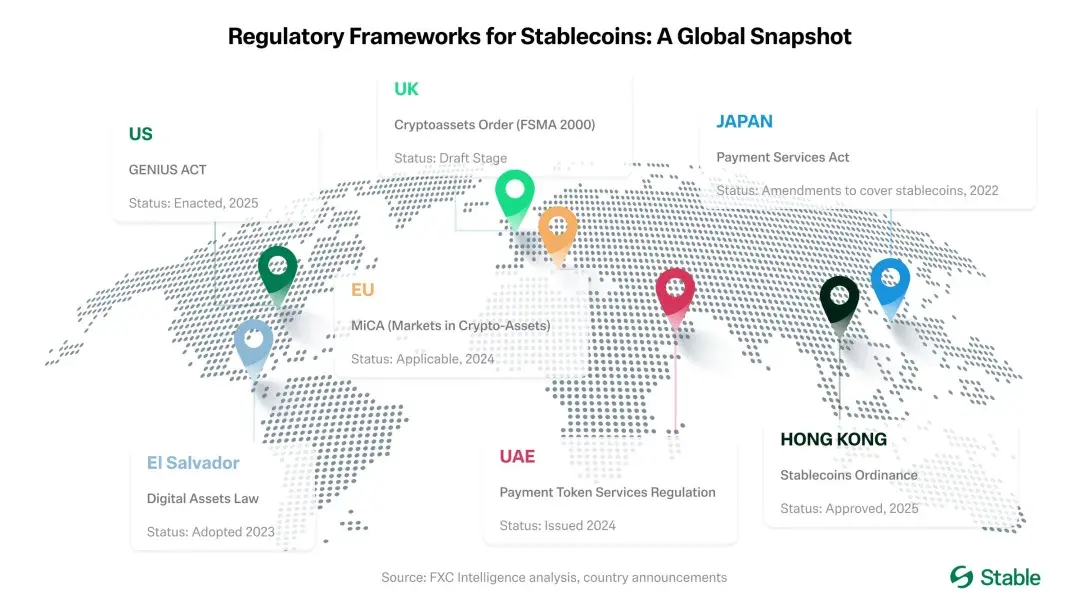
Opinion: The Era of the Stablecoin Duopoly Is Coming to an End

The article analyzes the underlying reasons why the duopoly of Circle (USDC) and Tether (USDT), which still dominate about 85% of the stablecoin market, is beginning to break down. It points out that various structural changes are driving the stablecoin market toward "substitutability," challenging the core advantages of the existing giants.
Chaincatcher·2025/10/09 17:41
IOSG: Understanding Stablecoin Public Chains in One Article

Public blockchains centered on stablecoins have already achieved the necessary scale and stability. To become everyday currencies, they still need: a consumer-grade user experience, programmable compliance, and transactions with imperceptible fees.

Chaincatcher·2025/10/09 17:41
Trading stocks is better than trading crypto? A global wave of "virtual asset reserves" emerges, with the DAT strategy of listed companies becoming a new investment trend

Enterprises are increasing their investments in bitcoin and ethereum, with DAT strategies setting a new paradigm in the capital market.
Chaincatcher·2025/10/09 17:39
Tether’s Next Chapter: From Offshore Issuance to Ambitions for Global Compliance Infrastructure

Can Tether evolve from an offshore issuer to a multi-chain, compliant infrastructure provider without compromising its core advantages in liquidity and distribution?

Chaincatcher·2025/10/09 17:39
What will be the peak of Ethereum?

Based on multiple historical and on-chain indicators, the article's author Michael Nadeau conducts a scenario analysis of the potential peak price of Ethereum in the current bull market, aiming to provide a quantitative reference for Tom Lee's "supercycle" hypothesis. By tracking the 200-week moving average, price-to-realized price ratio, MVRV Z-score, Ethereum-to-Bitcoin market cap ratio, and its ratio to the Nasdaq Index, the article presents a range of specific potential price targets, mainly concentrated in the $7,000 to $13,500 range.

Chaincatcher·2025/10/09 17:39
From the 200-week moving average to the market cap ratio, estimating the peak of Ethereum in this cycle

It may not be as exaggerated as Tom Lee’s $60,000 prediction, but can we look forward to $8,000?

BlockBeats·2025/10/09 17:33
Flash
07:54
Rising oil prices dampen Fed rate cut expectations, strengthening the US dollar
ChainCatcher News, according to data from a certain exchange, the US dollar has strengthened against all major currencies as rising oil prices have prompted swap traders to reduce their bets on Federal Reserve rate cuts this year. The current market expects the Federal Reserve to cut rates by about 59 basis points, down from 61 basis points last Friday. Gareth Berry, a strategist at Macquarie Group in Sydney, stated that this may be an early signal that the market believes continued increases in oil prices will lead to higher inflationary pressures in the US, thereby reducing the Federal Reserve's willingness to cut rates. Deteriorating risk sentiment has also contributed to the rise of the US dollar, with S&P 500 index futures falling by 1.5%.
07:46
Major Bank Ratings | Bank of Communications International: Raises Nvidia Target Price to $260, Increases Revenue and Profit Forecasts for This and Next Fiscal Year
Gelonghui March 2|Bank of Communications International released a report stating that Nvidia's revenue for the fourth quarter of fiscal year 2026 ending at the end of January this year reached $68.1 billion, higher than the previous guidance median of $65 billion and market expectations. The Non-GAAP gross margin was 75.2%, higher than the previous guidance median of 75%. The bank believes that among these, the network chip revenue of $11 billion, an annual increase of more than 3.5 times, was the biggest highlight. Management guided for first quarter fiscal year 2027 revenue ending at the end of April this year to be $78 billion (+/-2%), with a Non-GAAP gross margin guidance of 75% (+/-50 basis points) for the quarter. Considering the active capacity expansion by TSMC and memory suppliers, as well as Nvidia's leading position in the industry, the bank believes that supply chain tensions have less impact on Nvidia compared to its peers. The bank raised its revenue forecasts for Nvidia for fiscal years 2027 and 2028 to $354.5 billion and $455.7 billion, respectively, and raised its Non-GAAP earnings per share forecasts to $8.06 and $10.52; the target price was raised to $260, corresponding to 28 times the forecast P/E for fiscal years 2027 and 2028, and believes the stock price is attractive.
07:46
Turkish stock market plunges, authorities launch emergency rescue measures
Glonghui, March 2nd丨On Monday, due to the escalation of the Middle East conflict, the Turkish stock market plummeted. At 9:55 a.m. Istanbul time (UTC+8), the Borsa Istanbul 100 Index dropped by 5.3%. Turkish officials announced a series of measures targeting the foreign exchange market, stocks, and funds to protect investors from market volatility. The Turkish Capital Markets Board imposed a temporary short-selling ban on stocks, effective until March 6, and lowered the minimum equity protection requirement from 35% to 20%. The short-selling ban prevents investors from betting on further declines in stock prices, while the reduced equity threshold eases margin requirements, allowing traders to maintain leveraged positions with less of their own capital. The Borsa Istanbul also reduced the order-to-trade ratio from 5:1 to 3:1, tightening the restriction on the number of orders participants can submit relative to the number of executed orders. This move aims to curb the submission and cancellation of orders, thereby impacting high-frequency trading and algorithmic trading strategies.
News